



The Dawn of Driverless Ownership: Tensor’s Ground-Up Level 4 Autonomous Car Redefines Personal Mobility for 2027
For over a decade, I’ve navigated the intricate, often turbulent, currents of the automotive industry, witnessing the relentless march towards a truly autonomous future. We’ve seen the grand promises, the cautious rollouts, and the occasional missteps. Robotaxis like Waymo and Cruise have begun to normalize the idea of a car without a human driver, while systems like Tesla’s Full Self-Driving (Supervised) have brought advanced driver assistance to private garages. Yet, the holy grail – a privately owned, completely hands-off, eyes-off Level 4 autonomous vehicle – has remained just beyond reach, a vision perpetually slated for “next year.”
But here in late 2025, with an eye firmly on 2027, a new contender has emerged from the innovation hubs of Silicon Valley, promising to shatter that barrier. Enter the Tensor Robocar: an ambitious, purpose-built machine designed from the ground up to bring Level 4 autonomy directly to your driveway. This isn’t just another electric vehicle with enhanced ADAS; this is a fundamentally different approach, aiming to put a Waymo-style experience – or perhaps, something even more refined – into the hands of private consumers, marking a pivotal moment in the evolution of personal transportation.
The Genesis of an Autonomous Vision: From Robotaxi Fleets to Private Ownership
The story of Tensor isn’t a new chapter in a familiar book; it’s a dramatic rewrite. Founded in 2016 as AutoX, the company cut its teeth in the demanding world of commercial autonomous vehicles and robotaxis. With Silicon Valley roots, AutoX quickly expanded its testing to both California and China, eventually scaling to a fleet of over 1,000 autonomous taxis serving the public in five Chinese cities during the height of the COVID-19 pandemic. This extensive operational experience in complex urban environments provided an invaluable, real-world crucible for their automotive AI development and sensor fusion expertise.
However, the rapidly evolving landscape of global data privacy regulations and national security concerns prompted a significant strategic pivot. In a bold move, AutoX completely divested from its Chinese operations in the past year. Rebranding as Tensor, the company returned to its Californian origins in San Jose, shifting its singular focus to designing and manufacturing a Level 4 autonomous vehicle specifically for private ownership. This strategic realignment is critical; it reflects a deep understanding of the market’s trajectory towards smart mobility solutions that prioritize individual control and data sovereignty, diverging from the fleet-centric models currently dominating public discourse. This isn’t just a business decision; it’s a philosophical stance on the future of transportation.
Engineering the Future: A Deep Dive into Level 4 Autonomy
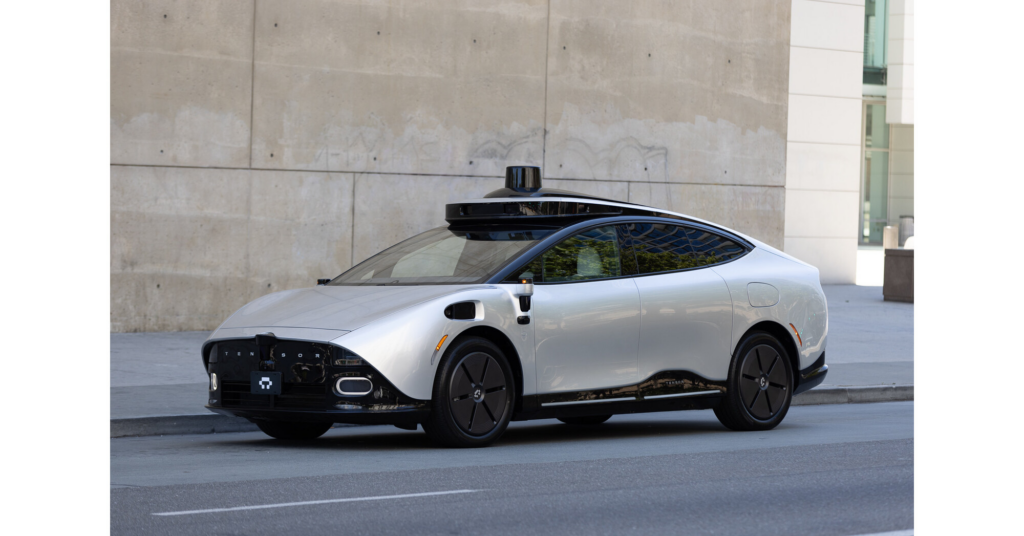
What truly sets the Tensor Robocar apart is its unequivocal commitment to SAE Level 4 autonomy, meaning the vehicle is capable of performing all driving tasks under specific conditions without human intervention, even when a human driver is present. While it retains a steering wheel and pedals for manual operation – a crucial psychological and functional bridge for consumers – its core design is predicated on self-sufficiency. This contrasts sharply with current offerings like Tesla’s FSD (Supervised), which despite its advanced capabilities, still demands constant driver attention and readiness to intervene. Tensor’s “ground-up” design, initiated in 2020 after their robotaxi service launched, allowed engineers to integrate every component with autonomous operation as the primary goal, avoiding the compromises inherent in adapting existing vehicle platforms.
To achieve this ambitious level of capability, the Robocar is an engineering marvel, bristling with an unparalleled array of sensors and prodigious computing power. More than 100 sensors blanket the vehicle, forming an omniscient perception system:
Lidar Technology: Five advanced lidar arrays are strategically placed – one on the roof providing a commanding 360-degree view up to 1,000 feet, and four additional units around the front, sides, and rear. These provide precise depth mapping, crucial for navigating complex environments and detecting objects in varied lighting conditions.
Visual Acuity: A staggering 37 cameras offer comprehensive visual coverage, enabling object classification, lane keeping, traffic light recognition, and intricate scene understanding.
Radar Precision: Eleven radar units provide robust all-weather detection of objects, their velocity, and distance, complementing lidar and camera data.
Ultrasonic Sensitivity: Ten ultrasonic sensors handle close-range obstacle detection, vital for parking and navigating tight spaces.
The meticulous design extends to maintaining sensor integrity. To combat environmental challenges, Tensor has equipped the Robocar with 30 washer nozzles, 13 mini wipers, and integrated heating elements to prevent fogging and snow buildup – details often overlooked but critical for consistent performance. Furthermore, taking a page from the aerospace industry, the Robocar features physical covers that automatically retract over the sensors when the vehicle is turned off, providing essential protection from dirt and damage, a practical innovation that improves reliability compared to many existing autonomous vehicle market solutions.
Underpinning this sophisticated sensor suite is a colossal onboard computer, the “brain” of the Robocar. It houses eight Nvidia Drive Thor-X chips, collectively capable of an astonishing 8,000 TOPS (trillion operations per second). This immense processing power enables the vehicle to perform the vast majority of its computational tasks onboard, minimizing reliance on cloud connectivity. While equipped with three redundant communication channels for maximum connectivity, this edge computing capability ensures robust operation even in areas with spotty 5G signals, a critical factor for widespread adoption.
The Tensor Foundation Model software, built on cutting-edge AI in automotive principles, orchestrates this symphony of data. It operates two parallel systems: one meticulously trained by professional human drivers, capturing nuanced driving behaviors and decision-making; the second, powered by a Visual Language Model (VLM), excels at solving unusual and unexpected “edge cases.” This dual-system approach is designed to enhance both predictable performance and adaptive intelligence, allowing the Robocar to operate confidently in challenging conditions like rain and snow, breaking the perception that self-driving cars are only viable in sunny California.
For pedestrian interaction, the vehicle features clever displays on its lower exterior corners. These broadcast simple messages and pictograms, clearly communicating to those outside that the car is operating autonomously and has registered their presence – a small but significant detail for building public trust in self-driving car safety.
The Private Sanctuary: Experience and Control
One of Tensor’s most compelling differentiators lies in its approach to user experience and, critically, data privacy. In an era where every connected device seems to be a data vacuum, the Robocar champions individual control. Because the majority of computing is done onboard, Tensor explicitly states it doesn’t need to collect data from your car. While it can share information with the cloud for updates or diagnostics, owners must explicitly opt-in. Otherwise, all your personal data, driving habits, and biometric information remain securely within your vehicle. Owners have complete access to this data via the vehicle’s interface or a dedicated phone app, with the power to review and delete it at will. This includes biometric data like facial and palm recognition, which are used for vehicle operation and theft prevention but are fully managed by the owner.
Furthermore, acknowledging concerns about in-cabin surveillance, Tensor has engineered thoughtful solutions. While interior cameras and microphones enable driver monitoring during manual driving and facilitate interaction with the voice assistant, each comes with a physical cover and dedicated off switches. This empowers owners to ensure their privacy, fostering a deeper sense of trust in this advanced technology. This level of data privacy in autonomous vehicles is a significant selling point and a potential game-changer for consumer acceptance.
Beyond privacy, the Robocar aims to redefine the human-vehicle interface through its Agentic AI, backed by a sophisticated Large Language Model (LLM). Forget rigid voice commands; the idea is to engage in natural, human-like conversations with your car. You can simply express where you’d like to go, ask it to perform tasks, or inquire about its status. This conversational AI learns your habits over time and, when integrated with your digital calendar, can even anticipate your upcoming trips, proactively assess battery range requirements, and suggest charging stops. Imagine summoning your car from anywhere with a simple call or text, asking it to pick you up – a seamless integration of personal assistant and personal mobility.
When You Want to Drive: Seamless Human-Machine Handoff
While the Robocar is engineered for autonomy, Tensor understands the enduring human desire to drive. It meticulously preserves the option for manual control. When you choose to drive yourself, a steering wheel and pedals emerge from their retracted positions in the dash and floor. The vehicle can then offer varying levels of assistance, from fundamental aids like automatic emergency braking to advanced Level 3 semi-automated driving, where the car handles most tasks but requires the driver to remain ready to take over.
When the urge to drive subsides, a simple switch initiates autonomous mode. The steering wheel gracefully retracts into the dashboard, and the center infotainment screen slides over to conceal it, enhancing the sense of a lounge-like interior. The accelerator and brake pedals also discreetly retract, clearing the footwell. This seamless physical transformation underscores the vehicle’s dual nature and commitment to both autonomous convenience and driving pleasure.
Under the hood, all critical driving systems – steering, braking, and accelerating – are entirely by-wire, meaning there are no direct mechanical linkages. This digital control allows for greater precision, faster responses, and, crucially, multiple redundancies. Each system, along with every sensor, is designed with built-in backups, ensuring the car can continue to operate safely even in the event of a component failure. This redundant architecture is fundamental to achieving robust self-driving car safety.
Further enhancing its practical capabilities, the Robocar features rear-wheel steering, allowing the back tires to turn up to 7 degrees in either direction. This ingenious design enables an impressively tight 37-foot turning circle, comparable to a Tesla Model Y despite the Robocar’s potentially larger footprint, making urban maneuvering surprisingly agile.
Safety remains paramount, and Tensor is actively targeting the highest crash safety scores from leading regulatory bodies globally, including the NHTSA and IIHS in the U.S., and the European NCAP. This commitment to structural integrity, combined with its advanced situational awareness, positions the Robocar as a leader in comprehensive autonomous driving technology 2025.
A New Business Model: Owning the Robotaxi Revolution
Beyond personal transport, the Tensor Robocar opens up intriguing new avenues for ownership and monetization. Tensor has already secured a deal with Lyft to integrate Robocars into its luxury rideshare fleet, signaling their immediate commercial viability. However, the more revolutionary promise echoes a vision long touted but yet unrealized: the ability for private owners to deploy their autonomous vehicle as a revenue-generating asset.
Remember the early promises from figures like Elon Musk about your car earning you money as an autonomous rideshare while you’re at work or asleep? Tensor is now articulating a path to potentially deliver on that concept. While the company has yet to detail the specifics of how a privately owned autonomous vehicle might be integrated into a rideshare network – issues like hailing, payment, insurance, and regulatory compliance will need to be addressed, likely through established platforms like Lyft – the potential for smart mobility solutions that provide owners with a significant return on investment is transformative. This could democratize access to the burgeoning robotaxi economy, shifting it from purely corporate fleets to individual entrepreneurs.
Market Position, Production, and the Road to 2027
As a product positioned at the apex of electric vehicle innovation and autonomous capability, the Tensor Robocar is expected to command a premium. While specific pricing remains under wraps, Tensor has indicated “luxury pricing.” Industry insights, often comparing it to a well-optioned Mercedes-Benz S-Class, suggest a price range likely between $150,000 and $200,000. This places it firmly in the luxury EV market, targeting early adopters and tech enthusiasts seeking the ultimate in automotive sophistication and convenience.
Production for the Robocar is slated to begin in late 2026, handled by Vietnamese automaker VinFast at its state-of-the-art factory in Haiphong, Vietnam. This partnership brings robust manufacturing capabilities to the table. While VinFast vehicles have faced scrutiny regarding initial build quality in the U.S. market, it’s crucial to remember their extensive experience, including years of assembling BMWs under license. This demonstrates a proven capacity for high-quality production, and Tensor will undoubtedly have stringent quality control protocols in place to ensure a premium product.
The global rollout will commence with deliveries in the United Arab Emirates (UAE) in late Q4 2026, a market known for its embrace of cutting-edge technology. Crucially for the North American market, U.S. deliveries are anticipated to begin in early 2027, pending regulatory approval. Tensor also has ambitious plans for expansion into the European Union and has recently announced a deal to supply vehicles to a rideshare service in Denmark, highlighting its global aspirations.
As of late 2025, the regulatory landscape for privately owned Level 4 autonomous vehicles is still evolving. Questions surrounding liability, particularly for infractions like traffic tickets incurred while in autonomous mode, will be a key area for regulators and policymakers to address. While current legal frameworks often default to the owner’s responsibility, this is fertile ground for new legislation as autonomous vehicle market share grows.
The Dawn of True Personal Autonomy: Your Invitation to the Future
The Tensor Robocar represents more than just another car launch; it signifies a profound leap forward in personal mobility. It’s a testament to a decade of relentless innovation, bringing Level 4 autonomy not just to designated robotaxi zones but directly to the individual. From its privacy-first design and conversational AI to its seamless blend of autonomous and manual driving, Tensor is poised to redefine our relationship with personal transportation. It promises to reclaim valuable time, enhance safety, and unlock entirely new possibilities for how we interact with our vehicles and cities.
This isn’t just about getting from point A to point B; it’s about experiencing genuine freedom and convenience, crafted with a deep understanding of human needs and technological capability. The future, truly, is arriving at your doorstep.
As the future of personal mobility accelerates towards us, don’t be left behind. Explore the possibilities of true Level 4 autonomy and stay informed on the Tensor Robocar’s journey. Visit Tensor’s official channels to learn more about pre-order opportunities and how this groundbreaking vehicle can transform your daily commute and beyond.