



Beyond Robotaxis: Tensor’s Vision for Private, Level 4 Autonomous Driving by 2027
As we stand in early 2025, the automotive landscape is experiencing a seismic shift, propelled by advancements in artificial intelligence and electrification. The dream of a truly self-driving car, once relegated to science fiction, is inching closer to mass reality. While robotaxi services like Waymo and Cruise are diligently carving out operational zones in select urban centers, demonstrating the feasibility of autonomous transport, the concept of personally owning a high-fidelity, Level 4 autonomous vehicle has largely remained an elusive promise. Enter Tensor, a company poised to disrupt this paradigm by offering a private, Waymo-style self-driving car – the Robocar – to individual consumers by early 2027. This isn’t just another EV; it’s a meticulously engineered statement about the future of personal autonomous mobility.
Having spent the last decade immersed in the intricacies of advanced automotive technology and the evolving autonomous vehicle (AV) sector, I can confidently say that Tensor’s approach marks a pivotal moment. Many players have focused on perfecting robotaxis or enhancing existing Advanced Driver-Assistance Systems (ADAS) in consumer vehicles. Tensor, however, is charting a course that prioritizes personal ownership, data privacy, and uncompromised autonomy, aiming to deliver a driving experience that is both revolutionary and deeply personal.
From Global Robotaxi Pioneer to Personal Autonomy Visionary: Tensor’s Reimagined Journey
The story of Tensor isn’t a new one, but its latest chapter is undeniably fresh and impactful. The company originated in Silicon Valley in 2016 under the name AutoX, quickly establishing itself as a formidable force in the development of autonomous commercial vehicles and, more notably, robotaxis. Their early years saw extensive testing in California and China, culminating in an impressive fleet of over 1,000 autonomous taxis providing public rides across five Chinese cities during the challenging COVID-19 pandemic. This hands-on experience in real-world, high-density urban environments provided invaluable data and operational expertise, positioning AutoX as a leader in the global robotaxi race.
However, the global geopolitical climate and evolving regulatory frameworks, particularly concerning data privacy and international operations, prompted a strategic recalibration. In a bold move, AutoX divested from its Chinese operations, rebranded as Tensor, and returned its core focus to its Silicon Valley roots in San Jose, California. This wasn’t merely a change of name; it was a profound shift in mission. As Amy Luca, Tensor’s Head of Marketing, explained, the pivot was driven by a clear understanding of the burgeoning demand for private autonomous solutions and the need to address growing concerns around automotive cybersecurity solutions and user data ownership. This strategic repositioning signals a mature understanding of market dynamics and a commitment to building a brand that resonates with individual consumers seeking ultimate control and cutting-edge technology. This pivot to private ownership, rather than just fleet services, is a significant differentiator in the competitive landscape of autonomous vehicle investment.
Engineering the Future: The Robocar’s Purpose-Built Foundation
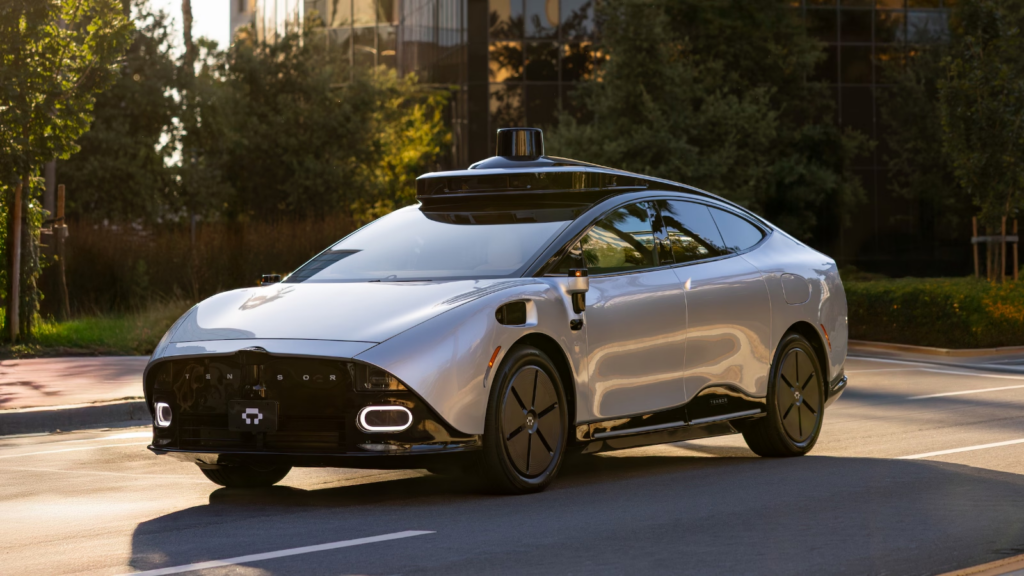
At its core, the Tensor Robocar is an electric vehicle innovation designed from the ground up for Level 4 autonomy. This fundamental design philosophy sets it apart from vehicles that merely adapt existing platforms for autonomous capabilities. Every aspect of the Robocar, from its structural integrity to its electronic architecture, is optimized for the demands of full self-driving, ensuring seamless integration of its sophisticated hardware and software.
Underneath its sleek exterior, the Robocar boasts a robust EV platform. It features a substantial 112-kWh battery pack, providing an estimated range of 250 miles – a practical figure for daily commuting and even longer excursions. What truly stands out, however, is its 845-volt battery architecture, enabling rapid DC fast charging from 10 to 80 percent in a mere 20 minutes. This exceptional charging speed is critical for reducing range anxiety and enhancing usability, placing it squarely among the next-gen electric vehicles that prioritize efficiency and convenience. While specific motor output and curb weight are yet to be disclosed, Tensor’s focus on a single rear motor suggests an emphasis on efficiency and streamlined design, rather than raw, neck-snapping acceleration, aligning with the vehicle’s primary purpose: safe and reliable autonomy.
Beyond its powertrain, the Robocar incorporates thoughtful design elements that enhance the user experience. Its coach-style, center-closing doors are fully powered and equipped with an array of sensors, preventing accidental collisions with obstacles or other vehicles. This touch of luxury, combined with practical automation, underscores Tensor’s commitment to a premium and effortless user experience. Furthermore, Tensor is actively developing an automated charging solution featuring a robotic arm – a futuristic concept that promises to make at-home charging entirely hands-free, further enhancing the autonomous lifestyle. This focus on integrated solutions hints at the future of advanced EV charging solutions.
The Sensor Symphony: A 360-Degree Vision for Unparalleled Safety and Awareness
Achieving true Level 4 autonomy demands an extraordinary level of environmental perception, far beyond what current consumer vehicles offer. Tensor addresses this by equipping the Robocar with an unparalleled sensor suite, comprising over 100 individual sensors. This includes five high-resolution lidar arrays (one strategically placed on the roof for a commanding view, and four others encircling the front, sides, and rear), 37 cameras offering comprehensive visual data, 11 radars for robust object detection in all weather conditions, and 10 ultrasonic sensors for close-range perception and parking maneuvers.
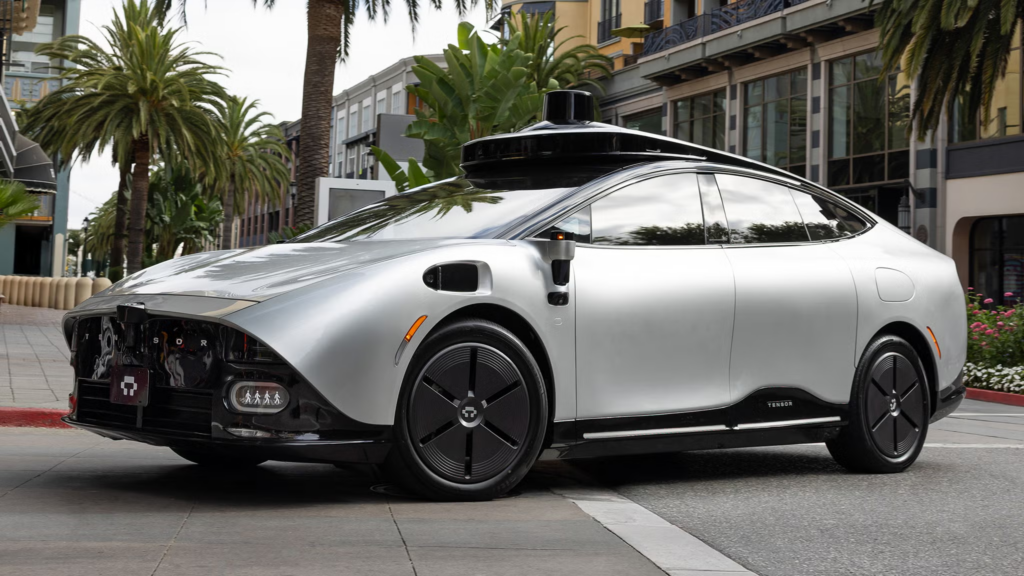
This multi-modal sensor fusion is the bedrock of the Robocar’s perception system. The rooftop lidar, capable of detecting objects nearly 1,000 feet away with a 360-degree field of view, creates a precise 3D map of the vehicle’s surroundings. The numerous cameras provide rich visual context, aiding in object classification and lane keeping. Radar excels at measuring velocity and distance, crucial for obstacle avoidance, especially in adverse weather where lidar and cameras might be compromised. Ultrasonic sensors handle precise short-range measurements, essential for navigating tight spaces and parking.
A critical aspect often overlooked in autonomous vehicle design is the maintenance of these vital sensors. Tensor has engineered a sophisticated system to ensure uncompromised visibility, featuring 30 washer nozzles, 13 mini-wipers, and integrated heating elements to prevent fogging, icing, and snow buildup. Going a step further than some existing robotaxi solutions, the Robocar features physical covers that automatically deploy over the sensors when the vehicle is turned off, providing protection from dirt, debris, and potential damage. This meticulous attention to detail highlights Tensor’s understanding that real-world operation requires robust, resilient hardware. This comprehensive high-performance autonomous hardware array is crucial for meeting stringent autonomous vehicle safety standards.
The Brains of the Operation: AI-Powered Decision-Making and Resilience
Processing the torrent of data generated by over 100 sensors requires immense computational power. Tensor tackles this with a formidable onboard computer featuring eight Nvidia Drive Thor-X chips. This powerhouse system boasts an astonishing 8,000 TOPS (trillion operations per second) – a metric that underscores its ability to perform complex calculations in real-time, enabling instantaneous decision-making critical for safe autonomous operation.
Tensor’s autonomous driving software, the Tensor Foundation Model, is at the vanguard of AI powered driving systems. It employs an AI-based architecture that operates two distinct yet parallel systems. The first is trained on vast datasets derived from professional human driving, teaching the AI to mimic expert human behavior in typical driving scenarios. The second system leverages a Visual Language Model (VLM), designed to address the notoriously challenging “edge cases” – those unusual, unexpected situations that are difficult to anticipate and program for. By processing visual information and language context, the VLM enhances the system’s ability to reason and react intelligently in novel situations, significantly improving its robustness and reliability. Tensor explicitly states the Robocar is engineered to operate in challenging weather conditions, including rain and snow, breaking the stereotype that autonomous vehicles are limited to sunny climates like California.
Crucially, the Robocar is engineered for resilience. While it maintains a connection to the cloud for updates and communication, the vast majority of its computing is performed directly within the vehicle. This onboard processing capability ensures the Robocar can operate equally well even in areas with limited or no 5G connectivity. To further enhance reliability, the vehicle incorporates three redundant communication channels, maximizing its ability to stay connected when necessary. Furthermore, externally mounted displays at the lower corners of the vehicle communicate simple messages and pictograms to pedestrians, indicating the car’s autonomous status and confirming that it perceives them – a subtle but vital component of pedestrian safety and public trust.
Reclaiming Your Data: A Privacy-First Autonomous Experience
One of the most significant differentiators for the Tensor Robocar, especially in today’s data-conscious world, is its unwavering commitment to user privacy. Unlike many tech-driven services that rely heavily on continuous data harvesting, Tensor has engineered the Robocar to minimize cloud-based data collection. Because the extensive computing is handled onboard, the vehicle does not inherently need to transmit your operational data to external servers.
Owners have complete control: cloud data sharing is strictly opt-in. Unless explicitly permitted by the owner, all vehicle data remains securely within the car itself. Furthermore, Tensor provides owners with full access to all collected data – including biometric data like facial and palm recognition used for vehicle operation and theft prevention – through the vehicle’s infotainment system or a dedicated smartphone application. Owners can review and, critically, delete any or all of their data at will.
Recognizing concerns about constant monitoring, Tensor has also integrated physical privacy controls for interior cameras and microphones. While these components are essential for driver monitoring during manual operation and enabling interaction with the vehicle’s voice assistant, each features a physical cover and a distinct off switch, allowing occupants to disable them completely when privacy is paramount. This level of transparency and control positions Tensor as a leader in addressing automotive cybersecurity solutions and establishing new benchmarks for data ownership in the era of smart vehicle technology 2025.
Your Intelligent Co-Pilot: Conversational AI and Seamless Interaction
The Robocar transcends traditional human-machine interfaces through its sophisticated Agentic AI, powered by an advanced Large Language Model (LLM). This isn’t about rigid voice commands; it’s about natural, human-like conversation. Instead of barking instructions, you can simply “talk” to your car, discussing your desired destination or preferences as you would with a human co-pilot.
The AI extends its intelligence beyond simple conversation. You can summon the Robocar from anywhere with a call or text message, directing it to your current location for pickup. Over time, the vehicle’s AI will learn your habits and preferences, proactively anticipating your needs. Connected to your personal calendar, it can foresee upcoming trips, ensure the battery has adequate range, and even initiate charging autonomously, truly integrating the car into your digital lifestyle. This represents a significant leap forward in user-vehicle interaction, transforming the car from a mere mode of transport into an intelligent, proactive companion.
The Best of Both Worlds: Manual Control with Advanced Assistance
While the Robocar is designed for autonomy, Tensor understands that personal preference and situational demands might necessitate human intervention. Thus, the vehicle retains a traditional steering wheel and pedals, allowing the owner to take manual control whenever desired. This flexibility is crucial for building user trust and accommodating diverse driving scenarios.
When driven manually, the Robocar acts as a hyper-aware co-pilot, offering a spectrum of assistance. From fundamental safety aids like automatic emergency braking (AEB) and lane-keeping assist, it scales up to advanced Level 3 semi-automated driving capabilities, allowing for hands-free and even eyes-off-the-road operation in specific, geo-fenced conditions. This graded approach to assistance ensures drivers can tailor the level of intervention to their comfort and the driving environment. This robust suite of advanced driver-assistance systems (ADAS) ensures a safe and comfortable driving experience, even when the human is in control.
The transition between autonomous and manual modes is a masterclass in elegant engineering. When autonomy is engaged, the steering wheel smoothly retracts into the dashboard, and the center infotainment screen slides to conceal it, creating a truly open, lounge-like cabin environment. Concurrently, the accelerator and brake pedals also retract, maximizing passenger space and comfort. Should the driver wish to reassume control, these elements seamlessly reappear, facilitating an immediate and intuitive takeover. The identical passenger screen remains static, ensuring continuous entertainment or information access for the front-seat passenger.
Engineered for Resilience and Redundancy: Safety Beyond Standard
Safety in a Level 4 autonomous vehicle is paramount, and Tensor has engineered the Robocar with multiple layers of redundancy to ensure operational integrity even in the event of component failure. All critical control systems – steering, braking, and acceleration – are “by-wire,” meaning they operate electronically without direct physical connections. This digital control allows for greater precision, faster response times, and, crucially, the integration of multiple redundant systems. Each of these by-wire systems, along with all the perception sensors, is backed by multiple fail-safe mechanisms. This means that if one sensor or drive system experiences an anomaly, another immediately takes over, ensuring the vehicle continues to operate safely and reliably.
Adding to its agility and safety, the Robocar incorporates rear-wheel steering, allowing the back tires to turn up to 7 degrees in either direction. This advanced feature significantly enhances maneuverability, granting the vehicle a claimed 37-foot turning circle – a remarkably tight radius comparable to a much smaller Tesla Model Y, despite the Robocar’s potentially larger footprint. This agility is invaluable for navigating urban environments and tight parking spaces.
Tensor is not merely aiming for functional safety but targeting the highest possible crash safety scores from leading global organizations, including the National Highway Traffic Safety Administration (NHTSA) and the Insurance Institute for Highway Safety (IIHS) in the U.S., as well as the European New Car Assessment Programme (Euro NCAP). This commitment underscores a holistic approach to safety, encompassing both accident prevention through autonomy and occupant protection in the rare event of a collision.
The Business of Autonomy: Monetization and Market Disruption
Tensor isn’t just selling a car; it’s offering a platform for future income generation. The company has already secured a significant partnership with Lyft to integrate Robocars into its luxury rideshare service, providing early operational experience and a clear pathway for commercial deployment. But the vision extends beyond corporate fleets. Remember Elon Musk’s long-standing promise that Tesla owners could put their self-driving cars to work as robotaxis while they were at the office or asleep? Tensor is echoing this promise, and given the methodical rollout of Tesla’s own Robotaxi service, Tensor might indeed be the first to deliver this capability for private owners on a wide scale.
While specific details on how private owners will hail and monetize their autonomous Robocars remain under wraps, it’s highly probable that this will be facilitated through existing, established platforms like Lyft, simplifying the process for both owners and riders. This potential for private owner monetization transforms the Robocar from a mere expense into a tangible asset, offering a revolutionary model for future of personal transportation and potentially offsetting the initial luxury self-driving cars investment.
The Price of Innovation: Luxury Autonomy and Global Production Outlook
True innovation and cutting-edge Level 4 autonomous driving technology command a premium. While Tensor has yet to release an official price tag for the Robocar, Amy Luca has indicated that prospective buyers should anticipate “luxury pricing.” Drawing parallels with Waymo’s CEO, who suggested their autonomous vehicles could cost as much as a well-optioned Mercedes-Benz S-Class, we can estimate the Tensor Robocar to fall in the higher end of the $150,000 to $200,000 range, potentially exceeding that depending on final specifications and market demand. This pricing places it firmly in the ultra-luxury segment, reflecting its advanced capabilities and pioneering status.
Production of the Robocar is being handled by Vietnamese automaker VinFast at its state-of-the-art factory in Haiphong, Vietnam. While VinFast has faced some initial challenges with build quality perception in the demanding U.S. market for its consumer vehicles, it’s crucial to acknowledge their established manufacturing pedigree. VinFast has, for years, assembled BMWs under license, demonstrating a sophisticated understanding of precision engineering and high-quality automotive manufacturing processes. This experience suggests they possess the capabilities to produce the high-standards required for Tensor’s advanced vehicles.
The production timeline is ambitious yet strategically phased. Manufacturing is slated to commence in late 2026, with the first deliveries targeting the United Arab Emirates (UAE) late in the fourth quarter of that same year. U.S. deliveries are anticipated to begin in early 2027, contingent upon obtaining the necessary Level 4 Autonomy Regulation US approvals – a critical hurdle that Tensor is actively navigating. The company also has plans for expansion into the European Union and has recently announced a deal to supply cars to a rideshare service in Denmark, signaling its global aspirations.
A final, practical consideration for early adopters of private autonomous vehicles: liability. While the car drives itself, the question of who pays the fine if a Robocar receives a ticket while operating autonomously is still being debated across jurisdictions. For now, it’s a reasonable assumption that the owner, as the registered party, would ultimately be responsible. This highlights the ongoing evolution of legal frameworks surrounding autonomous vehicle safety standards and operation.
Your Future Awaits: Embrace True Autonomy
The Tensor Robocar isn’t just a car; it’s a testament to a future where personal transportation is redefined. By merging unparalleled Level 4 autonomy with a strong emphasis on user control and data privacy, Tensor is not merely participating in the autonomous revolution – it’s leading a personalized charge. For those who yearn for the convenience of a robotaxi but demand the ownership and privacy of a private vehicle, the Robocar offers a compelling, sophisticated, and intelligent solution.
Are you ready to experience the next evolution of personal mobility? Imagine a vehicle that not only drives itself but anticipates your needs, safeguards your data, and potentially even earns you income. Learn more about the Tensor Robocar and prepare to welcome the future of personalized autonomous driving into your life.