



Navigating Tomorrow’s Roads: Why Tensor’s Private Level 4 Robocar Could Redefine Personal Mobility by 2027
As an industry veteran with a decade embedded in the rapidly evolving landscape of autonomous vehicles, I’ve witnessed countless promises and incremental advancements. From the early days of advanced driver-assistance systems (ADAS) to the burgeoning reality of commercial robotaxi fleets, the trajectory toward fully self-driving cars has been both exhilarating and fraught with challenges. Now, as we stand on the precipice of late 2025, a fascinating new player is poised to disrupt the market: Tensor. This California-based innovator, reborn from its robotaxi roots, is setting its sights squarely on a segment many thought years away—the private ownership of a Level 4 autonomous vehicle. Its proposed Robocar, slated for U.S. deliveries by early 2027, isn’t just another electric car; it’s a bold vision for personal freedom and an entirely new relationship with our vehicles, reminiscent of Waymo’s capabilities but designed for your driveway.
The concept of a personal, fully autonomous vehicle (AV) that can genuinely drive itself without human intervention in defined operational domains (ODDs) has long been the holy grail for enthusiasts and autonomous driving investment firms alike. While Waymo and Cruise have demonstrated this with their ride-hailing services in select cities, and Tesla’s Full Self-Driving (Supervised) continues its ambitious development, a ground-up Level 4 vehicle offered directly to consumers represents a monumental leap. Tensor’s Robocar isn’t an upgrade kit or an assisted driving feature; it’s an inherently self-driving machine engineered from scratch for a singular purpose: to liberate the driver.
From Fleet Operator to Personal Pioneer: Tensor’s Strategic Re-evaluation
To truly appreciate Tensor’s current trajectory, it’s essential to understand its genesis and the strategic pivot that brought it here. Founded in Silicon Valley in 2016 as AutoX, the company initially forged its path in the highly competitive commercial autonomous vehicle sector, particularly within the nascent robotaxi markets of California and China. For years, AutoX was a formidable player, building and operating extensive fleets, culminating in over 1,000 autonomous taxis providing public rides across five Chinese cities during the height of the pandemic. This period wasn’t just about deploying vehicles; it was an intensive, real-world crucible for developing and refining its core autonomous technology stack. The sheer volume of operational miles and the diversity of urban environments provided an invaluable dataset, fostering a robust and resilient AI foundation.
However, the global landscape for autonomous operations, particularly concerning vehicle data security and regulatory complexities, has shifted dramatically in recent years. By late 2024, facing escalating data privacy concerns and evolving geopolitical sensitivities, AutoX made a decisive move. The company completely divested its extensive Chinese operations, executed a strategic rebrand to Tensor, and relocated its core engineering and business development back to its Silicon Valley roots in San Jose, California. This wasn’t merely a name change; it signified a fundamental reorientation. Tensor’s focus transitioned from the capital-intensive and regulatory-heavy robotaxi fleet model to pioneering the private Level 4 self-driving cars market. This strategic pivot, informed by years of operational experience, allows Tensor to leverage its advanced technology while addressing a distinct, burgeoning consumer demand for personal autonomy, unburdened by the immediate operational complexities of fleet management. It’s a bold gamble, but one predicated on a deep understanding of the underlying technology and an astute reading of the future market.
The Tensor Robocar: An Electric Canvas for Autonomy
At its heart, the Tensor Robocar represents a sophisticated interpretation of electric vehicle innovation 2025. It’s an all-electric platform meticulously designed to serve as the perfect host for its advanced autonomous systems. The core specifications speak to both modern EV performance and a pragmatic approach to daily usability. Powering the Robocar is a substantial 112-kWh battery pack, providing an estimated driving range of 250 miles—a figure that, by 2027, will be considered respectable, offering ample capability for most daily commutes and even longer excursions without range anxiety. While current details only mention a single rear motor of unspecified output, the emphasis is clearly on efficient urban and suburban navigation, rather than raw acceleration figures, which are often secondary for autonomous applications.
What truly stands out, however, is the Robocar’s sophisticated power management. Its 845-volt battery architecture facilitates ultra-fast charging, capable of replenishing the battery from 10 to 80 percent in a mere 20 minutes. This significantly minimizes downtime, a crucial factor whether the car is used for personal errands or, as we’ll discuss, potentially generating income. Furthermore, Tensor is ambitiously working on an automated charging solution featuring a robotic arm designed to plug in the vehicle once it’s parked, embodying a vision of truly effortless ownership.
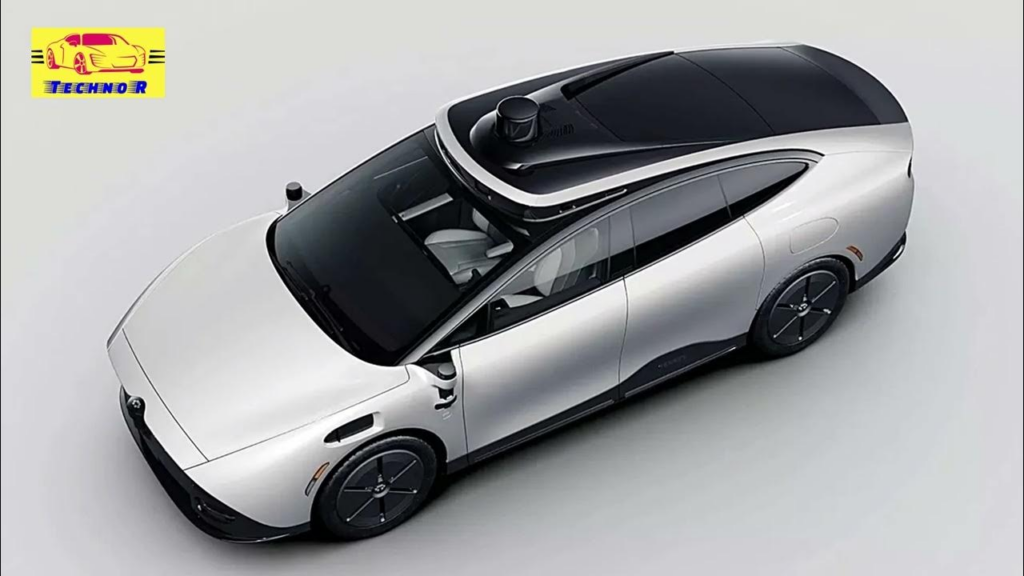
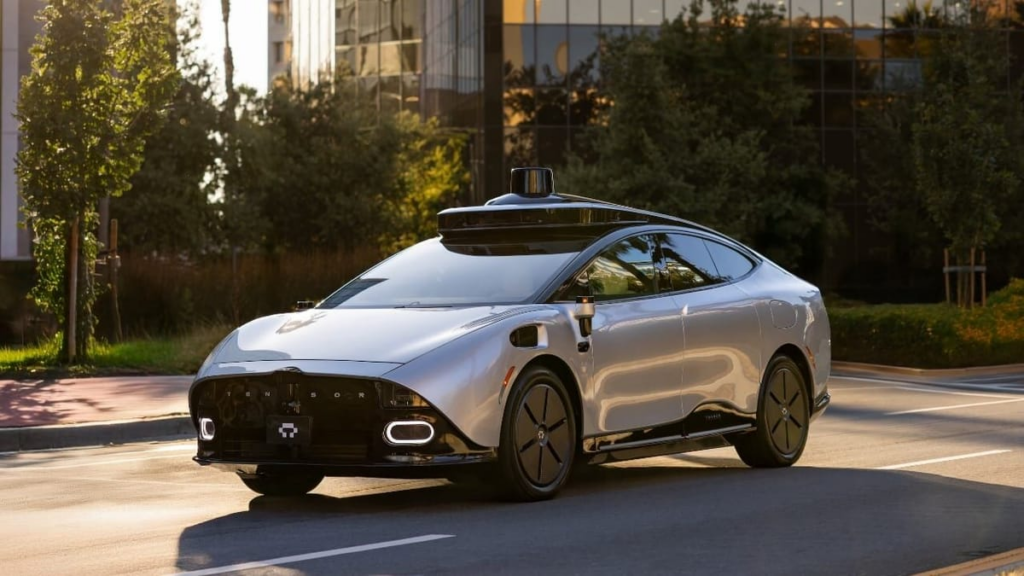
Beyond its electric powertrain, the Robocar’s design hints at a future of passenger-centric mobility. The coach-style, center-closing doors are fully powered and equipped with an array of sensors, intelligently preventing collisions with obstacles or adjacent vehicles. This thoughtful design element not only enhances convenience but also underscores a commitment to seamless, dignified ingress and egress, a small but significant detail in the overall premium EV self-driving features experience Tensor aims to deliver.
Achieving True Autonomy: The Level 4 Differentiator
The term “self-driving” is often thrown around loosely, leading to widespread confusion. Tensor’s unequivocal commitment to SAE Level 4 autonomy sets it apart from many competitors, particularly those offering advanced driver-assistance systems (ADAS) that still require constant human supervision. What does Level 4 truly entail for the Robocar? It means the vehicle can operate entirely autonomously under specific conditions (its Operational Design Domain or ODD) without any human intervention, or even a human present in the driver’s seat. Critically, unlike Level 5, it might still have limitations, such as geographical boundaries or adverse weather conditions, but within its ODD, it is entirely self-sufficient.
This capability is a significant leap beyond even the most sophisticated systems available to private consumers today, such as Tesla’s Full Self-Driving (Supervised). While Tesla’s system is impressively capable, it unequivocally requires a human driver to remain fully attentive, with hands on the wheel and ready to intervene at any moment. Tensor’s approach, forged from its robotaxi experience, fundamentally differs: the Robocar was conceived and designed from the ground up as an autonomous entity. Development began in 2020, concurrent with AutoX’s autonomous taxi services in China, meaning its core architecture, electrical systems, and physical layout are optimized for autonomous operation, not retrofitted onto a conventional vehicle. This foundational design principle is critical for achieving the reliability and safety standards necessary for Level 4 deployment. It minimizes the compromises inherent in adapting a human-centric vehicle for machine control, ensuring that every component works in harmony to achieve the ultimate goal: a car that drives itself, safely and reliably.
The Sensory Orchestra and the Brain of the Robocar
To navigate the complexities of the real world with Level 4 autonomy, the Robocar relies on an incredibly sophisticated and redundant array of sensors, acting as its eyes, ears, and spatial awareness. Tensor has equipped the vehicle with over 100 individual sensors, a veritable sensory orchestra working in concert. This includes five distinct lidar arrays—one strategically placed on the roof for a commanding 360-degree view, capable of detecting objects nearly 1,000 feet away, complemented by four others meticulously positioned around the front, sides, and rear of the vehicle for comprehensive short-range and redundant coverage. These are augmented by an astonishing 37 cameras, providing detailed visual information for object recognition, lane keeping, and traffic light interpretation. Eleven radars offer robust performance in adverse weather conditions, penetrating fog and heavy rain, while ten ultrasonic sensors provide critical close-range detection for low-speed maneuvers like parking.
Maintaining the integrity of this sensory suite in all conditions is paramount. Tensor has engineered a robust system of 30 washer nozzles and 13 mini wipers, ensuring clear vision for all critical sensors, along with integrated heating elements to prevent fogging or snow accumulation. Going a step further than even some leading robotaxi platforms, the Robocar features physical covers that automatically retract over the sensors when the vehicle is powered off, protecting them from dirt, damage, and environmental wear – a clever detail born from real-world operational experience.
The processing power required to interpret this torrent of data in real-time is immense. The Robocar houses a colossal onboard computer powered by eight NVIDIA Drive Thor-X chips, collectively boasting an incredible 8,000 TOPS (trillion operations per second) of computational muscle. This level of on-board processing is crucial, as it allows the vehicle to perform the vast majority of its computations directly within the car, minimizing reliance on cloud connectivity. This ensures consistent and reliable operation even in areas with spotty or non-existent 5G signals, though the Robocar itself features three redundant communication channels for maximum connectivity when available.
The heart of the Robocar’s intelligence is the Tensor Foundation Model software, an AI-powered automotive technology based on advanced artificial intelligence. This sophisticated system operates via two parallel, redundant frameworks. The first is trained on vast datasets derived from the driving behaviors of professional human drivers, capturing nuanced decision-making. The second leverages a Visual Language Model (VLM), designed to process and understand complex, unexpected “edge cases” – those unusual scenarios that traditional rule-based systems struggle with. Tensor confidently asserts that this dual-system approach enables the Robocar to operate reliably in challenging conditions, including rain and snow, broadening its appeal far beyond perpetually sunny climates. For urban safety, integrated displays on the vehicle’s lower exterior corners broadcast simple messages and pictograms to pedestrians, clearly communicating its autonomous operating status and confirming its awareness of nearby individuals. This focus on clear external communication is a key aspect of smart car connectivity solutions for urban environments.
Reclaiming Digital Sovereignty: Data Privacy in an Autonomous Age
One of the most pressing concerns in our increasingly connected world is data privacy, a concern amplified exponentially by autonomous vehicles that continuously gather vast amounts of environmental and user data. Tensor tackles this head-on with an approach that distinguishes the Robocar in the burgeoning next-generation AI in cars landscape. Because the vast majority of its computational tasks are performed onboard the vehicle, Tensor significantly reduces the need for constant cloud data transmission. This means that, unlike many connected cars, owners retain explicit control over their data. While the Robocar is capable of sharing information with the cloud for services or improvements, this is an explicit opt-in feature. If an owner chooses not to share, all collected data remains securely within the vehicle.
Furthermore, Tensor emphasizes user transparency and control. Owners can access and delete all data the car has collected about them and its users directly through the vehicle’s interface or an associated mobile application. This includes sensitive biometric data, such as facial and palm recognition, which are integral for vehicle operation (e.g., personalized settings, anti-theft measures).
The commitment to privacy extends to the vehicle’s interior. While the Robocar is equipped with interior cameras and microphones—necessary for driver monitoring during manual operation (should the driver choose to engage L3-like features) and for voice assistant interaction—each of these features comes with a physical cover and dedicated off-switches. This tangible control empowers owners to physically disable these systems, offering a level of assurance that software-based toggles alone cannot match. In an era where trust is paramount, Tensor’s philosophy on autonomous vehicle data security is not just a feature; it’s a foundational principle, offering a crucial differentiator for privacy-conscious consumers.
Conversational AI: Your Co-Pilot, Not Just an Interface
The human-machine interface within the Robocar is designed to be far more intuitive and engaging than typical voice command systems. Tensor envisions a future where you don’t merely bark commands at your car but genuinely converse with it. This is enabled by an advanced Agentic AI, backed by a sophisticated Large Language Model (LLM), which facilitates natural, human-like dialogue. Instead of rigid commands like “Navigate to Main Street,” you can engage in a more fluid conversation, saying something like, “Hey Robocar, I’m thinking of heading to that new cafe downtown, the one with the outdoor seating.” The AI is designed to understand context, infer preferences, and respond intelligently.
This conversational capability extends beyond navigation. Owners can summon their Robocar from anywhere with a simple call or text, asking it to pick them up. This seamless integration with daily life is designed to foster a sense of partnership with the vehicle. Moreover, the Robocar’s AI is engineered to learn your habits and routines. When connected to your digital calendar, it can anticipate upcoming trips, intelligently assessing the necessary battery range and proactively suggesting charging needs. This predictive and proactive behavior transforms the car from a mere mode of transport into a highly personalized and intelligent co-pilot, a testament to the advancements in AI-powered automotive technology.
The Hybrid Driving Experience: Autonomy on Demand
While the Robocar is designed first and foremost for autonomous operation, Tensor understands that the desire for manual control hasn’t vanished entirely. Therefore, the vehicle retains a traditional steering wheel and pedals, providing owners with the ultimate flexibility to drive themselves whenever the mood strikes. When a human takes the wheel, the Robocar doesn’t simply become a dumb machine; it can offer a spectrum of assistance levels. This ranges from foundational aids like automatic emergency braking (AEB) and blind-spot monitoring, all the way up to advanced Level 3 semi-automated driving, where the system can manage certain driving tasks (like highway cruising) allowing the driver to be hands-free, though still requiring attention ready for takeover. This modular approach to advanced driver-assistance systems 2025 allows for a personalized driving experience.
The transition between autonomous and manual modes is ingeniously designed for seamlessness and elegance. When the driver elects for autonomous operation, the steering wheel elegantly retracts into the dashboard, accompanied by the accelerator and brake pedals, which also recede out of the way. This transformation not only creates a more spacious and lounge-like cabin environment but also visually signals the vehicle’s self-driving state. The central infotainment screen smoothly slides to obscure the retracted steering wheel, while an identical passenger screen remains in place, ensuring an uninterrupted experience for occupants. Should the driver wish to regain control, a simple command or gesture instantly deploys the steering wheel and pedals, allowing for an immediate transition back to manual driving.
Underpinning this flexibility and safety is an advanced by-wire control system. Steering, braking, and acceleration are all controlled electronically, without direct physical linkages. This architecture allows for precise, computer-controlled inputs, essential for autonomous driving. Crucially, each of these by-wire systems, along with all the complex sensor arrays, is built with multiple layers of redundancy. This means that even in the unlikely event of a component failure within a sensor or drive system, the car has backup mechanisms to continue safe operation, a vital engineering principle for autonomous vehicle regulatory landscape compliance and ultimate peace of mind. Further enhancing maneuverability, rear-wheel steering allows the back tires to turn up to 7 degrees in either direction. This ingenious feature grants the Robocar an exceptionally tight claimed 37-foot turning circle, remarkably similar to a Tesla Model Y despite the Tensor being substantially larger, making it surprisingly agile in urban environments.
In terms of safety, Tensor is setting ambitious targets, aiming for top-tier crash safety scores from leading global organizations including the National Highway Traffic Safety Administration (NHTSA) and the Insurance Institute for Highway Safety (IIHS) in the U.S., as well as the European New Car Assessment Programme (Euro NCAP). This commitment underscores a dedication to not just autonomous capability but also occupant protection, a key factor in boosting consumer confidence and securing autonomous liability insurance at competitive rates.
Beyond Personal Use: Monetizing Your Autonomous Asset
The prospect of owning a Level 4 autonomous vehicle opens up exciting possibilities beyond mere personal transportation. Tensor is actively exploring these avenues, already having inked a significant deal with Lyft to integrate Robocars into its luxury rideshare fleet. This partnership not only provides a commercial validation for Tensor’s technology but also hints at a broader vision for private owners.
Recall Elon Musk’s long-standing promise that Tesla owners could put their vehicles to work as autonomous robotaxis while they’re at the office or asleep. Tensor is echoing this very aspiration, and given the measured, if not slow, rollout of Tesla’s dedicated Robotaxi service, Tensor might indeed be poised to deliver on this promise first. While the specifics of how a privately owned Robocar could participate in a rideshare network—such as hailing protocols, payment mechanisms, and operational liabilities—are still under wraps, it’s highly probable that such services would leverage existing platforms like Lyft. This model could fundamentally alter the economics of vehicle ownership, transforming a depreciating asset into a potential revenue generator, contributing to the broader robotaxi market growth projections and changing the future of personal mobility. Imagine your Robocar earning money for you during the hours you’d typically be working or relaxing at home; it’s a compelling proposition for luxury autonomous vehicle investment.
The Price of Pioneering: Investment and Accessibility
Naturally, the question on everyone’s mind revolves around cost. While Tensor remains tight-lipped about exact pricing, head of marketing Amy Luca has indicated that prospective buyers should anticipate “luxury pricing.” To put this into perspective, the CEO of Waymo has previously suggested that their autonomous vehicles carry a price tag comparable to a well-optioned Mercedes-Benz S-Class. This benchmark typically places the cost of such advanced vehicles in the range of $150,000 to $200,000. Given the comparable Level 4 capabilities and the bespoke, ground-up engineering of the Tensor Robocar, it’s reasonable to estimate that it will likely land at the higher end of this luxury spectrum, possibly even exceeding it slightly, reflecting the sophisticated hardware and software package.
This pricing strategy positions the Robocar as a premium product, initially targeting early adopters and high-net-worth individuals who are eager to embrace the cutting edge of automotive technology. While this might limit immediate widespread accessibility, it’s a common trajectory for groundbreaking technologies, often starting at a high price point before economies of scale and technological maturation lead to broader market penetration. For investors and consumers interested in the future of transportation, understanding this initial market positioning is key.
The Road to 2027: Production, Regulation, and the Global Rollout
Bringing a Level 4 autonomous vehicle to market is an endeavor of immense complexity, encompassing not just technological prowess but also manufacturing logistics and navigating a patchwork of global regulations. For production, Tensor has forged a strategic partnership with Vietnamese automaker VinFast, leveraging their state-of-the-art factory in Haiphong, Vietnam. While VinFast vehicles have faced some scrutiny regarding build quality in the highly demanding U.S. market, it’s crucial to remember VinFast’s extensive experience in contract manufacturing, including years of assembling BMWs under license. This background demonstrates a foundational understanding of automotive production processes and quality control that Tensor will undoubtedly build upon.
Production of the Robocar is slated to commence in late 2026. The initial rollout will target the United Arab Emirates (UAE) with deliveries beginning in the fourth quarter of that same year, a market often receptive to advanced technologies and luxury vehicles. U.S. deliveries, a critical milestone for Tensor, are anticipated to follow closely in early 2027, contingent upon obtaining the necessary regulatory approvals from federal and state authorities. This regulatory hurdle is often the most unpredictable aspect of launching novel autonomous vehicles, requiring extensive testing, data submission, and adherence to evolving safety standards. Beyond these initial markets, Tensor also has ambitions for the European Union and has recently announced plans for a rideshare service deployment in Denmark.
One final, intriguing point: Who bears the responsibility if a Robocar receives a traffic ticket while operating autonomously? While the legal framework for autonomous vehicle liability is still evolving, the current industry consensus, and the most pragmatic assumption, is that the owner of the vehicle will ultimately be responsible for any infractions incurred while the car is driving itself. This is a critical aspect for autonomous vehicle regulatory landscape discussions and will likely be addressed more explicitly as these vehicles become more common.
The Horizon of Autonomy: A New Era of Freedom Awaits
The Tensor Robocar represents a pivotal moment in the evolution of personal transportation. By offering a true Level 4 autonomous vehicle directly to consumers by 2027, Tensor isn’t just selling a car; it’s selling the promise of reclaimed time, enhanced safety, and unprecedented convenience. This isn’t merely an incremental upgrade; it’s a paradigm shift, a testament to what dedicated autonomous driving investment and relentless innovation can achieve.
From its ground-up design and redundant sensor arrays to its powerful AI and pioneering data privacy stance, every aspect of the Robocar is engineered for a future where the act of driving becomes an optional, rather than mandatory, engagement. As we anticipate the arrival of these intelligent machines, the questions surrounding their integration into our daily lives—from ethical considerations to urban planning—become more salient than ever.
Are you ready to experience the next frontier of personal mobility? Explore the future that awaits with the Tensor Robocar and reimagine your journey.