



The Dawn of Personal Autonomy: Tensor’s Robocar Redefines Luxury Self-Driving for 2027 and Beyond
As we stand at the precipice of 2025, the automotive landscape is undergoing a profound transformation, driven by an insatiable quest for autonomy. For years, the narrative has largely centered on robotaxis and commercial fleets, painting a picture of a future where personal vehicle ownership might become a relic. Yet, a seismic shift is underway, one that promises to put true, Level 4 self-driving capability directly into the hands of consumers. Enter Tensor, a pioneering force emerging from the crucible of autonomous innovation, ready to launch its groundbreaking Robocar – a private, Waymo-style self-driving experience – by early 2027. This isn’t just another electric vehicle with advanced driver-assistance systems; this is a ground-up reimagining of personal transport, designed for a future where your car is not just smart, but truly autonomous.
From Robotaxis to Revolution: Tensor’s Transformative Journey
My decade in the autonomous vehicle (AV) space has taught me that true innovation often stems from adaptability and a fearless willingness to pivot. Tensor’s journey exemplifies this perfectly. Founded in Silicon Valley in 2016 as AutoX, the company initially plunged headfirst into the burgeoning market for autonomous commercial vehicles and robotaxis. For years, they were a significant player, meticulously testing AVs across California and China, eventually deploying a formidable fleet of over 1,000 autonomous taxis providing public rides across five Chinese cities during the challenging COVID-19 pandemic years. This foundational experience in real-world, large-scale autonomous operation is critical; it provided an unparalleled dataset and practical engineering challenges that few pure-play private AV startups ever encounter.
However, the global landscape shifted dramatically, particularly concerning data privacy and international operational complexities. Recognizing these evolving dynamics, Tensor (then AutoX) made a strategic and audacious decision over the past year. They completely divested from their Chinese operations, an immense undertaking, and rebranded as Tensor. More importantly, they executed a strategic pivot, returning their core operations and focus to San Jose, California, with a singular, ambitious goal: to develop and sell a truly autonomous vehicle directly to private customers. This wasn’t merely a geographical move; it was a fundamental reorientation of their entire business model, shifting from B2B fleet services to B2C personal luxury autonomy. This move alone speaks volumes about their confidence in the technology and their understanding of an underserved, high-value market segment. For discerning consumers eager to invest in the future of personal mobility, Tensor’s history provides a robust, battle-tested foundation.
Engineering Autonomy: The Robocar’s Core Identity
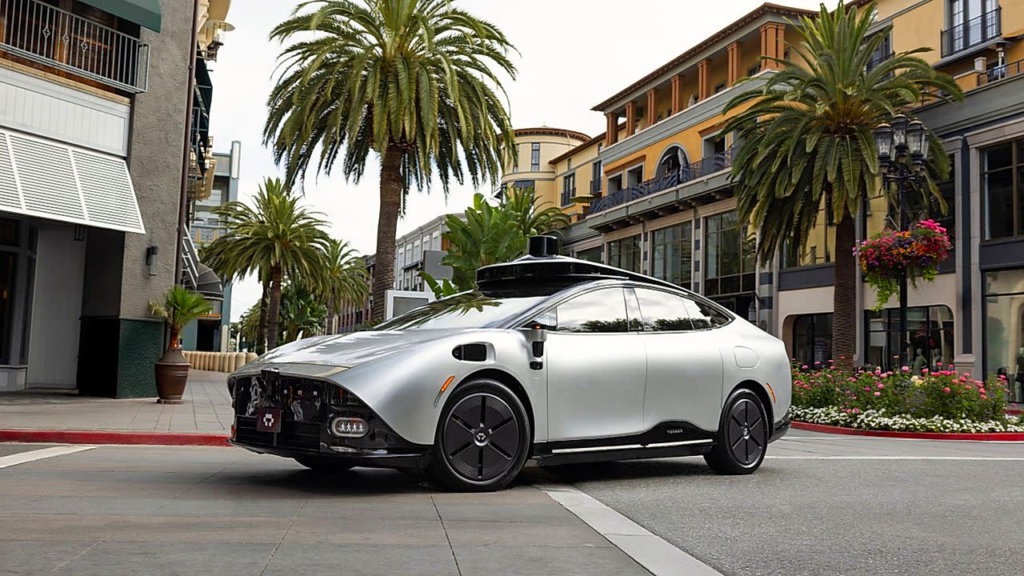
The Tensor Robocar isn’t just an autonomous layer slapped onto an existing chassis; it is an electric vehicle meticulously engineered from the ground up with autonomy as its raison d’être. This fundamental design philosophy is a critical differentiator, setting it apart from even the most advanced ADAS (Advanced Driver-Assistance Systems) available today.
At its heart, the Robocar is a sophisticated EV, built to support its advanced autonomous capabilities. While full performance specifications are still under wraps, Tensor has confirmed a substantial 112-kWh battery pack, providing an estimated range of 250 miles – perfectly suitable for urban and inter-city personal travel. The vehicle features a single rear motor, and though output details are pending, we can expect robust, smooth power delivery characteristic of modern luxury EVs. What truly impresses is the 845-volt battery architecture, enabling ultra-fast charging from 10 to 80 percent in a mere 20 minutes. This kind of rapid turnaround is vital for maximizing utility, whether for personal convenience or potential rideshare monetization.
Beyond the powertrain, Tensor is pushing the boundaries of user experience with an innovative automated charging system featuring a robotic arm designed to plug in the car for you at home – a significant step towards truly seamless integration into daily life. And convenience doesn’t stop there. The Robocar boasts coach-style, center-closing powered doors, equipped with intelligent sensors to prevent accidental contact with obstacles or other vehicles. These are not just aesthetic flourishes; they contribute to a holistic user experience designed to be effortless and intuitive, reinforcing the luxury autonomous vehicles promise.
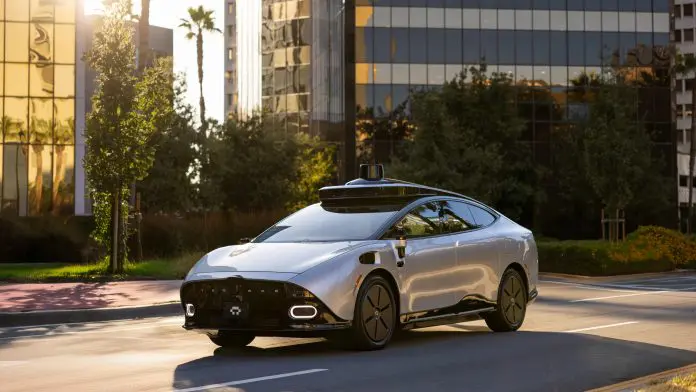
Crucially, Tensor bills the Robocar as an SAE Level 4 autonomous vehicle. For those navigating the complex landscape of autonomous vehicle technology, Level 4 signifies a vehicle that can operate entirely without human intervention under specific conditions (e.g., within a defined operational design domain, or ODD). While it retains a steering wheel and pedals for optional manual operation, the car is fundamentally designed to drive itself. This capability places it squarely in the league of Waymo’s established robotaxi services, but with the game-changing distinction of private ownership. This is a leap beyond even the most advanced consumer-grade systems, like Tesla’s Full Self-Driving (Supervised), which, as of 2025, still mandates active human supervision. Tensor’s commitment to a ground-up design, with development commencing back in 2020 after their initial robotaxi service launch, underscores their deep-rooted understanding of the requirements for achieving true, unsupervised autonomy.
A Sensory Masterpiece: Hardware and AI for Unrivaled Perception
Achieving Level 4 autonomy is not merely a software challenge; it demands an unparalleled orchestration of hardware and artificial intelligence. The Tensor Robocar is a testament to this, integrating a formidable array of over 100 sensors that paint a comprehensive, real-time 360-degree picture of its environment. This includes five high-resolution lidar arrays – one prominently mounted on the roof for expansive long-range detection, complemented by four strategically placed around the vehicle’s front, sides, and rear for granular short-to-medium-range perception. These are augmented by 37 high-definition cameras, 11 radar units, and 10 ultrasonic sensors, creating a robust multi-modal sensor fusion system. The rooftop lidar alone can detect objects nearly 1,000 feet away, providing critical foresight for safe navigation.
But what good are sensors if they’re obscured? Tensor has thought through this challenge with meticulous detail. The Robocar integrates 30 washer nozzles and 13 mini wipers, alongside heating elements, to actively combat fogging, snow buildup, and general grime – an essential feature for all-weather autonomous operation, extending its utility beyond sunny California. Taking a page from the aerospace industry, Tensor also incorporates physical covers that automatically retract over the sensors when the vehicle is powered off, protecting them from dirt, dust, and potential damage – a significant improvement over many current AV designs, including Waymo’s Zeekr-based vehicles. This commitment to sensor longevity and reliability is crucial for sustained, safe autonomous function.
Processing this torrent of data requires monumental computational power. Tensor has equipped the Robocar with a colossal onboard computer featuring eight Nvidia Drive Thor-X chips. This powerhouse setup is capable of an astounding 8,000 TOPS (trillion operations per second), enabling real-time, high-fidelity environmental modeling and decision-making. While the car maintains redundant communication channels (three in total) for maximum connectivity to the cloud, the vast majority of its computing is performed locally on the vehicle. This “edge computing” architecture is a strategic advantage, ensuring robust, reliable operation even in areas with spotty 5G signals, directly addressing a common concern in connected car technology.
At the core of its intelligence lies the Tensor Foundation Model software, an AI-based system that operates two parallel cognitive pathways. The first is rigorously trained on millions of miles of data collected from professional human drivers, encoding safe and predictable driving behaviors. The second, more innovative pathway, leverages a Visual Language Model (VLM) specifically designed to solve unusual and unexpected “edge cases” – those unique scenarios that stump traditional rule-based systems. This dual-system approach significantly enhances the Robocar’s ability to navigate complex, unpredictable real-world environments, even in challenging conditions like rain and snow, making it a viable option for diverse climates across the United States. Furthermore, the Robocar prioritizes pedestrian safety and communication; subtle displays on its lower exterior corners broadcast simple messages and pictograms, informing pedestrians that the vehicle is operating autonomously and has registered their presence. This human-machine interface is crucial for building trust and ensuring harmonious coexistence with other road users.
Redefining Ownership: Your Car, Your Data, Your Control
In an era increasingly defined by data privacy concerns, Tensor makes a bold, user-centric statement. Because the Robocar performs the overwhelming majority of its computational heavy lifting onboard, the company emphasizes that it does not inherently need to collect vast quantities of data from your vehicle. This stands in stark contrast to many consumer technologies that continuously funnel user data to the cloud.
With the Robocar, owners hold the reins of their data sovereignty. While the vehicle is capable of sharing information with Tensor’s cloud services, this is strictly an opt-in feature. If an owner chooses not to opt in, all their sensitive data – including driving patterns, routes, and even biometric information used for security like facial and palm recognition – remains exclusively within the vehicle. Moreover, Tensor provides owners with unprecedented access and control: all data collected on the owner and users can be accessed directly via the vehicle’s interface or a companion phone application, with the explicit option for owners to review and delete it at will. This level of transparency and user control is a significant selling point, especially for affluent individuals highly conscious of their digital footprint.
Even interior cameras and microphones, which facilitate driver monitoring during manual operation and enable interaction with the voice assistant, come with a critical layer of user agency. Each of these components is equipped with physical covers and dedicated off switches, empowering owners to disable them whenever privacy is paramount. This meticulous attention to user control over personal data and sensory input elevates the Robocar beyond mere technological prowess into a realm of truly personalized and private autonomous transport.
The Conversational Car: Agentic AI as Your Co-Pilot
The future of in-car interaction isn’t about rigid commands; it’s about seamless conversation. Tensor’s Robocar is at the vanguard of this evolution, equipped with an advanced Agentic AI backed by a sophisticated Large Language Model (LLM). This isn’t just a souped-up voice assistant; it’s designed to engage with you in a natural, human-like dialogue. Instead of barking terse commands like “navigate home,” you can simply converse with your car about your destination, preferences, and even the mood you’re in. This level of human-machine interface represents a significant leap forward in creating an intuitive and enjoyable user experience.
The integration of this Agentic AI extends far beyond simple navigation. You can summon the Robocar from virtually anywhere with a simple call or text, instructing it to pick you up. Furthermore, the system learns your habits over time, proactively anticipating your needs. When connected to your calendar, it can foresee upcoming trips, calculate the necessary battery range, and even autonomously initiate charging to ensure you’re always ready to go. This proactive, intelligent anticipation of user needs elevates the Robocar from a mere mode of transportation to a truly integrated personal assistant, embodying the essence of personal autonomous transport.
The Driver’s Dilemma: Autonomy with a Human Option
While the Robocar’s primary design intent is autonomous operation, Tensor understands that the desire for human control hasn’t vanished. For those moments when you simply want to take the wheel, the vehicle thoughtfully retains a physical steering wheel and pedals. This hybrid approach ensures ultimate flexibility.
When operated manually, the Robocar acts as a sophisticated co-pilot, offering a customizable spectrum of assistance. From fundamental safety features like automatic emergency braking to advanced Level 3 semi-automated driving capabilities – where the driver can be hands-free and occasionally eyes-off-the-road under specific conditions – the Robocar adapts to the driver’s preference and comfort level.
The transition between autonomous and manual driving is remarkably seamless and elegantly engineered. When autonomous mode is engaged, the steering wheel smoothly retracts into the dashboard, and the primary center infotainment screen glides over to conceal it, creating an expansive, uncluttered cabin environment. The accelerator and brake pedals also retract discreetly out of the way. Should the driver wish to reassume control, these elements swiftly reappear, making the switch intuitive and secure.
Underpinning this flexibility is a robust by-wire system for steering, braking, and acceleration, eliminating physical connections and enabling precise electronic control. Crucially, every critical system – from the drive controls to each sensor suite – boasts multiple redundancies. This engineering philosophy means that should a failure occur in any single sensor or drive system, the car can continue to operate safely, providing an unparalleled level of self-driving car safety. Furthermore, the Robocar features rear-wheel steering, allowing the back tires to turn up to 7 degrees in either direction. This translates to an impressive claimed turning circle of just 37 feet – comparable to a much smaller Tesla Model Y, despite the Robocar being substantially larger, enhancing maneuverability in urban environments. Tensor is also actively targeting top-tier crash safety scores from leading global organizations like the NHTSA, IIHS, and European NCAP, reinforcing its commitment to occupant protection.
Beyond Personal Use: Making Your Car Work For You
One of the most compelling aspects of Level 4 private ownership is the potential for monetization. Tensor isn’t just selling you a luxury vehicle; they’re offering a platform for generating income. The company has already forged a strategic alliance with Lyft, indicating that Robocars will be integrated into their platform as luxury rideshare vehicles. This immediately provides a lucrative channel for owners to put their autonomous asset to work.
Recall Elon Musk’s long-standing promise that Tesla owners could deploy their vehicles as autonomous rideshares while they were at work or asleep. Tensor is echoing this vision, and given the methodical rollout of Tesla’s Robotaxi service, Tensor might indeed be the first to deliver on this promise for private owners. While specific details on how hailing and payment for privately owned autonomous cars on a platform like Lyft will work are still forthcoming, the potential for offsetting the vehicle’s cost or even generating a significant side income is immense. This transforms the concept of vehicle ownership, potentially making the Robocar not just an expense, but an autonomous vehicle technology investment. The robo-taxi market projections for owner-operated models are substantial, and Tensor is positioning itself to capture a significant share of this evolving landscape.
The Price of Progress and the Path to Market
Such advanced technology and unparalleled convenience come with an expectation of luxury pricing. While Tensor is not yet ready to disclose the exact cost, their Head of Marketing, Amy Luca, has indicated that prospective buyers should anticipate a “luxury pricing” tier. Drawing parallels to industry estimates for Waymo’s self-driving cars, which are often benchmarked against a well-optioned Mercedes-Benz S-Class, we can reasonably estimate the Tensor Robocar to fall within the $150,000 to $200,000 range, likely on the higher end given its bespoke, ground-up design and cutting-edge feature set. This positions it firmly within the luxury autonomous vehicles segment, targeting a discerning clientele eager for the ultimate in personal mobility.
Manufacturing for the Robocar will be handled by Vietnamese automaker VinFast at its state-of-the-art factory in Haiphong, Vietnam. While VinFast vehicles have faced initial scrutiny regarding build quality in the nascent U.S. market, it’s crucial to remember their extensive manufacturing experience, including years of assembling BMWs under license. This background attests to their capability in producing high-quality automobiles. Tensor expresses confidence in VinFast’s ability to deliver on the Robocar’s demanding specifications.
Production is slated to commence in late 2026, with the first deliveries targeting the United Arab Emirates (UAE) in the fourth quarter of that same year. For the crucial U.S. market, deliveries are anticipated to begin in early 2027, contingent upon obtaining necessary regulatory approvals – a significant hurdle that all autonomous vehicle developers must navigate. Beyond the U.S. and UAE, Tensor has ambitious plans for expansion into the European Union and has recently announced an agreement to supply cars to a rideshare service in Denmark, signaling a robust global strategy.
Of course, with cutting-edge technology come new questions, particularly regarding liability. While the Robocar is designed for autonomy, the ownership model naturally raises queries, such as who bears the responsibility for traffic violations. Though Tensor has not yet provided explicit details, the prevailing assumption across the industry is that, for privately owned autonomous vehicles, the owner will ultimately be responsible for any tickets or fines incurred while the car is driving itself. This is an area where evolving autonomous vehicle regulatory challenges in the US will play a critical role in shaping future policies.
Your Future, On Your Terms.
The Tensor Robocar represents more than just a car; it’s a statement about the future of personal freedom and intelligent living. As we move into 2027, this vehicle offers a tangible glimpse into a world where true Level 4 autonomy is not a distant dream but an accessible reality for the discerning consumer. It combines unparalleled technological prowess with a deep respect for privacy and user agency, creating a driving experience that is as effortless as it is exhilarating.
Are you ready to redefine your relationship with personal mobility? To embrace a future where your vehicle is not just a mode of transport but a sophisticated, autonomous extension of your life, ready to serve, protect, and even generate income? The era of personal autonomous vehicles is here. Explore how the Tensor Robocar can transform your daily commute and weekend adventures, and join the vanguard of the autonomous revolution.