



The Dawn of Personal Autonomy: Tensor’s Robocar Reshaping 2027 Mobility
For a decade, I’ve navigated the intricate labyrinth of autonomous vehicle development, witnessing the ebb and flow of hype cycles, technological breakthroughs, and regulatory hurdles. From the nascent experiments of 2016 to the advanced prototypes gracing our streets in 2025, the journey towards true self-driving has been nothing short of transformative. Yet, even with robotaxis becoming an increasingly common sight in select urban centers – Waymo in Phoenix, Cruise in San Francisco, and a smattering of others – the dream of owning a personal Level 4 autonomous vehicle has remained largely just that: a dream. Until now.
Enter the Tensor Robocar. This isn’t just another electric vehicle with enhanced driver-assistance features; it’s a meticulously engineered, ground-up Level 4 autonomous machine designed explicitly for private ownership, slated for U.S. deliveries by early 2027. Tensor, a name that might be new to many in the consumer market but carries significant weight among industry insiders, is poised to democratize truly hands-off, eyes-off driving in a way no other company has credibly promised for the individual consumer. This vehicle represents a pivotal shift, moving beyond the shared robotaxi model to offer an unprecedented level of personal autonomy and convenience.
A Decade in the Making: Tensor’s Calculated Evolution
To truly appreciate the Tensor Robocar’s significance, one must understand the journey that led to its conception. The company began its life in Silicon Valley back in 2016 as AutoX, founded with an ambitious vision for autonomous driving innovation focused primarily on commercial fleets and the nascent robotaxi development sector. Their early years were characterized by intensive testing across California and China, accumulating invaluable real-world data and refining their AI models. The pandemic era, ironically, accelerated their operational capabilities, leading to the deployment of over 1,000 autonomous taxis in five Chinese cities, providing extensive public service. This period was crucial; it wasn’t merely theoretical development but practical, large-scale operation under diverse, real-world conditions.
However, the dynamic geopolitical landscape and evolving concerns around data privacy spurred a strategic reorientation. In a bold move over the past year, AutoX completely divested from its Chinese operations, repatriating its core talent and technology back to its roots in San Jose, California. Rebranding as Tensor, the company made a decisive pivot: from enterprise-focused robotaxis to crafting a bespoke, Level 4 private self-driving car for the individual consumer. This isn’t a mere change of branding; it’s a strategic refocusing, leveraging years of hard-won experience in complex autonomous vehicle technology to address a previously untapped market segment with a distinct value proposition around ownership and data control. Their decade of experience in the grueling world of robotaxi development has imbued them with a profound understanding of the robustness and reliability required for true autonomy, translating directly into the consumer-facing Robocar.
Engineering a Level 4 Masterpiece: Design Beyond the Ordinary
At its core, the Tensor Robocar is a sophisticated electric autonomous vehicle designed with a holistic approach to Level 4 autonomy. Powering this vision is a substantial 112-kWh battery pack, providing an estimated range of 250 miles – a practical figure for daily commuting and even longer excursions. What truly sets it apart in the EV space is its advanced 845-volt battery architecture, enabling remarkably swift replenishment. Tensor claims a 10 to 80 percent fast-charge in just 20 minutes, a crucial feature for minimizing downtime and maximizing the utility of a vehicle designed for high availability. While initial details point to a single rear motor, the emphasis isn’t on raw speed, but rather on smooth, reliable, and efficient autonomous operation, a common characteristic of vehicles prioritizing the future of transportation investment over track performance.
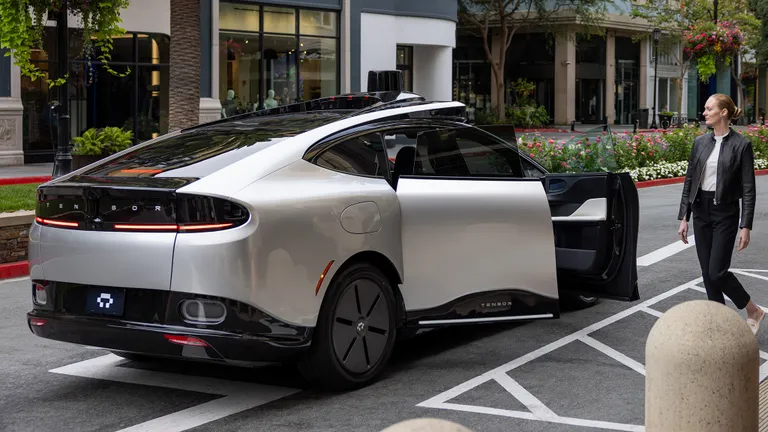
But Tensor’s innovation extends beyond the powertrain. Imagine arriving home, and your car autonomously navigates to its charging station where a robotic arm extends to plug itself in. This isn’t science fiction for 2027; Tensor is actively developing such an automated EV charging system, further enhancing the seamless, hands-off experience. Furthermore, the very interaction with the vehicle is redefined. The coach-style, center-closing doors, a hallmark of luxury, are fully powered and equipped with an array of sensors. These aren’t just for convenience; they actively prevent collisions with obstacles or other vehicles in tight parking scenarios, embodying a proactive approach to safety and user experience that elevates the concept of a luxury EV market.
The Autonomous Brain: Unpacking True Level 4 Capabilities
The term “autonomous vehicle” is often used loosely, leading to confusion. Tensor’s Robocar adheres strictly to SAE Level 4, meaning it is designed to perform all driving tasks under specific operational design domains (ODDs) without human intervention. Crucially, while it retains a steering wheel and pedals for manual override, the vehicle is capable of operating entirely on its own, even without a human occupant – a stark contrast to the advanced driver-assistance systems (ADAS) market currently dominated by Level 2 and nascent Level 3 technologies. This fundamental distinction is key: Tesla’s “Full Self-Driving (Supervised),” while impressive, still requires constant human attention and readiness to intervene. Tensor’s approach is a leap beyond, building the car from the ground up for autonomy, a development path that commenced shortly after their successful robotaxi launch in China. This holistic design philosophy bypasses the compromises inherent in retrofitting existing vehicle platforms, ensuring optimal sensor placement, computational integration, and system redundancy from day one.
Achieving this profound level of autonomy demands an extraordinary sensory apparatus and immense computational power. The Robocar is a marvel of sensor fusion, boasting over 100 sensors strategically placed around its chassis. This includes five distinct lidar arrays – one prominently mounted on the roof, providing a 360-degree view with a nearly 1,000-foot range, complemented by four others around the front, sides, and rear. Coupled with 37 cameras, 11 radars, and 10 ultrasonic sensors, the vehicle constructs an incredibly rich, redundant, and accurate perception of its environment. This comprehensive lidar technology in self-driving cars combined with camera and radar inputs creates an unparalleled perception stack, essential for navigating the unpredictable complexities of urban and suburban environments.
Maintaining the integrity of these sensors is paramount. Tensor has engineered a sophisticated system of 30 washer nozzles, 13 mini wipers, and integrated heating elements to combat fogging, snow buildup, and dirt. Taking a cue from their robotaxi development experience, they’ve innovated further with physical covers that automatically retract over the sensors when the vehicle is powered down. This clever design protects the delicate hardware from environmental damage and grime, a practical consideration often overlooked in early autonomous designs.
The sheer volume of data generated by this sensor suite requires a computational powerhouse. The Robocar integrates eight Nvidia Drive Thor-X chips, delivering an astounding 8,000 TOPS (trillion operations per second). While cloud connectivity is available and used for updates and mapping, the majority of the processing occurs on-board, ensuring robust operation even in areas with poor 5G signal – a critical feature given the nascent state of widespread 5G infrastructure for autonomous vehicles. The Tensor Foundation Model software, an AI in autonomous driving marvel, operates two parallel systems: one meticulously trained by millions of miles of professional human driving data, and a second driven by a Visual Language Model (VLM) specifically designed to address unusual and unexpected “edge cases.” This dual-system approach significantly enhances the vehicle’s ability to handle novel situations, enabling reliable operation in challenging weather conditions like rain and snow, extending its utility beyond perpetually sunny climates.
Furthering its integration into shared spaces, the Robocar features external displays on its lower corners. These simple, intuitive screens broadcast messages and pictograms to pedestrians, clearly indicating that the car is operating autonomously and has registered their presence. This proactive communication is vital for fostering trust and ensuring safety in increasingly crowded urban environments, a key aspect for addressing concerns around self-driving car liability and public acceptance.
Your Car, Your Data: Prioritizing Privacy in the Autonomous Age
One of Tensor’s most compelling differentiators, especially in the era of heightened digital concerns, is its staunch commitment to data privacy. By performing the vast majority of computing onboard, the company fundamentally reduces the need to continuously upload personal data to external servers. Owners retain control; cloud sharing of vehicle data is an explicit opt-in choice. If chosen not to opt-in, all data collected – ranging from driving patterns to biometric recognition information – remains securely within the vehicle. This includes sensitive biometric data such as facial and palm recognition, which are utilized for vehicle operation and theft prevention but are fully accessible and deletable by the owner via the vehicle’s interface or a dedicated phone app.
Even the interior cameras and microphones, essential for driver monitoring during manual operation or interaction with the voice assistant, come with physical covers and dedicated off switches. This level of granular control over personal information is a refreshing and critical feature, setting a new benchmark for data privacy autonomous vehicles and potentially appealing to a broad demographic wary of constant surveillance in the digital age. It underscores an ethical approach to AI in autonomous systems, emphasizing user agency and control.
The Conversational Cockpit: Agentic AI and Intelligent Interaction
Beyond mere voice commands, the Tensor Robocar aims for a genuinely conversational experience. It’s equipped with an Agentic AI, powered by a sophisticated Large Language Model (LLM), designed to interact with occupants in a natural, human-like manner. Instead of rigid instructions, you can simply “talk” to your car, discussing your destination, your preferences, and your needs. This goes beyond traditional voice assistants, offering a more intuitive and personalized interaction that truly redefines the in-car user experience.
This intelligent assistant learns your habits, anticipating your needs. Connected to your calendar, it can proactively suggest routes, estimate required battery range, and even initiate charging cycles to ensure you’re ready for your next appointment. The convenience extends to vehicle summoning; a simple call or text can dispatch your Robocar to your location, eliminating the need for complex app interfaces when you just want your car to come to you. This level of integration transforms the vehicle from a mere mode of transport into a truly intelligent, anticipatory companion, embodying the promise of personalized mobility solutions.
The Choice is Yours: Drive or Be Driven (Hybrid Operation)
While the Robocar’s primary purpose is autonomous operation, Tensor understands that the joy of driving hasn’t vanished. The vehicle retains a steering wheel and pedals, allowing the driver to take control at any moment. When a human is at the helm, the car can provide a spectrum of assistance, from fundamental safety features like automatic emergency braking (AEB) to advanced Level 3 semi-automated driving, where the vehicle handles steering, acceleration, and braking, allowing the driver to go “hands-free, eyes-off” in specific conditions.
The transition between modes is seamless and elegant. In autonomous mode, the steering wheel gracefully retracts into the dashboard, and the central infotainment screen slides to conceal it, creating an expansive, uncluttered cabin. The accelerator and brake pedals likewise recede, creating a genuinely lounge-like environment. Should the driver wish to intervene, a simple command or gesture instantly brings all controls back into position.
Underpinning this flexibility is a sophisticated drive-by-wire system for steering, braking, and acceleration. This eliminates physical connections, offering precise control and enabling the seamless retraction of controls. Critically, each of these systems, along with the entire sensor suite, is built with multiple redundancies. This architectural foresight ensures that the vehicle can continue to operate safely even in the event of a component failure, a paramount concern for autonomous vehicle safety and reliability. Further enhancing maneuverability, the Robocar features rear-wheel steering, allowing the back tires to turn up to 7 degrees. Despite its substantial size, this gives it an impressive 37-foot turning circle, comparable to a much smaller Tesla Model Y, making urban navigation surprisingly agile.
Safety remains paramount, and Tensor is rigorously targeting top crash safety scores from leading regulatory bodies, including NHTSA, IIHS in the U.S., and European NCAP. This commitment underscores their dedication to not just autonomous functionality, but also to fundamental occupant protection.
Beyond Personal Use: A New Paradigm for Vehicle Ownership
Tensor’s vision extends beyond simply driving yourself. They’ve already forged a strategic alliance with Lyft, positioning the Robocar as a premium, luxury rideshare vehicle within their network. This partnership hints at a broader, more flexible ownership model that echoes Elon Musk’s long-standing promise of turning personal vehicles into revenue-generating robotaxis. While Tesla’s robotaxi service rollout has been notoriously slow, Tensor, with its ground-up Level 4 architecture, might be better positioned to fulfill this promise sooner for private owners.
Imagine your Robocar ferrying passengers for Lyft while you’re at work, or even generating income while you sleep. While the precise details of how private owners will integrate their vehicles into the rideshare economy and manage payments are still evolving, the potential for a new paradigm in autonomous vehicle investment and utilization is immense. This could transform the depreciating asset of a car into a dynamic, income-generating tool, aligning with the broader trend towards transformative mobility solutions.
Investing in the Future: Pricing and Production Insights
As expected for a vehicle pioneering this level of technology and luxury, Tensor anticipates “luxury pricing” for the Robocar. While an exact figure hasn’t been announced, industry speculation, informed by comparisons to the cost of Waymo’s bespoke autonomous platforms and high-end luxury vehicles like a well-optioned Mercedes-Benz S-Class, places the Robocar in the range of $150,000 to $200,000, likely leaning towards the higher end given its advanced, ground-up Level 4 capabilities. This positions it squarely in the burgeoning luxury EV market and reflects the significant R&D and sophisticated engineering involved.
For production, Tensor has strategically partnered with Vietnamese automaker VinFast, utilizing their advanced factory in Haiphong, Vietnam. While VinFast vehicles have faced some scrutiny regarding build quality in the U.S. market, it’s crucial to remember their extensive experience, including years of assembling BMWs under license. This partnership leverages VinFast’s established global EV manufacturing capabilities, providing a robust pathway to scale production.
The ambitious rollout schedule begins with deliveries in the United Arab Emirates (UAE) in late 2026, followed by U.S. deliveries in early 2027, pending crucial regulatory approval autonomous vehicles. Plans are also in motion for expansion into the European Union and an announced partnership for rideshare services in Denmark, signaling a truly global aspiration for Tensor’s groundbreaking vehicle.
One final, practical consideration: if your autonomous Robocar gets a parking ticket or traffic infraction while operating itself, who pays? While the regulatory framework is still evolving, the industry consensus, and logical extension of current laws, points to the owner typically bearing this responsibility. It’s an interesting facet of self-driving car liability that will continue to be debated and refined as these vehicles become more common.
Your Journey into the Future of Mobility Awaits
The Tensor Robocar isn’t just another car; it’s a meticulously crafted portal to the next era of personal transportation. With its ground-up Level 4 autonomy, unwavering commitment to data privacy, intelligent Agentic AI, and flexible ownership models, it promises to redefine not just how we travel, but how we interact with our vehicles and perceive the concept of ownership itself. As we stand on the precipice of 2027, the potential for this vehicle to reshape our daily lives is immense.
Are you ready to experience the pinnacle of autonomous driving and reclaim your time, convenience, and control? Explore how the Tensor Robocar can transform your personal mobility landscape and embark on a journey where your car truly works for you. The future is no longer just on the horizon; it’s being delivered to your driveway.