



The Personal Revolution: Tensor’s Level 4 Robocar Redefines Private Autonomous Driving for 2027
As someone who has navigated the exhilarating, often turbulent, currents of the autonomous vehicle (AV) industry for the past decade, I can tell you this: the landscape of personal mobility is on the cusp of a seismic shift. While robotaxis have begun to etch their presence into select urban tapestries – Waymo in Phoenix and San Francisco, Cruise in pockets of Texas, and yes, even Tesla’s long-anticipated Robotaxi service seeing limited, supervised deployments in places like Austin by 2025 – the ultimate promise of a truly personal, fully self-driving car has largely remained a futuristic fantasy, confined to concept videos and speculative timelines. Until now.
Enter Tensor, a rebranded powerhouse with a rich lineage, poised to unleash what they call the Robocar: a ground-up designed, SAE Level 4 private autonomous vehicle slated for customer deliveries in the United States by early 2027. This isn’t just another car with advanced driver assistance; it’s a meticulously engineered machine designed to operate autonomously without human intervention in defined operational domains, offering a level of freedom and convenience previously reserved for the realm of science fiction. From my vantage point in 2025, this represents a pivotal moment, marking the true dawn of AI-powered self-driving car ownership.
From Robotaxi Pioneer to Personal Mobility Visionary: Tensor’s Odyssey
Tensor’s journey is as compelling as its current ambition. Tracing its roots back to 2016 as AutoX in the heart of Silicon Valley, the company initially plunged into the complex world of commercial autonomous vehicles and robotaxis. For years, they were a significant player, particularly in China, where their fleet of over 1,000 autonomous taxis provided public rides across five cities. They amassed invaluable real-world data and expertise, navigating the myriad challenges of urban self-driving in diverse, high-density environments.
However, the past year has seen a dramatic, strategic pivot. Citing burgeoning data privacy concerns surrounding its extensive Chinese operations, AutoX made the bold decision to divest entirely. Rebranding as Tensor and returning to its Californian genesis in San Jose, the company shifted its entire focus. The new mission: not to ferry strangers in corporate fleets, but to deliver a completely next-generation autonomous car directly to the private consumer. This move is significant. In an era where data ownership and privacy are increasingly paramount for consumers, Tensor’s renewed emphasis on user control and on-board processing could be a profound differentiator, especially when targeting the discerning luxury market for Level 4 autonomous vehicle for sale.
Engineering the Autonomous Dream: A Deep Dive into the Robocar’s Core
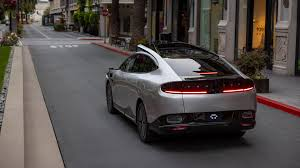
The Tensor Robocar isn’t just an existing platform retrofitted with autonomous tech; it’s conceived from the very foundation as an EV autonomous vehicle. This ‘design-from-the-ground-up’ philosophy, which commenced in 2020, is critical for achieving true Level 4 capabilities. It ensures that every component, from the structural integrity to the power delivery and sensory integration, is optimized for autonomy, rather than being an afterthought.
Powering this vision is a robust 112-kWh battery pack, designed to provide an estimated 250 miles of range – a respectable figure that addresses much of the range anxiety associated with electric vehicles today. But where Tensor truly pushes the envelope is in its charging capabilities. Its 845-volt architecture enables blistering fast-charging, claiming a 10 to 80 percent recharge in just 20 minutes. This is crucial for enabling the kind of spontaneous, long-distance journeys that truly autonomous ownership promises. Looking ahead, Tensor is also actively developing an automated charger, envisioning a future where a robotic arm handles the plug-in chore when you arrive home – a small detail, perhaps, but one that embodies the seamless, hands-off experience they aim to deliver.
Beyond the powertrain, the physical design reflects the luxury experience. Coach-style, center-closing doors aren’t just aesthetically pleasing; they’re powered and equipped with sensors to prevent accidental collisions with obstacles or other vehicles. This thoughtfulness permeates the entire design, emphasizing both elegance and functionality, a hallmark of luxury autonomous vehicles.
The Sensory Network: Eyes, Ears, and Brain of the Robocar
Achieving true Level 4 autonomy requires an unprecedented level of environmental perception and computational might. The Robocar is a rolling fortress of sensors, boasting over 100 individual units. This includes five high-resolution lidar arrays – one strategically mounted on the roof for panoramic, long-range perception (nearly 1,000 feet, 360 degrees) and four others distributed around the vehicle’s front, sides, and rear for granular, close-range detail. Supplementing these are 37 cameras offering a diverse range of perspectives, 11 radar units for all-weather distance and velocity detection, and 10 ultrasonic sensors for low-speed maneuvering and parking. This redundant, multi-modal sensor fusion is the bedrock of reliable autonomous driving technology.
Tensor understands that sensors are only as good as their ability to see. To counter environmental challenges like rain, snow, fog, and dirt, the Robocar integrates an advanced active cleaning system. This isn’t just a few spray nozzles; we’re talking about 30 washer nozzles and 13 mini wipers, strategically placed to maintain crystal-clear vision. Crucially, heating elements prevent fogging and snow buildup, a critical feature for expanding the operational design domain (ODD) beyond the perpetually sunny confines of California. What truly sets Tensor apart, even from advanced systems like Waymo’s Zeekr-based vehicles, are the physical covers that automatically retract over the sensors when the vehicle is powered down. This simple yet ingenious addition protects the delicate optics from dirt, debris, and potential damage, enhancing longevity and reliability – a significant detail for the longevity and maintenance of a private self-driving car.
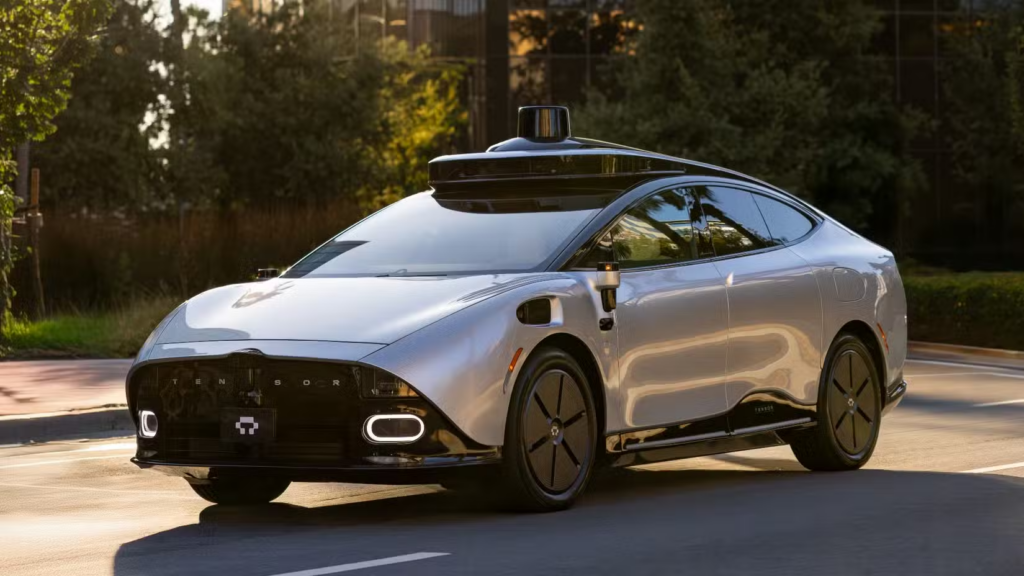
All this sensory input feeds into a colossal onboard computing system, featuring eight Nvidia Drive Thor-X chips. This represents an astonishing 8,000 TOPS (trillion operations per second) of processing power. In 2025, while cloud connectivity is increasingly ubiquitous, Tensor’s commitment to robust edge computing is a testament to its understanding of real-world operational constraints. This massive on-board processing capability ensures the Robocar can function flawlessly even when 5G signals are intermittent or unavailable, backed by three redundant communication channels for maximum connectivity.
The true intelligence, however, lies in the software. Tensor’s Foundation Model, an AI-powered system, operates two parallel, redundant decision-making frameworks. The first is extensively trained on billions of miles of data derived from expert human drivers, establishing a robust baseline for conventional driving scenarios. The second leverages a Visual Language Model (VLM) – a cutting-edge approach that combines visual data with natural language understanding – specifically designed to tackle complex, ambiguous, and unusual “edge cases” that conventional training data might miss. This dual-layer approach promises a highly resilient and adaptable autonomous vehicle investment, capable of navigating the unpredictable realities of public roads in varied weather conditions.
A subtle but crucial safety feature involves external displays on the vehicle’s lower corners. These panels broadcast simple messages and pictograms to pedestrians, clearly communicating the car’s autonomous status and acknowledging their presence. This enhances trust and predictability, vital for integrating smart mobility solutions into dense urban environments.
Beyond the Wheel: An Intelligent Companion Experience
Tensor isn’t just selling a car; they’re selling an experience centered around a truly intelligent co-pilot. In a world where personal data is gold, Tensor takes a remarkably user-centric stance. All primary computing and data processing happen onboard, within the vehicle itself. Cloud sharing of your data is strictly opt-in, giving owners unprecedented control. Every piece of information collected – from route histories to biometric data for facial and palm recognition (essential for vehicle operation and theft prevention) – is accessible via the car or a phone app, and critically, can be deleted by the owner at any time. This emphasis on data privacy in autonomous vehicles is a powerful counter-narrative to the common anxieties surrounding connected cars.
Even interior cameras and microphones, used for driver monitoring during manual operation or voice assistant interaction, are equipped with physical covers and off-switches. This granular control over internal surveillance offers peace of mind, allowing owners to dictate their level of privacy.
But you’ll likely want those microphones on, because the Robocar is designed for conversation. It integrates an Agentic AI, backed by a sophisticated Large Language Model (LLM), enabling fluid, human-like dialogue rather than rigid command structures. Imagine saying, “Robocar, I’m thinking of a quick trip to the mountains this weekend, but I also need to pick up dry cleaning on the way there. Can you map that out and ensure we have enough charge?” The system isn’t just executing commands; it’s understanding intent and context. This intelligent interaction extends to summoning the car via a call or text, and even proactive learning of your habits. Connect it to your digital calendar, and the Robocar can anticipate upcoming trips, pre-conditioning the cabin, and managing charging needs to ensure you’re always ready to go. This level of personalized, proactive service truly sets the stage for the future of transportation.
The Freedom to Choose: Autonomy and Human Oversight
The Robocar’s designation as an SAE Level 4 autonomous vehicle means it can, under specific conditions, handle all driving tasks without human supervision. This stands in stark contrast to even the most advanced Level 2 or Level 3 systems available today, such as Tesla’s FSD (Supervised), which still demands constant human vigilance. With Level 4, the driver is truly freed from the act of driving within the car’s operational design domain.
Yet, Tensor hasn’t discarded the steering wheel and pedals. The Robocar retains these traditional controls, allowing owners the choice to drive manually whenever they desire. This flexibility is key. When in autonomous mode, the steering wheel elegantly retracts into the dash, and the center infotainment screen slides over to conceal it, creating a more spacious, lounge-like cabin. The accelerator and brake pedals also retract, maximizing comfort. Should you wish to take control, everything seamlessly pops back into position.
For those moments when you prefer to drive, the Robocar still offers a spectrum of assistance. From fundamental self-driving car safety features like automatic emergency braking to more advanced Level 3 semi-automated driving that allows hands-free, eyes-off-the-road operation in specific situations, the driver assistance systems are comprehensive and customizable.
Underpinning all this are advanced by-wire systems for steering, braking, and acceleration, meaning there are no physical connections between the controls and the vehicle’s mechanics. Crucially, every one of these systems, along with the extensive sensor suite, boasts multiple redundancies. This architectural foresight ensures that even in the unlikely event of a component failure, the car can continue to operate safely, a paramount consideration for personal mobility solutions 2025 and beyond. Maneuverability, despite the Robocar’s potentially substantial size, is also impressive, with rear-wheel steering allowing the back tires to turn up to 7 degrees, resulting in a claimed 37-foot turning circle – comparable to a Tesla Model Y.
Safety isn’t an option; it’s a prerequisite. Tensor is aggressively targeting top crash safety scores from leading regulatory bodies like the NHTSA and IIHS in the U.S., as well as the European NCAP, reinforcing its commitment to passenger protection.
The Economic Upside: Monetizing Your Autonomous Asset
One of the most tantalizing prospects of private robotaxi ownership has been the vision of putting your car to work. Elon Musk famously spoke of owners earning income by deploying their Tesla as an autonomous rideshare while they’re at work or asleep. Tensor is embracing this very concept, and given the measured rollout of Tesla’s private Robotaxi vision for individual owners, Tensor might very well deliver on this promise first.
Tensor has already secured a significant partnership with Lyft, planning to introduce Robocars into their luxury rideshare segment. This offers a potential pathway for private owners to also participate in the autonomous gig economy. While details on the exact mechanics of hailing and payment for privately owned autonomous cars are still emerging, the existing platform infrastructure of companies like Lyft suggests a straightforward integration. This isn’t just about owning a car; it’s about owning an appreciating asset that can generate income, revolutionizing the conventional car ownership model and making it a genuine autonomous vehicle investment.
Bringing It Home: Availability, Pricing, and the Road Ahead
So, what will this groundbreaking technology cost? While Tensor isn’t ready to release official pricing, their head of marketing, Amy Luca, indicated “luxury pricing.” Industry benchmarks, such as Waymo’s CEO suggesting their vehicles cost comparable to a well-optioned Mercedes-Benz S-Class, place the potential price point between $150,000 and $200,000. Given the sheer complexity and the ground-up design of the Robocar, it’s safe to assume Tensor will likely position itself at the higher end of this spectrum. This positions the Robocar not merely as a car, but as a premium lifestyle choice, a luxury autonomous vehicle offering an unparalleled ownership experience.
Production for the Robocar is being handled by Vietnamese automaker VinFast, at its state-of-the-art factory in Haiphong, Vietnam. I recognize that VinFast’s initial foray into the U.S. market has faced scrutiny regarding build quality. However, as an industry expert, it’s crucial to remember that VinFast has a long history of assembling vehicles, including BMWs under license for many years. Their manufacturing capabilities are robust, and with Tensor’s meticulous design and quality control oversight, I anticipate a product that meets the high standards expected for a next-generation autonomous car.
The rollout plan is ambitious yet structured. Production is slated to begin in late 2026, with initial deliveries commencing in the United Arab Emirates (UAE) late in the fourth quarter of that same year. For U.S. customers, the wait won’t be much longer, with deliveries projected for early 2027, contingent upon crucial regulatory approvals – a significant hurdle that all AV companies must clear. Tensor also has its sights set on the European Union and has recently announced plans to supply vehicles to a rideshare service in Denmark, indicating a global vision for private autonomous car ownership.
A practical question that often arises with autonomous vehicles is liability. While the car drives itself, the current legal framework generally dictates that the owner will ultimately be responsible for fines if the Robocar receives a parking ticket or traffic violation while operating autonomously. This is an area where regulatory bodies are still evolving, but for now, ownership implies responsibility.
The Invitation to the Future
The Tensor Robocar represents more than just a technological leap; it signifies a profound shift in our relationship with transportation. It promises a future where your vehicle isn’t just a means to an end, but an intelligent, secure, and potentially income-generating companion that liberates you from the demands of driving. This is the future of transportation – a future that is not just autonomous, but deeply personal and empowering.
Are you ready to experience the next evolution of personal mobility? To embrace a vehicle that prioritizes your privacy, anticipates your needs, and seamlessly integrates into your life? The dawn of true private Level 4 autonomous driving is upon us, and Tensor is leading the charge. Explore what the Robocar could mean for your daily commute, your long-distance travels, and your personal freedom. We invite you to follow Tensor’s journey closely, envision your own autonomous future, and consider joining the revolution when the Robocar arrives in 2027.