



The Dawn of Personal Autonomy: Tensor Robocar Redefines Luxury Self-Driving for 2027
For over a decade, those of us immersed in the autonomous vehicle industry have watched the landscape evolve from sci-fi dreams to tangible, albeit still regulated, reality. We’ve witnessed the rise and occasional stumble of robotaxi services in major urban centers, the iterative advancements in advanced driver-assistance systems (ADAS), and the persistent promise of a truly self-driving future. Now, as we stand in 2025, a new player, Tensor, is poised to dramatically shift the paradigm, not with another fleet of AI-driven taxis, but with a groundbreaking Level 4 autonomous vehicle designed for private ownership. The Tensor Robocar, slated for a 2027 US debut, isn’t just another EV; it represents a bold leap into personalized mobility solutions, promising a freedom and luxury unprecedented in the automotive sector.
From Robotaxi Pioneer to Personal Autonomy Visionary: Tensor’s Transformative Journey
Many veterans of the autonomous driving space will recognize Tensor by its former moniker, AutoX. Founded in Silicon Valley back in 2016, AutoX quickly established itself as a frontrunner in commercial autonomous vehicles and robotaxi deployment. Their journey began with rigorous testing in California and China, rapidly expanding into a substantial fleet of over 1,000 autonomous taxis serving the public across five Chinese cities during the height of the pandemic. This extensive real-world experience provided an unparalleled data trove, honing their AI in automotive capabilities to an exquisite degree.
However, the global landscape shifts, and so too must visionary companies. In a strategic pivot over the past year, driven by increasingly stringent data privacy regulations and a desire to refocus their core mission, AutoX completely divested from its Chinese operations. Reemerging as Tensor, the company has repatriated to its roots in San Jose, California. This isn’t merely a rebranding; it signifies a profound strategic reorientation. Tensor is no longer chasing the shared mobility market alone; their ambition is to deliver a dedicated, ground-up Level 4 autonomous car directly into the hands of private consumers. This move speaks volumes about their confidence in their self-driving car technology and their foresight into the evolving desires of the luxury electric vehicle market.
The Tensor Robocar: An EV Engineered for the Autonomous Age
At its heart, the Tensor Robocar is a thoroughly modern electric vehicle, designed from the ground up to embody the next-gen EV technology expected in 2025 and beyond. It boasts a substantial 112-kWh battery pack, providing an estimated 250 miles of range, positioning it competitively within the premium EV segment. While specific performance metrics for its single rear motor are yet to be fully disclosed, Tensor emphasizes efficiency and seamless integration with its autonomous functions.
One of the standout features is its 845-volt battery architecture, which facilitates ultra-fast charging, allowing the Robocar to replenish from 10 to 80 percent in a mere 20 minutes. This significantly reduces range anxiety and enhances the practical utility of long-distance autonomous travel. Looking ahead, Tensor is also actively developing an automated charging solution featuring a robotic arm – imagine pulling into your driveway and your car autonomously connecting to its charger. Such smart charging infrastructure will be crucial for the widespread adoption of autonomous electric vehicles.
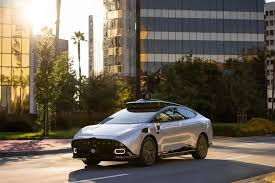
Beyond the powertrain, the Robocar’s design philosophy prioritizes user experience and autonomous functionality. Its coach-style, center-closing doors are fully powered and equipped with an array of sensors, preventing unintended contact with obstacles or other vehicles. This seemingly minor detail underscores Tensor’s holistic approach to autonomous design, where every component is optimized for a future where human interaction with the vehicle’s exterior may be minimal.
True Level 4 Autonomy: A Paradigm Shift for Private Ownership
The most compelling aspect of the Tensor Robocar is its designation as an SAE Level 4 autonomous vehicle. For the uninitiated, Level 4 represents a significant leap beyond the Level 2+ and Level 3 systems currently available, such as Tesla’s Full Self-Driving (Supervised) or Mercedes-Benz’s DRIVE PILOT. While those systems require constant driver attention or readiness to intervene, a Level 4 vehicle can operate entirely autonomously under specific conditions (e.g., geofenced areas, certain weather conditions) without any human input. It even includes the critical fail-safe: if the system encounters an issue it cannot resolve, it will safely pull over and stop.
What sets Tensor apart is its commitment to delivering this capability in a vehicle you can own. Unlike Waymo’s driverless taxis or Cruise’s robotaxi fleets, which are services, the Robocar is a product. You can park it in your driveway, manage its operations, and have direct control over your personal mobility solution. This is not merely an upgrade; it’s a redefinition of car ownership for the autonomous age.
Crucially, Tensor developed the Robocar from the ground up as an autonomous platform, a stark contrast to many manufacturers who adapt existing vehicle architectures. This “clean sheet” approach, initiated in 2020 shortly after their robotaxi services launched, allowed Tensor to deeply embed sensor integration, computing power, and redundancy into the vehicle’s very DNA, rather than retrofitting components onto a conventional car. This holistic design is fundamental to achieving the robust, reliable Level 4 performance Tensor promises.
Unparalleled Sensory Suite and Edge AI Computing
Achieving true Level 4 autonomy in a production vehicle demands an extraordinary array of sensors and immense computational muscle. The Tensor Robocar is a veritable rolling supercomputer, fitted with over 100 sensors. This includes five Lidar arrays – one prominently positioned on the roof for a 360-degree, nearly 1,000-foot detection range, complemented by four others strategically placed around the vehicle’s front, sides, and rear. These are bolstered by 37 high-resolution cameras, 11 radar units, and 10 ultrasonic sensors, creating a comprehensive, multi-modal perception system. This layered approach ensures robustness against individual sensor failures and diverse environmental conditions, a cornerstone of cutting-edge vehicle safety systems.
Maintaining the integrity of this sensory suite is paramount. Tensor has gone to remarkable lengths, incorporating 30 washer nozzles, 13 mini wipers, and integrated heating elements to combat fogging, snow buildup, and dirt. Taking a cue from their extensive robotaxi experience, the Robocar even features physical covers that automatically retract over the sensors when the vehicle is powered down, protecting them from damage and environmental wear – a practical innovation born from years of operational insight.
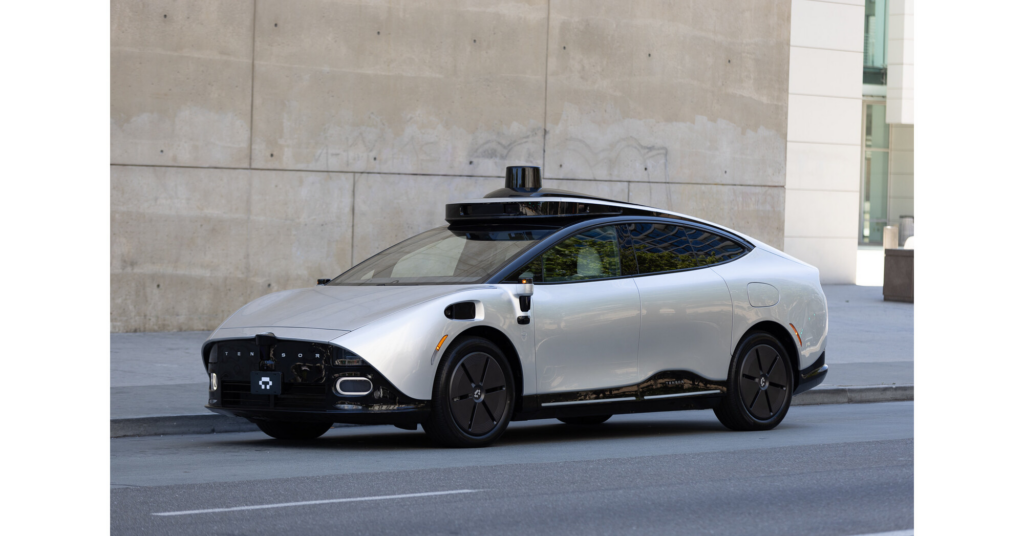
The processing power behind this sensory deluge is equally impressive. The Robocar houses a massive onboard computer featuring eight Nvidia Drive Thor-X chips, capable of a staggering 8,000 TOPS (trillion operations per second). While the vehicle maintains redundant cloud connectivity via three communication channels, the vast majority of its computing is performed locally, at the edge. This edge computing autonomous vehicles architecture ensures reliable operation even in areas with limited or no 5G signal, a critical consideration for real-world deployment across diverse geographies.
Tensor’s proprietary Foundation Model software is driven by a sophisticated AI-powered engine. This system operates two parallel processing streams: one meticulously trained on the data and nuances of professional human drivers, and another utilizing a Visual Language Model (VLM) specifically designed to analyze and resolve unusual or “edge case” scenarios that might confound traditional rule-based systems. This dual-pronged approach is pivotal for achieving robust performance in complex, unpredictable environments, enabling the Robocar to safely navigate in challenging conditions like rain and snow – expanding its usability far beyond the sunny climes often associated with early autonomous vehicle testing.
For enhanced pedestrian safety and communication, the Robocar also features external displays on its lower corners. These screens will broadcast simple messages and pictograms, informing pedestrians that the vehicle is operating autonomously and has detected their presence – a vital component for building trust and ensuring safe human-robot interaction in urban settings.
Your Car, Your Data: Prioritizing Privacy in a Connected World
In an era of increasing concern over vehicle cybersecurity and data privacy in connected cars, Tensor has made a significant statement. By performing the bulk of its AI processing onboard, the Robocar drastically reduces the need for constant data offloading to the cloud. Owners must explicitly opt-in for any data sharing with Tensor’s cloud infrastructure. Otherwise, all personal and vehicle operational data remains securely within the car itself. This level of owner control extends to accessing and deleting all biometric data – such as facial and palm recognition, which are used for vehicle operation and theft prevention – directly through the car’s interface or a dedicated smartphone app.
Even the Robocar’s interior cameras and microphones, designed for driver monitoring during manual operation and interaction with the voice assistant, come with physical covers and dedicated off switches. This commitment to user control and privacy sets a new benchmark in the automotive data privacy solutions space, distinguishing Tensor in a market where data collection often feels ubiquitous and opaque.
Conversational AI: Your Intelligent Co-Pilot
Beyond autonomous driving, the Tensor Robocar redefines the in-car experience through its advanced Agentic AI, powered by a sophisticated Large Language Model (LLM). This isn’t your typical voice command system; it’s designed for natural, conversational interaction. Instead of rigid commands, you can engage in a fluid dialogue with your car about your destination, preferences, and needs.
This intelligent co-pilot extends its capabilities to remote interaction. You can summon your Robocar from anywhere with a simple call or text message, directing it to your location. Furthermore, the system learns your habits, anticipating upcoming trips and even pre-conditioning the battery or suggesting charging stops if connected to your calendar. This integration of AI-powered personal assistant car technology transforms the vehicle from a mere mode of transport into a truly intuitive, proactive partner in your daily life.
The Hybrid Driving Experience: Autonomy on Demand
While the Tensor Robocar is built for autonomy, Tensor understands the enduring human desire for control. Owners retain the option to drive manually whenever they choose. The vehicle provides a spectrum of advanced driver-assistance systems (ADAS), from basic automatic emergency braking to sophisticated Level 3 semi-automated driving, allowing for hands-free operation while still requiring driver readiness.
When you’re ready to embrace full autonomy, a simple command transforms the cockpit. The steering wheel gracefully retracts into the dashboard, and the center infotainment screen slides over to conceal it, creating a vast, open space (the passenger screen remains in place for their enjoyment). The accelerator and brake pedals also retract, maximizing comfort and space. If you decide to take the reins again, these controls seamlessly reappear, ready for your input.
This entire drive system, encompassing steering, braking, and acceleration, is “by-wire,” meaning there are no direct physical connections. This digital architecture enables the seamless transition between autonomous and manual modes and, critically, facilitates multiple layers of redundancy. Every critical system, from sensors to drive actuators, features backups, ensuring the car can continue to operate safely even in the unlikely event of a component failure. This commitment to redundancy in autonomous systems is a non-negotiable for Level 4 deployment. Rear-wheel steering, allowing the back tires to turn up to 7 degrees, further enhances maneuverability, giving the substantially sized Robocar a claimed 37-foot turning circle, comparable to a compact SUV like a Tesla Model Y.
Safety remains paramount. Tensor is targeting top crash safety scores from leading regulatory bodies globally, including the NHTSA and IIHS in the US, and the European NCAP, reinforcing its dedication to occupant protection regardless of driving mode.
Make Your Car Work for You: The Future of Car Ownership Models
Tensor isn’t just selling a car; it’s offering a glimpse into future car ownership models. The company has already forged a partnership with Lyft to integrate Robocars into its luxury rideshare fleet. But the vision extends to private owners as well. Remember Elon Musk’s long-standing promise that Tesla owners could monetize their vehicles by deploying them as autonomous taxis while they’re at work or asleep? Tensor is making a similar proposition, and with the measured rollout of other robotaxi services, they might just bring this vision to fruition for private individuals first.
While specific details on how a privately owned Robocar would integrate into a rideshare network (presumably through an existing platform like Lyft) are still pending, the potential for owners to generate passive income from their luxury autonomous vehicle is an intriguing prospect, blending personal mobility with investment opportunities. This dual utility could significantly impact the total cost of ownership and make the Robocar an even more attractive proposition in the long term.
The Price of Pioneers: Luxury, Production, and the Road to 2027
As for the inevitable question of cost, Tensor remains tight-lipped on exact figures, though their head of marketing hints at “luxury pricing.” Given the groundbreaking technology and the Level 4 autonomous capabilities, industry experts, drawing parallels to the estimated cost of Waymo’s vehicles (often cited between $150,000 and $200,000), anticipate the Tensor Robocar to fall on the higher end of that spectrum, aligning with other premium EV features 2025 offerings.
Production of the Robocar will be handled by Vietnamese automaker VinFast at its state-of-the-art facility in Haiphong, Vietnam. While VinFast vehicles have faced scrutiny regarding build quality in the US market, it’s crucial to remember their extensive experience in assembling BMWs under license for many years. This background suggests a foundational capability in precision manufacturing that Tensor is undoubtedly leveraging.
The rollout will be strategic. Production is set to commence in late 2026, with the first deliveries targeting the UAE in the fourth quarter of that same year. US deliveries are slated to begin in early 2027, pending crucial regulatory approval for autonomous vehicles. Beyond that, Tensor has ambitious plans for expansion into the European Union and has already announced an agreement to supply vehicles to a rideshare service in Denmark, highlighting their global aspirations for sustainable transportation investment.
One final, practical consideration for the autonomous future: who bears responsibility for tickets incurred while the car is driving itself? While regulatory frameworks are still evolving, the current assumption, at least for the foreseeable future, remains with the owner. It’s a detail that underscores the ongoing dialogue between autonomous driving technology and our existing legal paradigms.
The Future Beckons: Are You Ready for Personal Autonomy?
The Tensor Robocar isn’t just another car; it’s a statement. It’s a testament to a decade of relentless innovation in autonomous vehicle technology and a bold step towards redefining what personal mobility means in the 21st century. As we look towards 2027, Tensor is offering a tangible vision of a world where luxury, freedom, and cutting-edge intelligence converge in your driveway.
For those who have keenly followed the developments in AI in automotive, Lidar sensor development, and the broader future of transportation investment, the Robocar represents a pivotal moment. It’s an opportunity to embrace the next generation of freedom, safety, and convenience.
Don’t miss out on this transformative journey. Explore the possibilities of the Tensor Robocar and join the conversation about the future of truly personal autonomy today.