



Revolutionizing Automotive Computing: Drako DriveOS and the Future of Affordable Performance
The automotive landscape of the mid-2020s is undeniably complex and costly. Vehicles today are sophisticated marvels of engineering, but their escalating price tags and intricate systems often leave consumers questioning the value proposition. Yet, a paradigm shift is brewing, spearheaded by innovators with deep roots in the semiconductor industry. Dean Drako and Shiv Sikand, co-founders of IC Manage – a firm instrumental in managing design data for silicon chipmakers – have channeled their expertise and significant financial success into Drako Motors. Their ambitious goal? To fundamentally alter how vehicles, from the most exclusive hypercars to everyday commuters, are engineered and built. Their ten-year endeavor has culminated in a groundbreaking operating system, Drako DriveOS, designed to streamline automotive electronics, enhance performance, and drastically reduce manufacturing costs.
From Silicon Valley to the Supercar Circuit: The Genesis of Drako DriveOS
The journey of Drako Motors began not with a grand automotive vision, but with a pragmatic solution for the burgeoning complexities of chip design. IC Manage’s success provided the financial bedrock for a passion project born from a shared belief: the automotive industry’s traditional approach to electronic architecture was ripe for disruption. Their initial proposition for Drako DriveOS echoed a familiar refrain in the world of advanced automotive tech: a centralized computing platform that communicates directly with sensors and actuators, thereby minimizing latency for superior performance, enhanced safety, and robust cybersecurity. This concept mirrors the ambition behind advanced single-brain architectures like BMW’s “Heart of Joy,” but Drako aims to elevate it to an entirely new level.
The most exhilarating way to demonstrate the transformative potential of their operating system, they reasoned, was within a high-performance electric vehicle. This led to the development of a 1,200-horsepower, four-motor electric hypercar – the Drako GTE. This vehicle wasn’t merely a showcase; it was a meticulously engineered testbed for Drako DriveOS, enabling precise torque vectoring to each wheel while simultaneously managing all safety, infotainment, and driving dynamics functions. Intriguingly, the GTE’s development necessitated collaboration with Pankl Racing Systems for ultra-high-strength half-shafts, a partnership that has since seen Pankl become a key supplier to other electric hypercar manufacturers, underscoring the advanced engineering that Drako’s project helped pioneer.
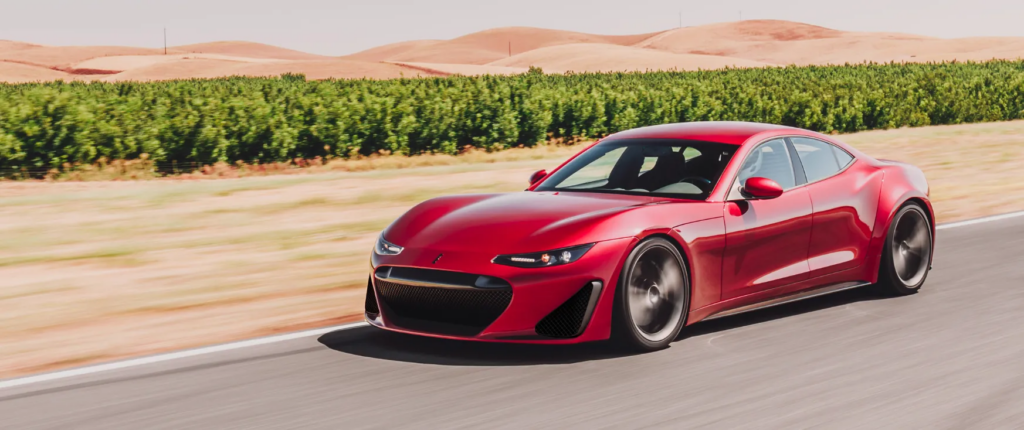
The Drako GTE and Dragon: Proofs of Concept on Wheels
To accelerate development and demonstrate their core technology, the initial Drako GTE sedan was built upon the chassis of the Fisker Karma. However, this was merely a starting point. The GTE underwent a radical transformation, featuring a complete electrification with a 90 kWh battery pack integrated into the former transmission tunnel and beneath a raised floor. Producing a colossal 1,200 horsepower, this hypercar was initially slated for a limited production run of 25 units, with a price tag of $1.25 million. The first GTE is now entering production, a testament to the team’s unwavering dedication. Following the GTE, Drako Motors unveiled plans for the Dragon, a more accessible five-seat SUV. Boasting a formidable 2,000 horsepower and featuring distinctive gullwing doors, the Dragon is positioned with a more attainable $300,000 price point. While these vehicles are undoubtedly headline-grabbing, their primary purpose is to serve as tangible embodiments of the revolutionary Drako DriveOS.
The Escalating Cost of Automotive Software: A Looming Crisis
A stark reality facing the automotive industry is the exponential growth in software’s contribution to a vehicle’s overall cost. In 1980, software constituted a mere 10 percent of a car’s total price. Fast forward to the present decade, and this figure has surged to between 30 and 40 percent. Projections indicate that the increasing integration of advanced safety systems and autonomous driving capabilities will push this percentage to a staggering 50 percent by 2030. This trend presents a significant challenge, as the traditional methods of automotive electronics development are proving increasingly unsustainable and costly. The reliance on a multitude of specialized ECUs (Electronic Control Units), each with its own proprietary operating system and communication protocols, creates an extraordinarily complex and expensive web of hardware and software. This intricate system also presents significant vulnerabilities for cybersecurity threats.
Rethinking Automotive Electronics: Drako DriveOS vs. Legacy Architectures
The automotive industry has, for the most part, resisted the broader technological trend seen in computing: the consolidation of dozens or even hundreds of specialized microcontrollers into a few powerful, commodity processor cores, akin to those found in personal computers, gaming consoles, and smartphones. This resistance stems from several factors, chief among them a perceived lack of deep software engineering talent within traditional automotive manufacturers. Furthermore, existing mainstream operating systems like Windows and Linux, while ubiquitous and powerful, are generally not designed for the deterministic, real-time processing demands of safety-critical automotive applications. The interruption of a critical braking command by a non-essential system, such as a tire pressure monitor or infotainment update, is simply unacceptable.
Historically, the safest and most expedient solution for automakers has been to delegate the development of specific functionalities to Tier 1 suppliers. Each supplier would then create bespoke, dedicated controllers for features ranging from anti-lock braking and airbag deployment to seat massagers and even integrated scent dispensers. This approach, while ensuring functional isolation, has resulted in a bewildering array of dedicated ECUs – often numbering in the hundreds – interconnected by miles of complex wiring. This “spaghetti wiring” not only adds significant weight and assembly complexity but also creates an alarming number of “attack surfaces,” vulnerabilities through which hackers can potentially gain access to a vehicle’s communication networks. Incidents involving remote access through vehicle infotainment systems or even through seemingly innocuous components like headlamps highlight the persistent cybersecurity challenges inherent in this fragmented architecture.
The Drako DriveOS Solution: Unifying and Securing Automotive Computing
The fundamental challenge with traditional operating systems like Linux in automotive applications is their non-deterministic nature. While Linux is incredibly versatile and forms the backbone of much of the digital world, it cannot guarantee the precise, millisecond-level timing required for safety-critical functions. Processing inputs from a rain sensor, for instance, could potentially interrupt a critical command related to steering or braking, leading to dangerous consequences.
This is precisely where Drako DriveOS, developed in collaboration with Boston University’s Richard West, introduces a revolutionary solution. The core innovation lies in its novel kernels and data pipes. Kernels, the fundamental building blocks of any operating system, act as intermediaries between a computer’s hardware and its software applications, managing crucial system resources. Drako’s kernel functions as a hypervisor, creating a secure and consistent environment for applications to interact with the underlying hardware.
The true breakthrough, however, is the proprietary “data pipe.” This innovative mechanism creates a direct, memory-based connection between the safety-critical processor and the silicon responsible for receiving safety-critical data. This effectively creates a secure, isolated “digital fortress” for essential functions, preventing them from being disrupted by less critical operations. This allows Drako DriveOS to leverage the broad capabilities and development ecosystem of Linux for non-critical tasks while ensuring that safety systems operate with the absolute determinism and reliability demanded by the automotive environment. This architectural innovation promises not only enhanced performance and safety but also significant cost reductions by simplifying the overall electronic architecture.
Streamlined Communication and Substantial Cost Savings
Drako DriveOS is engineered for flexibility, capable of interfacing with actuators and sensors using the diverse protocols prevalent in today’s automotive industry, including Ethernet, CAN, Flexray, and LIN. However, these legacy protocols often come with their own set of limitations. Typically, the main processor must translate or convert commands before transmitting them and again upon receiving responses. This translation process, coupled with the relatively slow data transmission rates of many of these protocols, introduces inherent latency. Shiv Sikand notes that even high-speed Ethernet typically exhibits a response time of around 514 microseconds, while USB can achieve as low as 108 microseconds in current implementations.
The genius of Drako DriveOS lies in its strategic adoption of readily available USB technology. Every modern Intel processor natively supports the USB communication and control protocol, the same protocol that enables your computer to recognize your mouse or keyboard. This direct integration eliminates the need for costly translation layers, allowing the central processor to send commands directly to devices. Furthermore, by incorporating simple, inexpensive pin connectors near the actuators and sensors, Drako eliminates the need for custom silicon required by many proprietary networks. Sikand estimates this can translate into savings of $4 to $10 per connection. The future of autonomous driving, with its insatiable demand for high bandwidth, will further necessitate a shift towards protocols like USB. USB 5, for instance, is projected to deliver an astounding 80 gigabits per second, a stark contrast to CAN XL’s maximum of 20 megabits per second, even after data compression. Commodity cameras, a cornerstone of advanced driver-assistance systems (ADAS) and autonomous driving, already natively communicate over USB, further simplifying integration and reducing costs.
Enhanced Cybersecurity: A Fortified Digital Fortress
The traditional automotive electronic architecture, with its multitude of interconnected ECUs and complex wiring looms, presents a significant cybersecurity challenge. Each point of connection represents a potential entry point for malicious actors. Drako DriveOS, by consolidating the vehicle’s electronic brain into a single, powerful PC core, drastically reduces the overall “attack surface.” More importantly, because USB is fundamentally an infrastructure designed for device control and not merely a communication protocol, the Drako DriveOS software can establish its own proprietary communication protocols. This layered security approach makes it exponentially more difficult for hackers to penetrate the vehicle’s systems compared to exploiting well-understood industry-standard protocols like CAN or Ethernet. This enhanced cybersecurity is not just a feature; it’s a critical necessity as vehicles become more connected and reliant on software.
The Drako Vision: Democratizing Automotive Innovation
Shiv Sikand encapsulates the Drako Motors mission with a compelling analogy: “Bill Gates put a PC on everyone’s desk, and everyone’s still got one on their desk. We want to put another one in their car.” Drako Motors is not driven by exclusivity; their goal is to democratize the benefits of their advanced operating system. They envision a future where the performance enhancements, cost savings, and improved safety offered by Drako DriveOS are accessible across a wide spectrum of vehicles. Their licensing model is designed to be economically viable, proposing a modest fee of a few hundred dollars per vehicle. Across the vast global car market, estimated at tens of millions of units annually, this approach would represent a substantial return on the millions invested in developing DriveOS, while simultaneously making advanced automotive technology more affordable for consumers.
Having personally experienced the palpable improvements in cornering, acceleration, and braking afforded by reduced latency in vehicles like the BMW iX3, and knowing the discerning taste of Shiv and Dean, evidenced by their collection of automotive icons like the Ferrari 288 GTO and their passion for exploring California’s scenic routes, one can confidently assert that their expertise in leveraging silicon technology to elevate vehicle performance is second to none. The integration of Drako DriveOS promises not just incremental improvements but a fundamental redefinition of what’s possible in automotive engineering, making advanced features accessible and achievable for a wider audience.
The automotive industry stands at a pivotal juncture. The escalating costs and complexities of traditional electronic architectures are unsustainable. Drako DriveOS offers a compelling vision for the future – a future where cutting-edge performance, robust safety, and advanced cybersecurity are not confined to the realm of ultra-exclusive hypercars but can be seamlessly integrated into vehicles of all segments.
Are you a manufacturer looking to redefine your vehicle’s electronic architecture, enhance performance, and significantly reduce production costs? Discover how Drako DriveOS can empower your next generation of automotive innovation. Contact us today to explore a partnership and unlock the future of intelligent, affordable, and secure automotive computing.