



Hyundai Crater Concept: Forging the Future of Electric Off-Road Dominance for 2025
The automotive landscape for 2025 is a crucible of innovation, constantly reshaped by electrification, sustainable design, and an insatiable demand for authentic adventure. In this dynamic environment, Hyundai has once again made a resounding statement, pulling back the curtain on the aggressively styled Crater concept at the Los Angeles Auto Show. This isn’t just another show car; it’s a robust, purpose-built electric off-roader that stares unblinkingly into the future of the brand’s burgeoning XRT subbrand, signaling a seismic shift in how we perceive rugged utility vehicles. For seasoned enthusiasts and industry watchers alike, the Crater represents a pivotal moment, a clear declaration of Hyundai’s intent to carve out a dominant niche in the burgeoning electric adventure vehicle segment.
For years, the XRT badge adorned Hyundai SUVs, initially serving as little more than an aesthetic package – a subtle nod to off-road aspirations without serious mechanical enhancements. While models like the Santa Fe and Tucson XRT offered a rugged appearance, their capabilities remained largely within the confines of mild trail excursions. However, Hyundai’s commitment deepened with the Palisade XRT Pro, which introduced more substantial upgrades, hinting at a bolder direction. The Crater concept, however, isn’t just an evolution; it’s a revolution. It embodies a holistic vision for an electric off-road SUV that seamlessly blends extreme capability with cutting-edge technology and a progressive design philosophy, setting a new benchmark for rugged electric vehicles and future adventure machines.
I. Reshaping the Off-Road Narrative: Hyundai’s XRT Ambition
The year 2025 finds consumers increasingly seeking vehicles that offer more than just transportation; they demand experiences. This paradigm shift has fueled a dramatic surge in the off-road EV market, where capability meets sustainability. Hyundai’s XRT subbrand, once a nascent experiment, is now poised to become a formidable player, and the Crater concept is its North Star. It’s a strategic move to position Hyundai not just as a provider of efficient urban crossovers, but as a serious contender in the hard-core adventure segment, challenging established players and emerging EV specialists alike. This concept isn’t merely showcasing a design; it’s laying the groundwork for a future lineup of Hyundai off-road capabilities that are both environmentally conscious and genuinely thrilling.
The Crater signals Hyundai’s understanding that true off-road enthusiasts desire uncompromising performance, regardless of powertrain. It embraces the inherent advantages of electric propulsion – instant torque delivery, silent operation, and precise motor control – to redefine what’s possible on challenging terrain. By combining these attributes with a fiercely durable platform and innovative cabin technology, Hyundai is painting a vivid picture of a future where adventure is electrifying, accessible, and deeply engaging. This bold step demonstrates EV innovation isn’t confined to sleek sedans; it’s aggressively expanding into the wilderness, promising next-gen adventure vehicles that are as responsible as they are capable.
II. The “Art of Steel” Design: Form Meets Uncompromising Function
The visual impact of the Crater concept is immediate and arresting. It showcases Hyundai’s latest “Art of Steel” design language, a philosophy first glimpsed on the Initium concept and subsequently realized in the second-generation Nexo. This design ethos celebrates industrial aesthetics, emphasizing raw strength, geometric precision, and an unyielding sense of purpose. For the Crater, this translates into a crisp, angular, and powerfully expressive form that is unmistakably built for the wilderness. The exterior is a masterclass in sustainable automotive design, blending aesthetic appeal with practical functionality crucial for extreme environments.
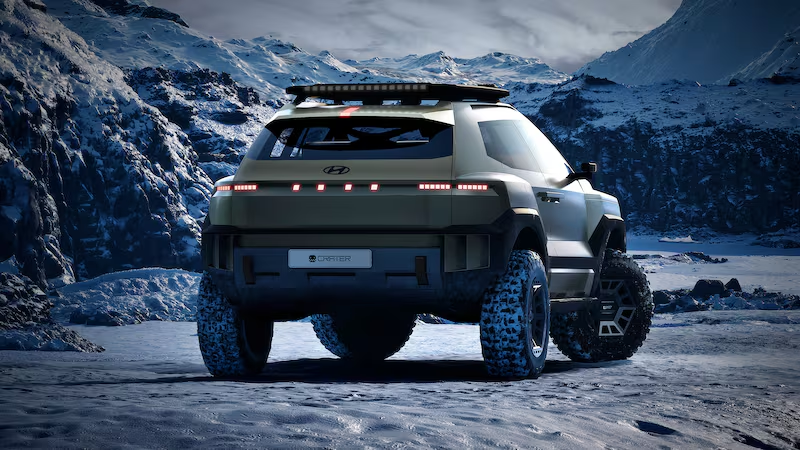
Every element of the Crater’s design speaks to its off-road intentions. Short overhangs, both front and rear, are immediately apparent, meticulously engineered to provide exceptional approach and departure angles – critical metrics for navigating steep inclines and declines without scraping bodywork. The chunky bumpers, integrated seamlessly into the design, are more than just aesthetic additions; they house substantial metal skid plates, offering vital underbody protection against rocks, roots, and unforeseen obstacles. Adding a vibrant touch of functionality, integrated orange tow hooks punctuate the bumpers, ready for recovery operations. In a delightful nod to practicality and charm, one of the front tow hooks cleverly doubles as a bottle opener, complete with the subtle, robotic face of “Crater Man” – a delightful mascot we’ll delve into later. This attention to detail elevates the Crater beyond a mere utility vehicle; it imbues it with personality and thoughtful design.
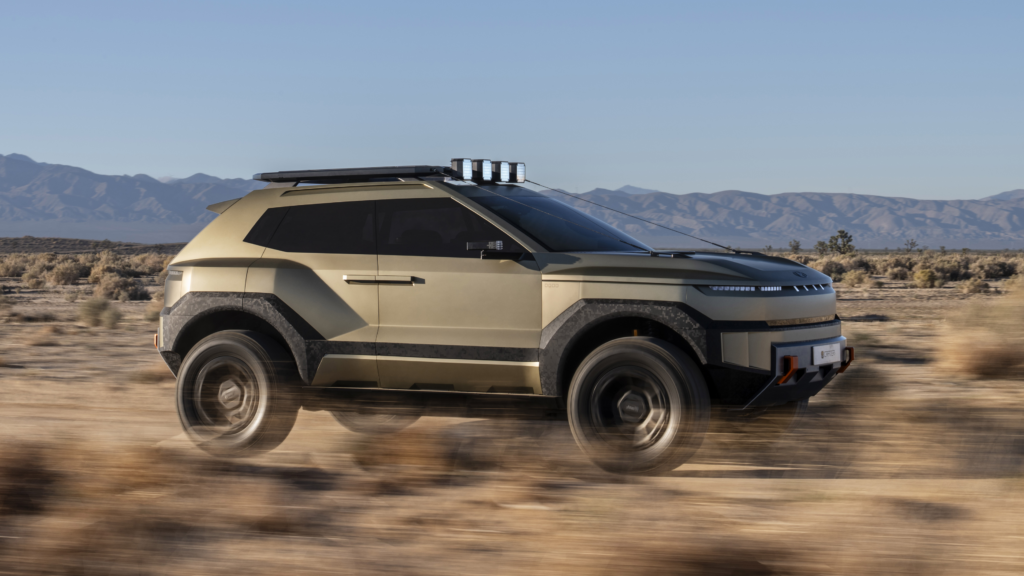
The aggressive stance of the Crater is further accentuated by its formidable wheel and tire package. The elevated ground clearance isn’t solely a product of a robust, raised suspension; it’s significantly bolstered by a set of truly gnarly, 33-inch all-terrain tires. These muscular tires, designed for maximum grip and durability across diverse surfaces, wrap around robust-looking 18-inch wheels. Hyundai’s design team drew inspiration from a compelling visual: “a hexagonal asteroid impacting a sheer metal landscape,” leaving a distinct crater in its wake. This conceptual origin manifests in the wheels’ unique hexagonal shape, reinforcing the vehicle’s rugged, almost extraterrestrial aesthetic. Further enhancing its trail-ready demeanor, the black wheel arches and body trim feature the distinctive “pixel camo” finish, a motif familiar from the Ioniq 5 XRT’s bumpers, harmonizing the Crater with Hyundai’s broader EV design language.
Signature pixelated lighting, a hallmark of Hyundai’s current EV lineup, extends across the Crater. The headlights and taillights feature this retro-futuristic pixelated look, providing excellent illumination while maintaining a distinctive brand identity. Even the side-view mirrors adopt this pixelated style, though here, they reveal a practical innovation: they are actually high-definition cameras. While outdated legislation in the United States has historically prevented these advanced EV technology features from widespread adoption, Hyundai already implements camera mirrors in its home market on models like the Nexo. On the Crater concept, these camera mirrors offer enhanced visibility and a practical twist: they are detachable, capable of serving as powerful flashlights for night operations or as rugged cameras to document your wilderness adventures. This thoughtful integration underscores Hyundai’s commitment to combining advanced tech with real-world utility.
III. Electrifying the Trail: A Powertrain for the Future
While Hyundai has remained tight-lipped on specific powertrain details for the Crater, confirming only that it is a pure electric vehicle (EV), this revelation alone unlocks a universe of possibilities for premium off-road performance. The inherent characteristics of electric powertrains are exceptionally well-suited for off-road applications. The instant, immense torque delivered by electric motors provides unparalleled control over difficult terrain, allowing for precise throttle modulation over rocks and through mud, significantly reducing the risk of wheel spin. The near-silent operation transforms the off-road experience, allowing adventurers to immerse themselves more fully in the natural environment without the roar of an internal combustion engine.
We can surmise that the Crater would feature a sophisticated all-wheel-drive (AWD) system, likely employing multiple electric motors to provide independent power delivery to each axle, or even individual wheels for ultimate traction control. The mention of front and rear locking differentials confirms its serious off-road intent, ensuring maximum traction by distributing power evenly when one or more wheels lose grip. Hill descent control and trailer brake control are essential tools for managing challenging inclines and towing capabilities, and their integration further solidifies the Crater’s credentials as a truly capable electric off-road SUV.
For 2025, battery technology would have advanced significantly, offering improved energy density and faster charging capabilities. While specific range figures remain speculative, Hyundai would undoubtedly aim for a robust range suitable for extended off-road excursions, potentially incorporating ultra-fast charging architectures. The strategic placement of the battery pack, typically low in the chassis, contributes to a lower center of gravity, enhancing stability on uneven terrain – a crucial advantage for any off-roader. The Crater would likely face competition from the likes of the upcoming Jeep Recon EV and the established Rivian R1S, both demonstrating the growing appetite for future Hyundai SUVs that are both powerful and sustainable. Hyundai’s advantage would lie in its distinctive design, innovative interior tech, and potentially a more accessible price point compared to premium rivals, expanding the off-road EV market to a broader audience.
IV. Beyond the Beaten Path: Advanced Adventure Tech
The Crater concept is equipped with a comprehensive suite of advanced EV technology and practical gear designed to enhance the off-road experience and ensure readiness for any situation. Limb risers, those essential cables stretching from the hood to the roof, are cleverly integrated to deflect pesky tree branches and brush away from the windshield and bodywork, preserving visibility and preventing cosmetic damage on overgrown trails. A sleek, low-profile roof rack not only adds to the vehicle’s rugged aesthetic but also provides crucial additional cargo capacity for gear, recovery equipment, or even a rooftop tent. Integrated auxiliary lights, mounted strategically on the roof rack, project powerful beams to illuminate the trail ahead, transforming night drives into confidently navigated expeditions. These lights, like the main head and taillights, incorporate Hyundai’s distinctive pixelated design, a visually cohesive touch.
Beyond physical hardware, the Crater likely integrates advanced connectivity solutions vital for wilderness exploration. Satellite communication systems could provide essential lifeline capabilities in areas without cellular service, crucial for emergency situations or maintaining contact. Advanced, off-line capable navigation systems would offer detailed topographical maps and trail data, allowing adventurers to plan and execute complex routes. Furthermore, the integration of detachable camera mirrors as both flashlights and adventure recorders is a testament to Hyundai’s focus on multi-functional utility, blurring the lines between vehicle features and personal gear. This holistic approach to Hyundai off-road capabilities ensures that drivers are not just equipped, but empowered for their adventures.
V. The Command Center: A Radical Interior Experience
Stepping inside the Crater concept reveals an interior that is both tough and surprisingly inviting, defying the often-spartan nature of traditional off-roaders. The most striking feature is the integrated roll cage, a visible testament to the vehicle’s commitment to occupant safety and structural rigidity in demanding environments. Yet, despite its utilitarian purpose, the cabin exudes comfort, upholstered in a sophisticated mix of black leather and Alcantara – materials chosen for their durability, tactile quality, and ease of cleaning after dusty excursions. The seats themselves are a design marvel, composed of a series of cylindrical elements inspired by the ergonomic comfort of sleeping bags, offering both support and flexibility. Each seat is equipped with four-point harnesses, providing enhanced security during aggressive off-road maneuvers.
The roll cage isn’t just a safety feature; it cleverly doubles as a built-in grab handle, aiding ingress and egress into the rear seats. Throughout the cabin, a subtle yet pervasive orange ambient lighting bathes the doors and dashboard, creating a warm, adventurous glow that enhances visibility and mood during nighttime journeys. This thoughtful design demonstrates a focus on the user experience, acknowledging that even in rugged vehicles, comfort and aesthetics matter.
The Paradigm Shift: Head-Up Display as the Primary Interface
One of the most audacious design decisions within the Crater’s cabin is the complete absence of a traditional, large infotainment screen in the center dashboard. Instead, Hyundai has embraced a radical paradigm shift, utilizing a head-up display (HUD) that spans the entire width of the windshield as the primary interface for key information. While smaller, contextual displays are present, the majority of critical driving data, navigation prompts, and infotainment visuals are projected directly into the driver’s line of sight. Our experience with the concept revealed a crisp, easy-to-read image, offering an immersive digital cockpit experience.
As seasoned experts, we appreciate the potential of such a system to minimize driver distraction by keeping eyes on the road (or trail). However, it also raises questions about information density and potential cognitive overload, a challenge Hyundai would undoubtedly address through intuitive UI/UX design. By 2025, augmented reality (AR) integration into HUDs would be increasingly common, and the Crater’s setup is perfectly positioned for this, capable of overlaying navigation arrows, obstacle warnings, and trail markers directly onto the real-world view.
Despite this futuristic approach, Hyundai judiciously maintains a suite of physical controls for critical functions. Cylindrical, gear-like elements allow for tactile adjustment of the all-wheel-drive system and differentials, ensuring reliable operation even with gloved hands or on bumpy trails. A series of dedicated buttons below manage the climate controls, emphasizing safety and ease of use over purely digital interfaces. The squarish steering wheel, another nod to modernity and control, houses intuitive buttons for switching between various drive modes: Snow, Sand, Mud, Auto, and a dedicated XRT mode, each optimizing the vehicle’s performance for specific conditions.
The cabin is also thoughtfully equipped with practical adventure-ready amenities. A clearly visible first aid kit and a fire extinguisher are integrated, underscoring safety and preparedness. A highlight for the modern adventurer is the removable Bluetooth speaker on the center console, a feature already popular in models like the Toyota Tacoma and 4Runner. This allows users to take their music or podcasts with them from the vehicle to the campsite, seamlessly extending the in-car experience into the outdoor environment.
VI. Engaging the Adventurer: Gamification and Immersion
The Crater concept goes beyond mere utility, integrating elements of gamification and immersive experiences to create a truly unique and personalized cabin. Crater Man, the endearing robotic mascot seen on the exterior tow hook, plays a central role in this digital ecosystem, appearing as a character in the interactive modes.
One of the most engaging features is the “Game Mode,” which transforms the full-width head-up display into an interactive platform game. Crater Man’s animated face becomes the protagonist, moving across virtual platforms, and the player interacts by pressing one of the smaller console displays to make him jump. This playful integration fosters a sense of fun and engagement, particularly during downtime at a campsite or during long waits.
The “Music Mode,” meanwhile, allows occupants to unleash their creativity. An electronic song plays, while the four smaller cabin screens transform into interactive drum pads, each triggering different drum sounds that can be added to the mix. This turns the cabin into a collaborative musical playground, fostering entertainment and interaction.
Perhaps most innovative is the “Camp Mode,” designed to enhance the outdoor experience even when stationary. This mode offers a selection of immersive simulations that utilize the expansive HUD and premium audio system. Users can choose to transform the head-up display into a simulated campfire, complete with the mesmerizing flicker of burning logs and the realistic crackle of wood playing over the speakers. Alternatively, a depiction of rainfall can be activated, accompanied by the soothing roar of precipitation, creating a calming ambiance. For those seeking enhanced awareness, a “night vision trail cam” option turns the HUD into a live feed, displaying the environment surrounding the camp in real-time, offering peace of mind and an extended view of your surroundings. These features elevate the Crater from a vehicle to an interactive sanctuary, a mobile base camp designed for ultimate relaxation and engagement.
VII. The Road Ahead: What the Crater Concept Means for Hyundai XRT
The Hyundai Crater concept is not merely a flight of fancy; it’s a tangible vision, a crystal ball peering into the future Hyundai SUVs and the trajectory of the XRT subbrand. It’s a powerful statement of intent, unequivocally declaring Hyundai’s seriousness about taking XRT far beyond mere appearance packages. While there are no immediate production plans for the concept as shown, its design language, technological innovations, and philosophical underpinnings will undoubtedly trickle down into future XRT models, dramatically enhancing their capabilities and appeal.
We can anticipate that future production XRT vehicles will adopt the “Art of Steel” design philosophy, imbuing them with a more aggressive, purposeful aesthetic. The concept’s focus on advanced EV traction control and robust off-road hardware like locking differentials will likely become standard on top-tier XRT trims. Furthermore, the innovative digital cockpit experience, particularly the emphasis on advanced HUD technology and the unique in-cabin entertainment features, could redefine user interaction across Hyundai’s entire adventure lineup.
The Crater clearly positions Hyundai to directly challenge emerging electric off-road SUV contenders like the Jeep Recon and solidify its place alongside existing adventure titans. It suggests that Hyundai is not just building vehicles; it’s crafting comprehensive adventure platforms, integrating sustainability with uncompromised capability. The long-term vision is clear: to offer a range of sustainable, capable, and technologically sophisticated adventure vehicles that cater to the evolving demands of the modern explorer. For those seeking to venture further off the beaten path, the future, as envisioned by the Crater, is electrifying, engaging, and exceptionally bold.
Embrace the Future of Adventure
The Hyundai Crater Concept has illuminated a thrilling path forward for rugged electric vehicles and the burgeoning XRT subbrand. It’s a bold declaration that sustainable mobility and uncompromising off-road capability can, and will, coexist. As we look towards 2025 and beyond, this concept stands as a testament to Hyundai’s relentless pursuit of innovation and its commitment to delivering exhilarating, responsible adventure vehicles.
Are you ready to explore the electrifying future of off-roading? Stay tuned to Hyundai’s official channels and visit your local dealership to discover how the spirit of the Crater concept is already shaping the next generation of adventure-ready SUVs.