



The Dawn of Personal Autonomy: Tensor’s Robocar Reimagines Private Transportation for 2027
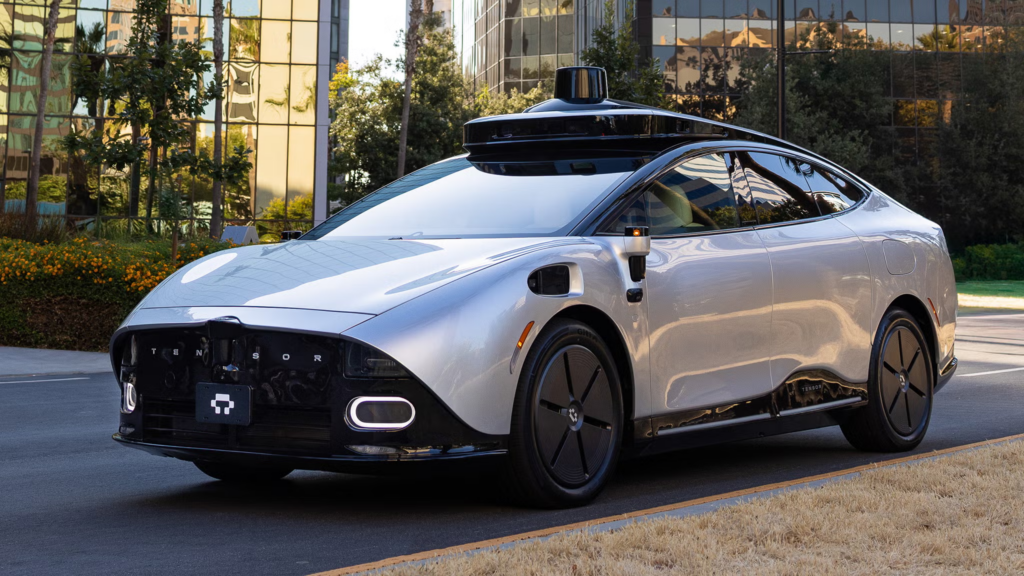
For over a decade, my journey through the autonomous vehicle landscape has been a fascinating ride, from the early days of academic research to the cutting-edge commercial deployments we see in 2025. We’ve witnessed the rise and fall of countless concepts, the cautious expansion of robotaxi services, and the tantalizing, yet unfulfilled, promises of personal self-driving. But now, a disruptive force is emerging from the heart of Silicon Valley, poised to redefine private ownership of advanced autonomous technology. Enter the Tensor Robocar – a ground-up Level 4 autonomous vehicle designed not for fleets, but for your driveway.
In an era where Waymo and Cruise cautiously expand their geofenced robotaxi operations, and Tesla’s Full Self-Driving (Supervised) continues its incremental, human-supervised evolution, Tensor is taking a bold, divergent path. They’re offering an honest-to-goodness Level 4 system, meaning it operates completely without human intervention within its designed operational domain, available for purchase by individual consumers. This isn’t merely an upgrade to an existing car; it’s a meticulously engineered private mobility platform, a significant investment in the future of transport, and a profound statement about personal freedom in the autonomous age.
From Pioneering Robotaxis to a Strategic Consumer Pivot
The roots of Tensor trace back to 2016, initially known as AutoX, a name synonymous with some of the most advanced robotaxi deployments in China. As a veteran observer, I closely followed AutoX’s impressive ascent, from early California testing to building a robust fleet of over 1,000 autonomous taxis operating across five Chinese cities. They were pioneers, pushing the boundaries of commercial autonomous deployment in complex urban environments.
However, the geopolitical and data privacy landscapes of the mid-2020s prompted a strategic recalibration. Recognizing the paramount importance of data sovereignty and user trust, particularly for a technology as intimate as personal transportation, the company made a decisive move. They divested from their Chinese operations, rebranded as Tensor – a name that intrinsically links their identity to the deep learning and AI core of their technology – and returned to their Silicon Valley origins in San Jose, California. This wasn’t a retreat; it was a pivot, a masterful strategic maneuver to address a distinct, burgeoning market: the private consumer yearning for true autonomy without the complexities of shared ownership. In 2025, with increasing scrutiny on how tech companies handle personal data, this focus on individual ownership and robust privacy safeguards places Tensor in a uniquely advantageous position.
Engineering Excellence: The Uncompromising Foundation of Private Level 4
Achieving Level 4 autonomy is not a feature you simply bolt onto an existing vehicle; it demands a fundamental rethinking of automotive engineering. This is where Tensor’s “ground-up” design philosophy truly shines. Development for the Robocar commenced shortly after their successful robotaxi launch in 2020, leveraging years of real-world operational data and experience.
The Robocar is, at its core, a sophisticated Electric Vehicle (EV) designed around its autonomous capabilities. It features a robust 112-kWh battery pack, providing an estimated 250 miles of range – a practical figure for urban and suburban excursions in 2025. Crucially, its 845-volt architecture supports ultra-fast charging, taking the battery from 10 to 80 percent in a mere 20 minutes. This rapid replenishment capability is vital for mitigating range anxiety and ensuring that your electric autonomous vehicle is always ready for its next mission, whether it’s chauffeuring you to a meeting or picking up groceries. Tensor is even exploring next-generation features like an automated charger with a robotic arm, promising a future where your car parks itself and plugs in, seamlessly integrating into your smart home ecosystem.
Every design element speaks to its autonomous purpose. The coach-style, center-closing doors are fully powered and equipped with sensors to prevent collisions with obstacles, reflecting a passenger-first approach. Furthermore, the integration of steer-by-wire, brake-by-wire, and throttle-by-wire systems isn’t just about convenience; it’s a critical enabler for the vehicle’s redundancy architecture and the seamless transition between autonomous and manual modes. This advanced by-wire technology, coupled with rear-wheel steering allowing up to 7 degrees of movement, grants the Robocar an impressively tight 37-foot turning circle – comparable to a Tesla Model Y despite its larger footprint – enhancing maneuverability in dense urban environments.
Demystifying Level 4: A True Driverless Experience for Your Driveway
Let’s be unequivocally clear about what “SAE Level 4 autonomous vehicle” means for the owner of a Tensor Robocar. Within its defined Operational Design Domain (ODD), this car can drive itself completely, from point A to point B, without any human intervention, supervision, or even presence. This is a profound distinction from the Level 2 advanced driver-assistance systems (ADAS) prevalent in most production vehicles today, and even from Level 3 systems that, while allowing “eyes off” driving in certain conditions, still demand the driver remain ready to take over.
The comparison to Tesla’s Full Self-Driving (Supervised) is inevitable, but fundamentally misguided when discussing true Level 4. While Tesla has made incredible strides in AI-driven driving assistance, its current iteration still unequivocally requires a human in the driver’s seat, attentive and ready to intervene at any moment. The Tensor Robocar eliminates that requirement. You can send it on an errand, summon it from across town, or simply enjoy a ride without needing to touch the controls. This represents a monumental leap in autonomous driving technology for the private consumer, shifting the paradigm from driver assistance to personal chauffeur.
Of course, operating a Level 4 vehicle in the U.S. in 2025 involves navigating a patchwork of state and federal regulations. Tensor’s phased rollout, beginning in the UAE before reaching the U.S. and EU in 2027, reflects the meticulous groundwork required for regulatory approval. Their stated target of achieving top crash safety scores from NHTSA, IIHS, and European NCAP underscores their commitment to safety, a paramount concern for both consumers and regulators in the ongoing evolution of autonomous vehicle regulations 2025.
The Sensory Arsenal and AI Brain: Unparalleled Situational Awareness
To deliver on the promise of Level 4 autonomy, a vehicle must perceive its environment with an acuity far exceeding human capability. The Tensor Robocar is equipped with an astonishing array of over 100 sensors, orchestrating a symphony of data collection: five high-definition lidar arrays, 37 cameras, 11 radars, and 10 ultrasonic sensors. This isn’t sensor stuffing; it’s a carefully designed, multi-modal sensor fusion system, each technology compensating for the weaknesses of the others.
The rooftop lidar, capable of perceiving objects nearly 1,000 feet away with 360-degree coverage, provides precise depth mapping, indispensable for navigating complex urban landscapes and highway scenarios. Cameras offer rich semantic information, recognizing traffic lights, signs, and pedestrian intent. Radar excels in adverse weather and provides accurate velocity data, while ultrasonic sensors handle close-range detection for parking and low-speed maneuvers. This comprehensive sensory input ensures the vehicle maintains unparalleled situational awareness, even in dynamic and unpredictable environments.
Critically, Tensor has addressed the mundane yet vital issue of sensor maintenance. The Robocar features an impressive 30 washer nozzles and 13 mini wipers to keep lenses clear, alongside heating elements to prevent fogging and snow buildup – crucial for expanding the vehicle’s operational domain beyond perpetually sunny locales. Going a step further than even advanced robotaxi platforms like Waymo’s Zeekr-based vehicle, the Robocar incorporates physical covers that automatically shield sensors when the vehicle is off, protecting them from dirt and damage, a thoughtful detail that speaks to their long-term reliability and next-generation self-driving cars design.
All this sensory data is processed by a formidable onboard computer featuring eight NVIDIA Drive Thor-X chips, collectively capable of an staggering 8,000 TOPS (trillion operations per second). This immense compute power enables true edge computing, meaning most data processing and decision-making occurs directly within the vehicle. While the car boasts three redundant communication channels for maximum 5G connectivity, its self-contained processing capability ensures robust operation even in areas with poor or no network signal. The Tensor Foundation Model software, an AI-based system, operates two parallel decision-making pipelines: one trained extensively on professional driver data, and another leveraging a Visual Language Model (VLM) to tackle novel and unexpected “edge cases,” ensuring the car is adept at handling the unforeseen realities of real-world driving. This sophisticated AI enables the Robocar to confidently operate in diverse weather conditions, from heavy rain to snow, significantly broadening its appeal beyond niche markets. Exterior displays on the vehicle’s lower corners further enhance safety by communicating simple messages and pictograms to pedestrians, signaling autonomous operation and confirming recognition of nearby individuals.
Your Car, Your Data: Prioritizing Privacy in the Autonomous Age
In 2025, data privacy isn’t just a buzzword; it’s a cornerstone of consumer trust, especially concerning personal mobility solutions. Tensor has clearly prioritized this, making it a key differentiator for the Robocar. Because the vast majority of computing is performed onboard, the company fundamentally doesn’t need to collect your vehicle’s operational data. While the car is capable of sharing information with the cloud, owners must explicitly opt-in for any data transmission. Otherwise, all your vehicle and personal data remains securely within the car itself.
This commitment extends to biometric data, such as facial and palm recognition, which are utilized for vehicle access and theft prevention. Tensor ensures that owners have full control, allowing access and deletion of all collected data through the vehicle’s interface or a dedicated phone app. Furthermore, addressing deep-seated concerns about surveillance, the Robocar’s interior cameras and microphones – used for driver monitoring in manual mode and voice assistant interaction – are equipped with physical covers and manual off switches. This empowers owners to disable them at will, providing an unprecedented level of privacy and control in a connected, AI in self-driving cars landscape.
The Conversational Cockpit: Agentic AI as Your Personal Chauffeur
The human-machine interface in the Robocar transcends mere voice commands. Leveraging advanced Agentic AI backed by a Large Language Model (LLM), the vehicle is designed for natural, conversational interaction. Instead of rigid commands, you can engage in a fluid dialogue with your car, expressing your destination and preferences in a natural, human-like manner. This level of intuitive interaction drastically lowers the barrier to entry for complex autonomous functions.
Beyond spoken instructions, the Robocar demonstrates true intelligence by learning your habits. Connected to your digital calendar, it can anticipate upcoming trips, proactively calculate necessary battery range, and even suggest optimal charging times. The ability to summon your car from anywhere with a simple call or text message further integrates the Robocar seamlessly into your daily life, transforming it from a mere mode of transport into an anticipatory, personalized assistant.
Flexibility and Control: Drive When You Want To
Despite its formidable autonomous capabilities, Tensor understands the enduring human desire for control. The Robocar is not just a self-driving pod; it retains a fully functional steering wheel and pedals, empowering owners to take the wheel whenever the mood strikes. The transition is remarkably fluid: when in autonomous mode, the steering wheel elegantly retracts into the dash, the center infotainment screen slides over to obscure it, and the accelerator and brake pedals discreetly stow away. The moment you wish to take control, these elements swiftly reappear, providing a seamless shift between modes.
When driven manually, the Robocar acts as an intelligent co-pilot, offering a spectrum of assistance levels. From foundational advanced driver-assistance systems (ADAS) Level 4 like automatic emergency braking (AEB) to more sophisticated Level 3 semi-automated driving that supports hands-free, eyes-off-the-road operation in specific conditions, the vehicle caters to the driver’s preferences, ensuring both safety and engagement. This dual nature ensures that the Robocar appeals to a broader demographic, from early tech adopters embracing full autonomy to those who appreciate the flexibility of manual driving when desired. The inherent redundancy in its by-wire steering, braking, and acceleration systems further ensures that critical functions remain operational even in the unlikely event of a component failure.
Beyond Personal Use: Monetizing Your Autonomous Asset
A decade ago, the concept of your personal vehicle generating income while you’re at work or asleep was a futuristic fantasy, famously championed by Elon Musk. While Tesla’s robotaxi ambitions have seen a slower rollout for private owners, Tensor is poised to potentially deliver on this promise. They’ve already inked a deal with Lyft, signifying the Robocar’s imminent introduction as a luxury rideshare vehicle.
This partnership is a powerful validation of the Robocar’s commercial viability and hints at the potential for private owners. Imagine the economic possibilities: your Tensor Robocar could transform from a depreciating asset into a revenue-generating entity, participating in an autonomous ride-sharing network during downtime. While specific details on how private hailing and payment mechanisms would operate are still forthcoming, it’s reasonable to assume integration with existing platforms like Lyft would streamline the process. This vision of personal AVs contributing to the gig economy opens up fascinating discussions around autonomous vehicle investment and the future of mobility solutions, potentially offsetting the vehicle’s luxury price tag and redefining traditional car ownership.
The Price of Progress: Market Positioning and Production Rollout
Tensor isn’t shy about the Robocar’s positioning: expect “luxury pricing.” While specific figures are not yet public, Amy Luca, head of marketing, has indicated it will align with high-end luxury vehicles. Drawing parallels to Waymo’s CEO suggesting their vehicles cost as much as a well-optioned Mercedes-Benz S-Class (which hovers between $150,000 and $200,000), the sophisticated engineering and Level 4 capabilities of the Robocar likely place it at the higher end of this spectrum. This makes the Robocar a significant luxury EV acquisition, comparable to other premium electric autonomous vehicles on the horizon. Considering the Total Cost of Ownership (TCO) will also need to factor in potential insurance premiums for Level 4 autonomy, which are still evolving in the 2025 market.
On the production front, Tensor has partnered with Vietnamese automaker VinFast, leveraging their factory in Haiphong, Vietnam. While VinFast vehicles have faced initial scrutiny regarding build quality in the nascent U.S. market, it’s crucial for discerning observers to remember their extensive experience, including years of assembling BMWs under license. VinFast possesses established manufacturing capabilities and scale, which Tensor will undoubtedly oversee with stringent quality control. Production is slated to commence in late 2026, with initial deliveries reaching the United Arab Emirates late in Q4 of that year. U.S. deliveries are anticipated in early 2027, contingent upon final regulatory approvals. Plans for expansion into the European Union are also well underway, with a recently announced agreement to supply cars to a Danish rideshare service.
A common question in the realm of private autonomous vehicles in 2025 pertains to liability: who pays the fine if your private self-driving car receives a ticket? While legal frameworks are still catching up, the prevailing assumption, until explicitly stated otherwise, is that the owner would ultimately be responsible.
A Glimpse into Tomorrow’s Garage
The Tensor Robocar stands as a compelling testament to the convergence of advanced AI, sophisticated sensor technology, and visionary automotive engineering. It’s not just another EV; it’s a meticulously crafted personal mobility solution that offers unparalleled freedom, uncompromising data privacy, and the tantalizing potential for personal utility. In a world still largely navigating the complexities of Level 2 and Level 3 driver assistance, Tensor’s bold leap into private Level 4 ownership for 2027 is nothing short of revolutionary.
As we stand on the precipice of this automotive revolution, the Tensor Robocar invites us to reconsider our relationship with transportation. Are you ready to claim your personal slice of the autonomous future? Stay tuned as Tensor paves the way for a truly driverless tomorrow, right in your driveway.