



The Dawn of Driverless Ownership: Tensor’s Robocar Redefines Personal Autonomy for 2027
As an industry veteran with a decade embedded in the volatile yet exhilarating world of autonomous vehicles, I’ve seen countless promises made and often, just as many delayed. Yet, here in 2025, the narrative is shifting dramatically. While robotaxi services from pioneers like Waymo, Cruise, and even Tesla’s evolving Full Self-Driving (Supervised) system are becoming increasingly common sights in urban centers, a new paradigm is emerging: the personal autonomous vehicle. No longer merely a sci-fi fantasy, the prospect of owning a truly self-driving car – one that operates with Level 4 autonomy and beyond the confines of a corporate fleet – is rapidly transitioning from concept to tangible reality. Enter the Tensor Robocar, a bold new contender poised to revolutionize personal mobility by offering a private, Waymo-style self-driving experience directly to consumers by early 2027. This isn’t just another electric vehicle; it’s a meticulously engineered Level 4 autonomous vehicle designed from the ground up to be your autonomous co-pilot, a personal chauffeur, and a smart extension of your lifestyle. It promises to unlock an unprecedented level of convenience, safety, and freedom that epitomizes the very future of mobility.
The Genesis of Personal Autonomy: Tensor’s Vision
To truly appreciate the significance of the Tensor Robocar, we need to trace its origins. The company wasn’t born yesterday; it has a rich, albeit complex, history rooted in the foundational efforts of autonomous driving. Originally founded as AutoX in Silicon Valley back in 2016, the enterprise initially dedicated its considerable talents to developing commercial autonomous vehicle technology for robotaxis and logistics fleets. Their journey began with extensive testing in California, a hotbed for AV innovation, before expanding their operations to China. During the unprecedented challenges of the COVID-19 pandemic, AutoX made a strategic pivot, fully relocating its operations to China. There, it achieved significant milestones, deploying a robust fleet of over 1,000 robotaxis that provided public rides across five major cities, accumulating invaluable real-world data and operational experience in diverse urban environments.
However, the global landscape for data governance and privacy rapidly evolved. Acknowledging the escalating concerns surrounding data privacy, particularly in cross-border operations, AutoX undertook another pivotal strategic shift within the past year. According to Amy Luca, Tensor’s Head of Marketing, the company completely divested from its Chinese operations, repatriated to its original home base in San Jose, California, and rebranded itself as Tensor. This wasn’t merely a change of name; it signaled a profound reorientation of its core mission. Instead of solely catering to corporate fleets, Tensor pivoted its focus entirely towards developing an unparalleled, truly private self-driving car for individual customers. This decision underscores a deep understanding of the market’s burgeoning demand for personal autonomy, moving beyond the shared ownership model that has dominated the public perception of self-driving cars. This commitment to a “ground-up” design philosophy, specifically for consumer use, sets the Tensor Robocar apart from many competitors attempting to adapt existing platforms.
Engineering Excellence: A Glimpse Under the Hood
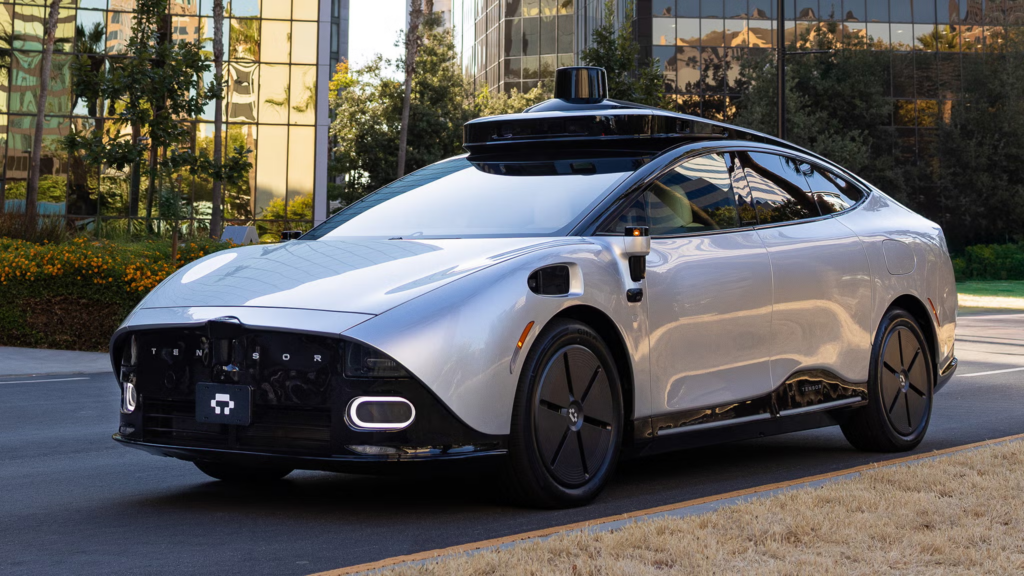
At its core, the Tensor Robocar is a sophisticated electric vehicle innovation, an elegant fusion of advanced EV architecture and cutting-edge autonomous technology. Powering this futuristic machine is a substantial 112-kWh battery pack, providing an estimated driving range of 250 miles – a respectable figure that addresses common EV range anxiety for daily commutes and longer journeys. The single rear motor’s output remains undisclosed, but given the emphasis on a smooth, autonomous experience, instantaneous torque delivery typical of EVs will undoubtedly contribute to a responsive drive. Crucially, the Robocar boasts an 845-volt battery architecture, enabling ultra-fast charging capabilities that are increasingly becoming a benchmark in the premium EV segment. Tensor claims a rapid 10 to 80 percent charge in just 20 minutes, leveraging high-speed EV charging to minimize downtime.
Beyond its impressive power train, Tensor is also innovating in the realm of convenience. The company is actively developing an automated charging solution featuring a robotic arm designed to plug the vehicle in once it’s parked at home – a significant step towards seamless, hands-off ownership. In terms of physical accessibility and aesthetic appeal, the Robocar features powered, coach-style center-closing doors. These aren’t just for show; they are intelligently integrated with sensors to prevent accidental contact with obstacles or other vehicles, enhancing both safety and user experience.
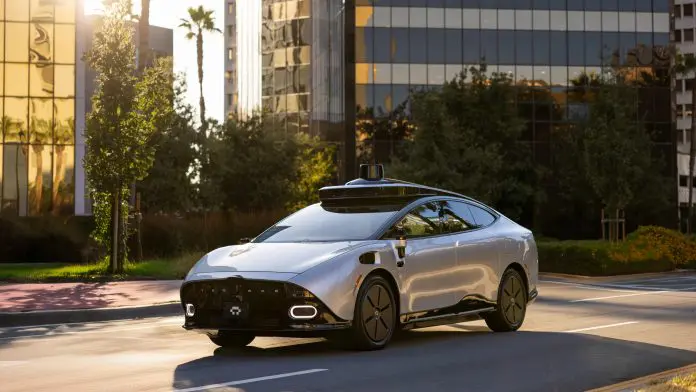
The vehicle’s fundamental control systems represent a paradigm shift. Steering, braking, and acceleration are all managed by sophisticated by-wire systems, meaning there are no physical mechanical linkages between the controls and the wheels or brakes. This electronic interface offers numerous advantages, particularly for autonomous operation, including faster response times, greater precision, and, critically, built-in redundancy. Each of these by-wire systems, along with the extensive sensor suite, is designed with multiple fail-safes, ensuring that the vehicle can continue to operate safely even in the unlikely event of a component failure. Furthermore, the Robocar incorporates rear-wheel steering, allowing the back tires to pivot up to 7 degrees. This feature significantly enhances maneuverability, granting the substantial vehicle a claimed 37-foot turning circle – comparable to a much smaller Tesla Model Y, which is exceptional for its class and a boon for urban navigation. From a safety perspective, Tensor is unwavering in its commitment, actively targeting top crash safety scores from stringent bodies like the NHTSA, IIHS, and European NCAP, reinforcing its dedication to passenger protection.
Unpacking True Level 4 Autonomy
The cornerstone of the Tensor Robocar’s appeal is its commitment to SAE Level 4 autonomy. For the uninitiated, Level 4 represents a profound leap beyond what most consumers currently experience. It means the vehicle can fully drive itself under specific operational design domains (ODDs) without any human intervention or supervision. Crucially, while it can operate entirely independently, it still retains a steering wheel and pedals, allowing for manual override if desired. This capability stands in stark contrast to even the most advanced Advanced Driver-Assistance Systems (ADAS) available today, such as Tesla’s “Full Self-Driving (Supervised),” which, despite its name, is definitively a Level 2 system that requires constant human attention and readiness to intervene. Tensor’s approach is fundamentally different: the Robocar was conceived and designed from the ground up as an autonomous platform, not as a conventional vehicle retrofitted with self-driving capabilities. This foundational difference, with development commencing as early as 2020, allows for a holistic integration of hardware and software optimized for genuine autonomy.
Achieving this level of sophisticated AI-powered driving requires an extraordinary array of sensors and immense computational horsepower. The Tensor Robocar is an engineering marvel, equipped with over 100 sensors strategically placed around its exterior. This includes five high-resolution Lidar sensor technology arrays – one prominently mounted on the roof, providing a 360-degree, nearly 1,000-foot perception range, complemented by four additional Lidars positioned around the front, sides, and rear. This comprehensive Lidar coverage is augmented by an impressive suite of 37 cameras, 11 radars, and 10 ultrasonic sensors, creating a redundant and robust perception system capable of interpreting its environment with exceptional detail and accuracy.
Maintaining the clarity and functionality of these critical sensors is paramount, especially in varying weather conditions. Tensor has addressed this with an ingenious system comprising 30 washer nozzles, 13 mini wipers, and integrated heating elements to prevent fogging, icing, and snow buildup. Going a step further than even some existing robotaxis like Waymo’s Zeekr-based vehicles, the Robocar features physical covers that automatically retract over the sensors when the vehicle is powered down. This innovative feature provides crucial protection against dirt, debris, and potential damage when the car is not in active use, ensuring optimal performance and longevity of these expensive components.
All this sensor data is processed by a truly massive onboard computer system. It leverages eight Nvidia Drive Thor-X chips, capable of an astounding 8,000 TOPS (trillion operations per second). This represents a formidable leap in deep learning in automotive computing power. While the vehicle maintains redundant communication channels for maximum connectivity to the cloud (three separate systems, no less), the vast majority of its computational tasks are performed on-device. This robust local processing capability ensures the Robocar can operate flawlessly even in areas with poor or no 5G signal, guaranteeing reliability irrespective of network infrastructure limitations. Tensor’s proprietary Foundation Model software, an AI-powered driving system, operates two parallel perception and decision-making systems. The first is meticulously trained on data collected from professional human drivers, while the second utilizes a Visual Language Model (VLM) specifically designed to identify and solve novel, unusual, or “edge case” scenarios that might confound traditional rule-based AI. This dual-pronged approach significantly enhances the system’s robustness and adaptability. Tensor also proudly states the Robocar’s ability to operate safely in challenging conditions like rain and snow, eliminating the geographical limitations often associated with early autonomous deployments. To foster trust with its surroundings, the Robocar features subtle displays on its lower exterior corners, broadcasting simple messages and pictograms to pedestrians, clearly indicating its autonomous status and confirming that it has detected their presence – a small yet significant detail for smart mobility solutions in dense urban areas.
Your Sanctuary on Wheels: Privacy and Control
One of the most compelling, and often overlooked, aspects of private autonomous vehicle ownership, particularly for a discerning US market in 2025, is data privacy. Tensor has clearly prioritized this, adopting a “Your Car, Your Data” philosophy that directly addresses growing concerns about vehicle data privacy and automotive cybersecurity. Because the bulk of the Robocar’s intensive computing is performed onboard, Tensor explicitly states that it does not inherently need to collect data from your vehicle. While the system is capable of sharing information with the cloud, owners must actively opt-in for this to occur. If they choose not to, all data generated by and within the vehicle remains entirely on the local system, under the owner’s sole control.
This extends to all data the car collects on its owner and users, which can be easily accessed and permanently deleted by the owner via the vehicle interface or a dedicated smartphone application. This includes sensitive biometric data such as facial and palm recognition, which are utilized for secure vehicle operation and theft prevention – functions crucial for a cutting-edge EV feature like keyless access. Further emphasizing privacy, the interior cameras and microphones, designed for driver monitoring during manual operation and interacting with the voice assistant, are equipped with physical covers and discrete off switches. This thoughtful design choice empowers owners to disable these features entirely, ensuring their conversations and movements within their private vehicle remain just that – private. This level of granular control over personal data and surveillance within the vehicle is a significant differentiator and a strong selling point for privacy-conscious consumers.
Intelligent Interaction: More Than Just a Ride
Beyond mere automation, the Tensor Robocar aims to redefine the human-vehicle interface through an advanced conversational AI. You won’t just be barking commands at your car; you’ll be having a genuine conversation. The Robocar is equipped with an Agentic AI system, backed by a sophisticated Large Language Model (LLM), designed to interact with you in a natural, intuitive manner. Imagine simply telling your car, “Take me to that new cafe downtown, the one with the great espresso,” rather than inputting a precise address. This conversational interface promises a more organic and less distracting interaction.
The intelligence extends to convenience: you can summon the Robocar from anywhere by simply calling or texting it, requesting it to pick you up. Furthermore, the vehicle is designed to learn your habits. When connected to your digital calendar, it can anticipate your upcoming trips, proactively assess the required battery range, and even initiate charging if necessary. This predictive capability transforms the Robocar from a mere mode of transport into an intelligent, proactive personal assistant, seamlessly integrating into your daily routine and embodying the true potential of connected car technology.
The Human Touch: Manual Override & Driver Assistance
Despite its strong emphasis on Level 4 autonomy challenges and driverless operation, Tensor acknowledges the innate human desire for control. The Robocar thoughtfully retains a conventional steering wheel and pedals, providing the owner with the option to take the wheel whenever they choose. This duality offers the best of both worlds: effortless autonomy for daily commutes or long journeys, and the engaged driving experience for those moments when you simply want to drive.
When operating in autonomous mode, the interior transforms. The steering wheel gracefully retracts into the dashboard, and the central infotainment screen slides to conceal it, creating a more open, lounge-like passenger experience. The accelerator and brake pedals also retract, freeing up valuable footwell space. Should you decide to resume manual control, these elements seamlessly reappear, ready for your input. When driven by a human, the Robocar still offers a comprehensive suite of driver assistance features, scalable to the driver’s preference. From fundamental aids like automatic emergency braking to more advanced Level 3 semi-automated driving capabilities (hands-free, but still eyes-on-the-road), the vehicle provides a spectrum of support, enhancing safety and reducing driver fatigue. This flexibility is a key aspect of its appeal, catering to a broader range of driver preferences and comfort levels with personal autonomy.
Beyond Personal Use: Monetizing Your Autonomous Asset
The vision for the Tensor Robocar extends beyond just private ownership. The company has already forged a strategic partnership with Lyft, planning to introduce Robocars as premium luxury rideshare vehicles within their network. This move aligns with the broader robotaxi evolution and the future of transportation, showcasing the vehicle’s versatility. But what’s truly intriguing is the potential for individual owners to participate in this autonomous economy. Remember Elon Musk’s much-discussed vision of Tesla owners earning income by deploying their self-driving cars as robotaxis while they’re at work or asleep? Tensor is echoing a similar promise, and given the measured rollout of Tesla’s own robotaxi service, they might be in a position to realize this vision for private owners sooner.
While Tensor hasn’t yet provided specific details on the mechanisms for hailing and paying for a privately owned autonomous vehicle that’s part of a network, it’s reasonable to assume integration with existing platforms like Lyft would be a logical first step. This opens up an exciting avenue for owners to monetize their luxury electric vehicle, potentially offsetting its initial investment and contributing to a more efficient utilization of highly advanced automotive assets. It represents a paradigm shift from simple car ownership to owning a revenue-generating asset, further blurring the lines between private and commercial mobility.
The Road Ahead: Pricing, Production, and Market Entry
As of early 2025, Tensor remains tight-lipped about the exact pricing for the Robocar, but their Head of Marketing, Amy Luca, has indicated customers should anticipate “luxury pricing.” Drawing a comparison to Waymo’s stated costs for its highly advanced vehicles, which are often benchmarked against a well-optioned Mercedes-Benz S-Class, we can project a price point in the range of $150,000 to $200,000, potentially even higher given the Robocar’s extensive ground-up engineering and formidable sensor suite. This positions the Tensor Robocar firmly within the premium segment of luxury electric vehicles 2025, appealing to early adopters and tech enthusiasts seeking the pinnacle of personal mobility.
Manufacturing for the Robocar is being handled by the Vietnamese automaker VinFast at its state-of-the-art factory in Haiphong, Vietnam. While VinFast vehicles have faced some initial scrutiny regarding build quality in the US market, it’s crucial to remember their extensive experience. VinFast has a proven track record of assembling BMWs under license for years, demonstrating a clear capability for precision manufacturing and adherence to high quality standards. Tensor emphasizes that its collaboration with VinFast leverages this expertise, ensuring a robust and well-built product.
The production timeline is ambitious yet concrete: manufacturing is slated to begin in late 2026. The first deliveries are anticipated in the United Arab Emirates (UAE) in the fourth quarter of that same year, a market known for its embrace of cutting-edge technology and luxury vehicles. For the US market, deliveries are projected to commence in early 2027, contingent upon crucial regulatory landscape autonomous vehicles approvals. Beyond these initial markets, Tensor has ambitious plans for global expansion, including entry into the European Union and a recently announced partnership to supply cars to a rideshare service in Denmark, signaling a worldwide vision for their autonomous technology.
One final, practical consideration: the question of liability. While the Tensor Robocar is designed for complete autonomy, the legal frameworks surrounding self-driving cars are still evolving. In the event of a traffic infraction or ticket while the vehicle is operating autonomously, it’s a safe assumption that, as the owner, you would ultimately be held responsible. This is a common and necessary point of understanding for early adopters of advanced autonomous technologies.
Embrace the Future of Personal Mobility
The Tensor Robocar represents more than just another vehicle; it embodies a paradigm shift in how we perceive and interact with personal transportation. It’s a testament to a decade of relentless innovation in autonomous vehicle technology, bringing true Level 4 autonomy out of the realm of science fiction and into your driveway. With its unwavering commitment to safety, unparalleled data privacy, intelligent conversational AI, and the flexibility of manual override, the Robocar is poised to deliver an experience that transcends mere driving. It promises a future where your vehicle is not just a mode of transport, but a sophisticated, autonomous extension of your life, offering unprecedented freedom and convenience.
As we stand on the precipice of this exciting new era, the question isn’t if personal autonomy will arrive, but when you’ll be ready to embrace it. Explore how the Tensor Robocar could redefine your driving experience and propel you into the future of personal mobility. Visit Tensor’s official channels or stay tuned for more updates on this groundbreaking vehicle, set to revolutionize the way we own and interact with our cars in 2027 and beyond. The future of driving, or rather, not driving, is almost here.