



Title: Unpacking the 2026 Chevrolet Silverado EV Trail Boss: A Deep Dive into GM’s Electrified Workhorse
The automotive landscape in late 2025 is electric, dynamic, and fiercely competitive, especially in the pickup truck segment. For years, the pickup has been the undisputed king of American roads, a symbol of utility and capability. Now, as the industry charges towards an all-electric future, traditional stalwarts like Chevrolet are rolling out their heavy hitters, and few command as much attention as the 2026 Chevrolet Silverado EV Trail Boss. Positioned as the rugged, range-topping variant of Chevy’s electric truck lineup, it promises an enticing blend of massive power, impressive range, and an adventurous spirit.
Having spent the better part of a decade immersed in the evolution of pickup trucks, from the grunt of diesel heavy-duties to the whisper of pioneering EVs, I’ve witnessed firsthand the promises and pitfalls of this transition. The Silverado EV Trail Boss arrives with significant fanfare, a truck designed to capture the hearts of loyal Chevy customers while also appealing to a new generation of electric vehicle enthusiasts. But does this bold, new offering truly live up to the “Trail Boss” moniker, or is there a subtle disconnect between its formidable appearance and its real-world ruggedness? Let’s peel back the layers and take a discerning look at what this formidable machine truly brings to the burgeoning electric pickup truck market.
A Commanding Presence with Refined Road Manners
From the moment you lay eyes on the 2026 Silverado EV Trail Boss, its sheer scale is undeniable. This is a truck that demands attention, embodying the gargantuan proportions we’ve come to associate with heavy-duty pickups, yet subtly refined by its electric powertrain and modern design language. The Trail Boss treatment—distinguished by its larger tires, enhanced ground clearance, and signature red recovery hooks—communicates an intent for adventure, a promise of off-road prowess. Inside, the cabin offers a contemporary, tech-forward environment that still feels intrinsically “truck.” Ample space, intuitive infotainment, and quality materials provide a comfortable sanctuary, reflecting Chevrolet’s commitment to an elevated user experience in their electric trucks.
What truly sets the Silverado EV Trail Boss apart on pavement is its unique suspension setup. Unlike many traditional body-on-frame trucks, the Silverado EV rides on a fully independent suspension system, complemented by coil springs and generously sized 35-inch diameter tires. This combination works wonders for on-road comfort. The ample sidewall of the tires effectively cushions impacts, while the coil springs provide a suppler ride than the leaf springs found on many conventional pickups. During extensive testing, our team noted a significant reduction in the aggravating head toss and harsh bump-stop contact that can plague less refined truck suspensions. The experience is largely smooth, absorbing road imperfections with a confident composure that belies its substantial mass. There’s a predictable amount of body roll when pushed hard into twisty roads, a characteristic common to large vehicles, but it never feels uncontrolled.
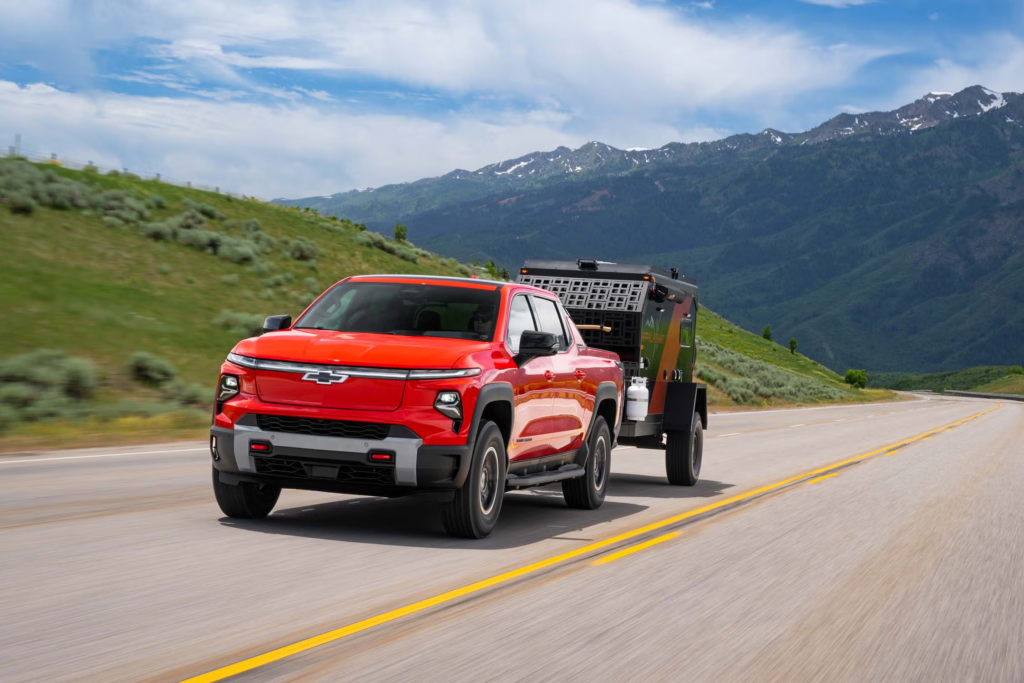
Even when tasked with significant loads, the Trail Boss impressed. Hauling 1,000 pounds of payload in the bed, the ride quality actually improved, suggesting the added weight settled the suspension slightly, refining rebound characteristics. However, towing proved to be a more nuanced experience. While the Silverado EV towing capacity is certainly impressive on paper, and the instant torque makes pulling heavy loads feel effortless, one particular observation stood out: a tendency for the truck and trailer to pitch noticeably over expansion joints and undulating concrete on highways. This undulating motion, which some judges likened to “seasickness,” highlights a potential area for further refinement in the interaction between the heavy battery pack, independent suspension, and trailering dynamics. This isn’t necessarily a deal-breaker, but it’s a characteristic that drivers transitioning from a conventional truck should be aware of.
Another aspect of the Trail Boss’s on-road performance that demands attention is its prodigious power delivery. With instantaneous electric torque, hammering the throttle on a straightaway can induce noticeable torque steer. This phenomenon, where the steering wheel tries to pull to one side under heavy acceleration, is a common trait in high-power, front-wheel-drive or all-wheel-drive EVs, and in a vehicle of this size, it can catch unsuspecting drivers off guard. It’s a vivid reminder of the sheer force lurking beneath the floorboards.
The Powerhouse Beneath: Battery, Range, and Charging Realities
At the heart of the Silverado EV Trail Boss lies a colossal 205 kWh Max Range battery pack. In an era where “range anxiety” is a primary concern for many potential EV buyers, this massive energy reservoir serves as Chevrolet’s wholly American remedy. An estimated range exceeding 400 miles is a compelling figure, providing a substantial buffer for long hauls, demanding work tasks, and extended off-road excursions without constantly fretting about the next charging station. This kind of range positions the Silverado EV as a serious contender for those who need genuine long-distance capability from their electric truck.
However, with great range comes great responsibility – and in this case, a significant appetite for electrons. Much like its fuel-slurping ancestors, the Trail Boss, despite being electric, consumes a substantial amount of juice when performing demanding truck tasks such as towing, hauling, or even just navigating at highway speeds with its considerable mass and robust tires. While its sheer battery capacity largely mitigates the impact of this “dismal efficiency” on overall range, it’s a reminder that even the most advanced EV technology advancements can’t defy the laws of physics. Heavy trucks require energy to move, and electric trucks are no exception.
The upside to such a large battery, beyond its impressive range, is its fast-charging capability. Leveraging the latest GM Ultium platform and its 800-volt architecture, the Silverado EV Trail Boss is capable of DC fast charging at rates up to 350kW. In our tests, replenishing the battery from 5 percent to 80 percent charge took approximately 49 minutes. This is a critical factor for usability, transforming what could be a lengthy downtime into a manageable break during a long journey or a busy workday. It ensures that the Silverado EV charging time aligns with the practical needs of truck owners, making it a viable alternative for commercial fleets and private owners alike.
Innovative Features: Gimmick or Game-Changer?
The Silverado EV Trail Boss pads its resume with a few standout technological innovations, most notably four-wheel steering and the intriguing Sidewinder mode. Four-wheel steering is a feature that truly shines in a vehicle of this magnitude. In tight urban parking lots or navigating complex, low-speed trail obstacles, the system dramatically reduces the truck’s effective turning radius, making intricate maneuvers feel as if you’re piloting a much smaller vehicle. It genuinely enhances the electric truck maneuverability, providing a level of agility that would be impossible with traditional two-wheel steering on a truck this size. This is a tangible benefit that improves daily drivability and confidence in challenging environments.
Sidewinder mode, on the other hand, elicited more head-scratching. This unique function allows all four tires to turn a few degrees simultaneously in the same direction, effectively allowing the truck to “crab walk.” While it’s undoubtedly a fascinating piece of engineering and a fantastic party trick for “peacocking” in a gravel parking lot, finding genuinely practical scenarios where it would be indispensable proved challenging. One could imagine niche applications for extreme parallel parking in impossibly tight spaces or very specific industrial maneuvers, but for the average truck owner, its utility seems more speculative than practical. It might be a glimpse into future autonomous driving capabilities or extreme recovery scenarios, but for now, it feels more like an innovative EV feature that’s ahead of its time for most users.
The Trail Boss’s Off-Road Prowess: A Candid Assessment
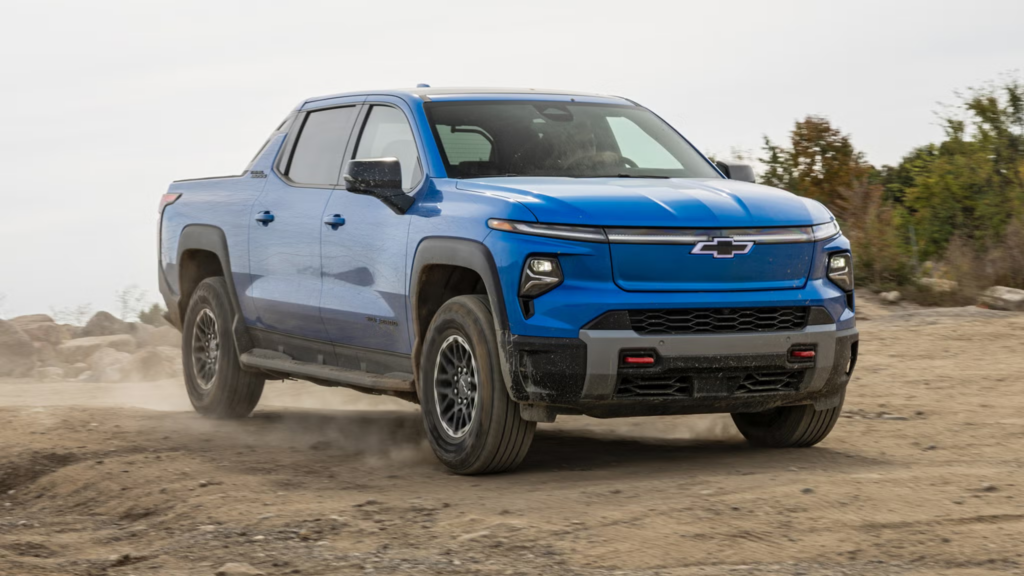
This is where the narrative around the Silverado EV Trail Boss becomes most complex and, frankly, where its “resume” needs a closer look. With a name like “Trail Boss,” one naturally expects a vehicle designed to dominate a wide variety of off-road terrain, to be a true off-road electric vehicle contender. And to its credit, for many casual dirt-road adventures, it performs admirably. Thanks to its generous ground clearance, the protection offered by its underbody battery housing, and those meaty 35-inch tires with ample sidewall, the Trail Boss plods along minimally maintained rutted tracks and moderately rocky paths without much complaint. Judges found it well-suited for the kind of light to moderate off-roading that most truck owners actually engage in.
However, when the challenge escalated even slightly, the Trail Boss revealed a surprising Achilles’ heel. Our testing included a seemingly innocuous 28-degree slope – a common obstacle on many recreational trails, certainly not “Rubicon-level rocks” or “bottomless gumbo mud.” Attempting to climb this slope at a controlled, low speed, typical of responsible off-roading, repeatedly left the truck paralyzed. Its sophisticated traction control system, instead of propelling it forward, frantically buzzed and clicked, unable to find the grip needed. No amount of careful “trail footwork” or delicate throttle modulation could coax it up.
The fundamental issue here became glaringly apparent: the absence of a true mechanical locking differential, especially on the rear axle, and ideally, the front. Modern traction control systems, while powerful, rely on brake-based torque vectoring, which can only do so much when one or more wheels are completely unloaded or spinning freely. When a tire lifted even slightly, or traction became uneven, the entire machine would pause, lurch backward, and generally fail to progress. To overcome such obstacles, the Trail Boss often required a “bareknuckle approach” – a blast of throttle and a hope-for-the-best attitude, which is antithetical to careful, controlled off-roading and potentially risky.
This limitation was also observed with its GMC Sierra EV cousin during our EV truck comparison testing, suggesting it’s a design characteristic inherent to the current Ultium platform’s initial off-road tuning for these vehicles. For a truck branded “Trail Boss,” this inability to handle what should be moderate trail challenges at low speed is a significant drawback. It means that while the Silverado EV Trail Boss looks the part and handles well on easier tracks, it lacks the critical hardware necessary for serious, technical off-roading. Buyers expecting to conquer challenging terrain akin to what an ICE Trail Boss with lockers could handle might find themselves wanting.
The Value Proposition and Future Market Context
With a sticker price around $92,000, the 2026 Chevrolet Silverado EV Trail Boss firmly positions itself in the premium segment of the electric truck market. This price point aligns loosely with luxury-loaded internal combustion engine (ICE) pickups and places it in direct competition with other high-end electric trucks like the Rivian R1T and the Ford F-150 Lightning Platinum. The question then becomes: does its blend of features, performance, and capabilities justify this significant investment?
For many, the sheer scale of its battery, the impressive range, the comfortable ride, and the unique maneuverability afforded by four-wheel steering will be compelling factors. It’s a supremely capable workhorse for many truck tasks, and a comfortable, futuristic daily driver. However, the Achilles’ heel in its off-road prowess does introduce a caveat. If the “annual performance review” of the Trail Boss included navigating a snow-dusted uphill driveway with limited traction, or a moderately challenging trail, its current configuration might lead to disappointment.
The EV market trends 2025 clearly indicate a growing demand for sustainable transportation solutions, and electric trucks are a crucial part of that shift. The Silverado EV Trail Boss is undoubtedly a monumental step forward for Chevrolet, showcasing the power and potential of the Ultium platform. It’s a truck that excels in many areas critical to the modern buyer, delivering a comfortable, long-range, and technologically advanced experience. It caters beautifully to the needs of those who require a large, powerful EV for daily driving, towing, and light-duty adventure. But for those who genuinely seek to push the boundaries of off-road capability, hoping for a true “boss” of the trail, the current iteration may leave them wishing for more robust traction solutions.
Your Next Adventure Awaits: Experience the Future of Trucking
The 2026 Chevrolet Silverado EV Trail Boss is a marvel of engineering, a bold statement in the rapidly evolving world of electric vehicles. It’s big, comfortable, boasts an incredible range, and brings a suite of innovative features to the table. While its ultimate off-road credentials for technical terrain might raise some questions, its overall package is undeniably impressive for the vast majority of truck owners. It represents a significant stride towards a future where power and sustainability coexist seamlessly.
Are you ready to experience the next chapter in American trucking? We invite you to delve deeper into the capabilities and features of the 2026 Chevrolet Silverado EV Trail Boss. Visit your local Chevrolet dealer today to schedule a test drive, feel the instant torque for yourself, and discover how this groundbreaking electric pickup truck fits into your lifestyle and your adventures. Join the conversation and explore the future of Chevrolet EV ownership. Your electrified journey starts now.