



Hyundai Crater Concept: Forging the Future of Electric Off-Road Dominance with the XRT Subbrand
As a seasoned industry observer with a decade entrenched in automotive innovation, I’ve witnessed countless concepts come and go. Yet, few electrify the imagination quite like the Hyundai Crater Concept, unveiled with audacious fanfare at the Los Angeles Auto Show. This isn’t just another pretty face on the EV landscape; it’s a bold declaration from Hyundai, a crystal ball peering directly into the rugged, electrifying future of their burgeoning XRT subbrand. In a market increasingly hungry for sustainable adventure vehicles, the Crater doesn’t just promise to tackle the trails; it redefines the entire electric off-road experience for 2025 and beyond.
For years, the XRT badge has been Hyundai’s subtle nod to wilderness enthusiasts, evolving from mere appearance packages on popular SUVs like the Santa Fe and Tucson to more substantial upgrades on models like the Palisade XRT Pro. But the Crater Concept transcends these predecessors, presenting a vision where hardcore capability, advanced electric propulsion, and seamless digital integration converge. This concept isn’t merely designed for the path less traveled; it’s engineered to carve entirely new ones, setting an ambitious benchmark for next-gen adventure vehicles and signaling Hyundai’s serious intent to dominate the burgeoning electric off-road SUV segment.
The Art of Steel: A Design Language Forged for the Wild
The Crater Concept immediately grabs attention with its “Art of Steel” design language, a philosophy first introduced on the Initium concept and subsequently refined for the second-generation Nexo. This isn’t about delicate curves or futuristic swoops; it’s about unapologetic, industrial-strength aesthetics that convey resilience and purpose. Every line, every panel, speaks to a functional robustness engineered for the rigors of the backcountry. In a competitive 2025 market increasingly populated by rugged EV concepts, the Crater manages to stand out with its distinctive, purposeful stance.
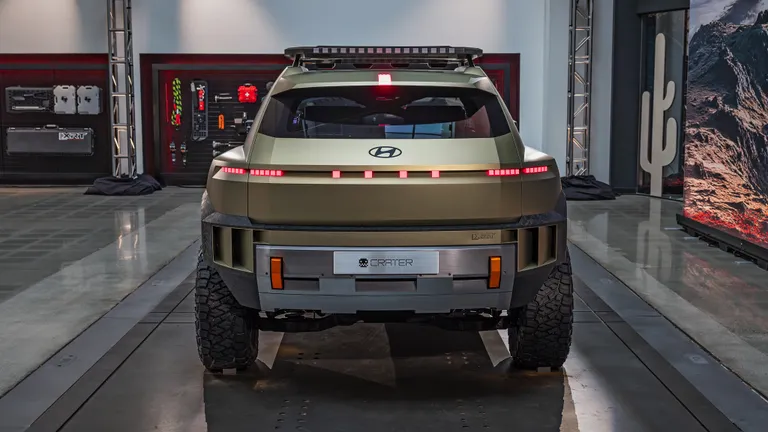
The exterior boasts all the non-negotiable hallmarks of a truly capable off-roader. Short overhangs and sharply angled bumpers are not just stylistic choices; they are crucial design elements that provide exceptional approach and departure angles, enabling the Crater to conquer steep ascents and descents without scraping. Integrated metal skid plates offer vital underbody protection, shielding critical EV components from rocks and debris – a crucial consideration for any high-performance electric SUV venturing off-pavement. The striking orange tow hooks, seamlessly integrated into the chunky bumpers, are not only highly visible and functional for recovery but also conceal a whimsical secret: one front tow hook doubles as a bottle opener, a nod to the social aspect of remote campsites and a unique feature sure to be a conversation starter. If you look closely, you’ll even discern a subtle robotic face within the opener – that’s Crater Man, the concept’s charming mascot, a recurring motif that adds a layer of playful personality to this otherwise serious machine.
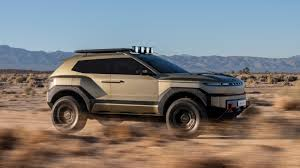
Underneath its purposeful facade, the Crater sits proudly with an elevated ground clearance, a combination of a beefy raised suspension and a formidable set of 33-inch all-terrain tires. These aren’t just for show; they’re vital for navigating challenging terrain, providing maximum grip and absorbing impacts. The tires wrap around robust 18-inch hexagonal wheels, a design Hyundai describes as being “inspired by envisioning a hexagonal asteroid impacting a sheer metal landscape,” leaving an indelible mark. This hexagonal motif isn’t just aesthetic; it hints at structural strength and durability. Further enhancing its rugged persona, the black wheel arches and body trim feature the distinctive “pixel camo” finish, a subtle yet effective design cue that ties the Crater to Hyundai’s broader electric vehicle identity, notably seen on the Ioniq 5 XRT. This cohesive design language ensures the Crater, despite its unique aesthetic, remains recognizably Hyundai, a testament to the brand’s evolving automotive design language for its future fleet.
Powering the Path: An Electric Drivetrain for Uncharted Territory
While Hyundai has been coy about specific powertrain details, the core revelation is that the Crater is a pure electric vehicle. In the rapidly advancing landscape of 2025, an EV powertrain for an off-roader brings distinct advantages, especially concerning torque delivery and environmental footprint. Imagine instantaneous, silent power to precisely modulate your ascent over a treacherous rock crawl, or the quiet solitude of cruising through a pristine forest. The precise power delivery inherent to electric motors would make the Crater exceptionally adept on muddy, undulating trails, where nuanced throttle control is paramount.
What Hyundai has confirmed, however, speaks volumes about its off-road pedigree: the Crater concept features all-wheel drive and boasts front and rear locking differentials. For any seasoned off-road enthusiast, these are non-negotiable features, and their inclusion in an electric off-road SUV of this caliber highlights Hyundai’s commitment to genuine capability. Locking differentials ensure that power is evenly distributed to all wheels, preventing slippage and maximizing traction in challenging low-grip situations – be it deep mud, loose sand, or uneven rock faces. This is a critical distinction from many “soft-roaders” and positions the Crater squarely against purpose-built off-road EVs.
Further reinforcing its trail-ready credentials, the Crater also incorporates hill descent control and trailer brake control. Hill descent control automatically manages speed on steep declines, allowing the driver to focus on steering, a boon for safety and control. Trailer brake control is essential for those planning extended overlanding adventures, ensuring safe and stable towing of camping gear, utility trailers, or even another off-road toy. While exact battery capacity and range figures are still under wraps, the industry’s rapid advancements in energy density and charging infrastructure by 2025 suggest that the Crater would be designed to offer sufficient range for substantial off-road excursions, potentially leveraging advanced 800V architectures for rapid recharging on the go. This focus on practical EV off-roading technology is what sets the Crater apart.
Beyond the Frame: Innovative Exterior Features for the Modern Adventurer
The Crater’s commitment to off-road utility extends beyond its core drivetrain and robust chassis. Integrated limb risers, a subtle yet crucial feature for navigating dense forest trails, stretch tautly from the hood to the roof, deflecting pesky tree branches away from the windshield and bodywork. This prevents scratches and ensures unobstructed visibility – a small detail that speaks volumes about Hyundai’s understanding of the overlanding experience.
Crowning the vehicle is a sleek, multi-functional roof rack, not just for carrying gear but also housing a set of powerful auxiliary lights. These are designed to illuminate the darkest trails, transforming night into day and enhancing safety during nocturnal expeditions. True to Hyundai’s electric vehicle signature, these auxiliary lights, along with the main headlights and taillights, sport the distinctive retro-futuristic pixelated look we’ve come to associate with their Ioniq lineup. This unique lighting aesthetic serves as a modern brand identifier while providing excellent illumination.
Perhaps one of the most intriguing and forward-thinking features lies in the Crater’s side-view mirrors – or rather, camera mirrors. While US legislation has historically been antiquated in this regard, limiting the widespread adoption of camera-based mirrors, Hyundai has already implemented these in markets like its home country on models such as the Nexo. On the Crater Concept, these digital mirrors are not only sleek and aerodynamically efficient but also detachable, boasting dual functionality as a powerful flashlight for setting up camp or navigating dark trails, or as a portable camera to film your wilderness adventures. This clever integration hints at a future where vehicle components are multi-purpose, enhancing both utility and the overall adventure experience. The potential for such features to become standard in future adventure vehicles by 2025 is an exciting prospect.
Inside the Crater: A Functional, Futuristic Cockpit for the Trail
Stepping inside the Crater’s cabin immediately reinforces its tough, utilitarian ethos. The built-in roll cage, an integral part of the vehicle’s structure, is a clear indicator of its serious off-road intentions, providing enhanced safety and structural rigidity in extreme conditions. Yet, despite its rugged appearance, the interior surprises with a remarkable level of comfort, courtesy of soft yet highly durable materials. The seats, upholstered in a sophisticated mix of black leather and Alcantara, feature a distinctive cylindrical element design, drawing inspiration from the comfort and compact nature of sleeping bags – a thoughtful touch for those spending extended time in the wild.
The roll cage isn’t merely a safety feature; its strategically placed sections double as integrated grab handles, aiding ingress and egress, particularly into the rear seats. Each seating position is equipped with a four-point harness, underscoring the Crater’s extreme capability and occupant security. Throughout the cabin, ambient lighting casts an inviting orange glow from the doors and dashboard, adding a touch of warmth and sophistication to the otherwise robust interior.
In a striking departure from the trend of oversized central infotainment screens, the Crater champions a different vision. Instead of a single dominant display, there are four smaller, strategically placed screens. The bulk of critical driving information, however, is communicated to the driver via an expansive head-up display (HUD) that spans the entire width of the windshield. The image projected onto the windshield is crisp, vibrant, and remarkably easy to read, keeping the driver’s eyes focused on the trail ahead. While proponents argue this minimizes distraction, a full-width HUD of this magnitude does raise questions about information overload, a balance Hyundai will undoubtedly refine for production models. Nevertheless, the Crater ensures a tactile experience with plenty of physical controls. Cylindrical, gear-like elements intuitively adjust the all-wheel-drive system and differentials, while a series of robust buttons below manage climate controls – crucial for gloved hands in rough terrain.
The squarish steering wheel, designed for optimal grip and control, integrates an array of buttons, allowing the driver to effortlessly switch between various drive modes: Snow, Sand, Mud, Auto, and a dedicated XRT mode, each optimizing the vehicle’s performance for specific conditions. Further enhancing its adventure-ready status, the cabin is thoughtfully appointed with practical amenities. A readily accessible first aid kit and fire extinguisher are standard, emphasizing safety. On the center console, a removable Bluetooth speaker, similar to innovative features seen in the Toyota Tacoma and 4Runner, provides portable audio entertainment for campsites or outdoor gatherings, reinforcing the vehicle’s role as a mobile base for outdoor enthusiasts. This modular interior design EV focus truly maximizes utility.
Crater Man and the Interactive Journey
Crater Man, the endearing robotic mascot, is more than just a charming design element; he’s integral to the concept’s interactive experience. His playful face appears subtly throughout the cabin and exterior, but he truly comes alive within the vehicle’s unique digital modes, transforming the Crater into an entertainment hub during downtime.
Imagine reaching your remote campsite after a day of rugged driving. Instead of traditional infotainment, the Crater offers a range of engaging options. Game mode projects a platform video game onto the expansive head-up display, with Crater Man as the main character. The driver, using one of the smaller displays, controls Crater Man, making him jump from platform to platform – a novel way to unwind and engage with the vehicle’s technology.
For the musically inclined, a music creation app transforms the four smaller screens into different drum sounds, allowing occupants to create and add to an electronic song mix. This interactive feature promotes creativity and communal enjoyment, turning the cabin into a mobile jam session.
Perhaps the most compelling interactive feature for the overlanding segment is the “camp mode.” This mode transcends mere utility, enhancing the immersive outdoor experience. The head-up display can seamlessly transition into a simulated campfire, complete with the mesmerizing crackle of burning logs playing through the vehicle’s speakers – perfect for ambiance on a cool evening. Alternatively, it can depict a calming rainfall, accompanied by the soothing roar of precipitation, ideal for relaxation. For practical purposes, a “night vision trail cam” mode utilizes the exterior cameras to display the environment surrounding your camp, offering enhanced security and awareness in remote locations. These features elevate the Crater beyond a mere mode of transport, positioning it as an integral part of the outdoor adventure itself, enriching the overall experience.
The Horizon Beckons: Hyundai’s Future in the Rugged EV Space
As an industry expert, I see the Hyundai Crater Concept not merely as a flight of design fancy but as a strategic statement. While Hyundai isn’t dropping hints about immediate production plans, it’s clear the Crater is a crucial “crystal ball,” offering a tantalizing glimpse into the features, styling, and engineering philosophy we can expect from future XRT models. The automotive landscape of 2025 is poised for a significant shift towards electric adventure vehicles, and Hyundai is positioning itself to be a formidable contender.
Could a dedicated off-road EV from Hyundai, directly inspired by the Crater, be on the horizon – a true rival to upcoming electric behemoths like the Jeep Recon? All signs point to yes. Hyundai’s consistent investment in its XRT subbrand, culminating in this audacious concept, suggests a deep commitment to taking its vehicles, and its customers, further off the beaten path than ever before. The Crater is more than a concept; it’s a commitment to a sustainable, exciting, and highly capable future for electric off-roading.
The path ahead for electric adventure is bright, and Hyundai, with the Crater Concept, is undeniably leading the charge. We invite you to join us in anticipating the next chapter of Hyundai’s XRT evolution. What innovations do you hope to see make it to production? Share your thoughts and stay tuned as we track the journey from concept to conqueror. The future of electric off-road dominance is here, and it looks a lot like the Crater.