



Hyundai Crater Concept: An Expert’s Take on How It Redefines the 2025 Off-Road Landscape
For a decade, I’ve watched the automotive industry’s tectonic plates shift, especially in the electrifying and ever-competitive off-road segment. From the humble beginnings of utility vehicles to the sophisticated, tech-laden adventure rigs we see today, the evolution has been relentless. But nothing quite signals a seismic shift like Hyundai’s XRT Crater concept. This isn’t just another concept car; it’s a bold declaration from a manufacturer traditionally known for its value and reliability, now aggressively muscling into the territory of legends like the Jeep Wrangler, Ford Bronco, and the burgeoning electric titan, Rivian. In the rapidly evolving landscape of 2025, the Crater doesn’t just promise to join the fray; it aims to profoundly redefine the expectations for an electric off-road SUV.
Hyundai’s XRT: From Trim Package to True Trailblazer
For years, Hyundai’s XRT designation was largely an aesthetic package – a nod to ruggedness without truly committing to the dirt. It dressed up models like the Tucson and Santa Fe with black cladding, unique wheels, and roof rails, hinting at adventure without delivering hardcore off-grid capability. As an industry observer, I saw it as a cautious dip of the toe into the adventure vehicle market. But as we stand in 2025, that narrative has completely flipped. Hyundai has been strategically investing, evolving XRT into a legitimate sub-brand focused on actual trail-driving upgrades and robust engineering.
This isn’t just about slapping a tougher badge on a crossover; it’s about a philosophical shift within the company. The establishment of an XRT-specific workshop in their Southern California design center, adorned with serious outdoor gear and large-diameter all-terrain tires, isn’t for show. It signals a deep commitment to understanding the needs of genuine off-road enthusiasts. This dedicated space is a fertile ground for designers to push the boundaries, to imbue future Hyundai models with the kind of authentic ruggedness that goes beyond superficial styling. The Crater concept, then, isn’t an anomaly; it’s the logical, albeit extreme, culmination of this deliberate strategy to challenge the competitive off-road market.
The Crater Unveiled: A Radical “Art of Steel” Statement
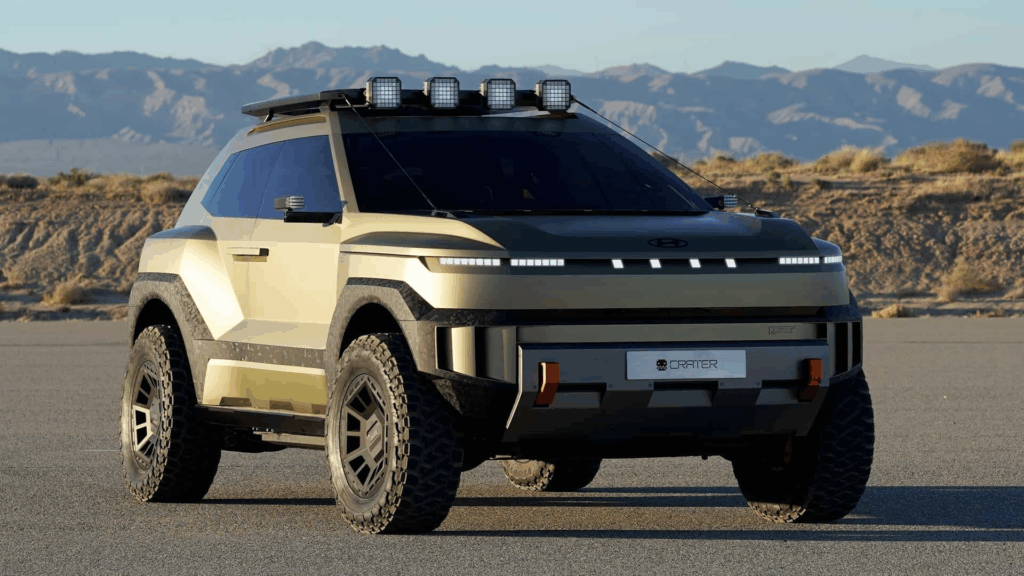
When the Hyundai Crater concept touched down, it wasn’t just another vehicle; it was an event. This machine epitomizes what Hyundai calls its new “Art of Steel” design language, a philosophy that prioritizes dramatic, angular bodywork and pushes stamping presses to their absolute limit. The result is a vehicle that doesn’t merely look tough; it looks like it belongs on a mission to an uncharted planet. From my perspective, it’s a masterclass in aggressive, next-gen SUV design that instantly sets it apart.
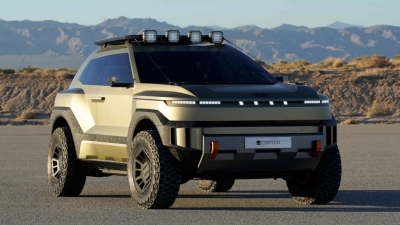
The exterior is a symphony of sharp edges and hard creases, an evolution of the parametric pixel aesthetic first popularized by the Ioniq 5. But here, the pixels aren’t just in the head and taillights; they extend to auxiliary roof lights and even detachable side mirror camera pods – cleverly doubling as portable flashlights for those late-night trail fixes. The matte black camo cladding, which we’ve seen on the Ioniq 5 XRT, solidifies its role as a signature element for future XRT electric vehicles. This isn’t just a design choice; it’s a statement about durability and purpose.
Despite its imposing presence, the Crater is surprisingly compact. Hyundai positions it as roughly the same length as an Ioniq 5, a trick of visual engineering that gives it a massive road presence without the cumbersome footprint often associated with hardcore off-roaders. This smart design, coupled with its broad stance tapering upward from aggressive 35-inch tires, contributes to its deceptive visual bulk. The name “Crater” itself, as explained by Hyundai, isn’t about sales projections but about the profound impact a seemingly small object can make. This philosophy resonates deeply with the ethos of breaking new ground in automotive innovation.
Beyond Aesthetics: Functional Artistry and Off-Road Intent
The Crater isn’t just a pretty face for the trails; its design is imbued with functional artistry that speaks volumes about its off-road intent. Take, for instance, the driver-side orange-anodized front recovery point. A closer look reveals the “Crater Man” emblem – a skull-like motif with jagged teeth that ingeniously doubles as a bottle opener. This kind of playful yet practical design detail is what truly differentiates a concept and points to a brand that isn’t afraid to inject personality into serious machinery.
This “Crater Man” theme isn’t confined to a single Easter egg. It permeates the cabin as well. The opposed-hinge doors, reminiscent of an old-school land rover, reveal interior cubes that mesh together like teeth when closed. His visage reappears in the buckles of the interior nylon straps and the tiny pulls that unlatch the doors. These are not just whimsical touches; they reinforce a cohesive design narrative, building a distinctive brand identity for the XRT line. It signals that this vehicle isn’t just a utilitarian tool; it’s a lifestyle statement for those seeking sustainable adventure.
A Glimpse Inside: Rethinking the Adventure Cabin for 2025
While the Crater’s exterior screams California cool, its interior, developed by Hyundai’s Korean team, offers a fascinating contrast. The cabin embraces a soft, rounded aesthetic in its seats, armrests, and a tubular dashboard, creating a welcoming cocoon within the rugged shell. A robust roll cage isn’t just for safety; it seamlessly integrates overhead grab handles, emphasizing both protection and practicality. This balance of hard-core utility with thoughtful ergonomics is precisely what the 2025 overlanding trends demand.
What truly stands out, however, is Hyundai’s audacious departure from the ubiquitous large central touchscreen. Instead, the Crater boasts four small, detachable panels for vehicle settings and built-in games, signaling a “bring-your-own-device” philosophy. Imagine magnetically affixing your smartphone or tablet to the dash, turning it into the central hub. This approach acknowledges that in 2025, many users prefer the familiarity and customizability of their own devices. Yet, the Crater doesn’t skimp on cutting-edge tech; a vivid head-up display spans the entire width of the lower windshield, providing critical information directly in the driver’s line of sight, while a pixel board on the steering wheel offers customizable messages.
Crucially, the Crater indicates a refreshing analog direction for future Hyundai cabins. Gear-like toggles on the dashboard and steering wheel control vital powertrain functions like the all-wheel-drive system and locking differentials. Below these, a dedicated panel of physical buttons manages climate settings. This emphasis on tactile controls isn’t retro; it’s pragmatic. For serious off-road driving, muscle memory is paramount, allowing drivers to maintain focus on the challenging trail ahead rather than fumbling through touch menus. This blend of high-tech and high-touch is a testament to an expert understanding of the true off-road user experience, a critical component for any high-performance electric SUV designed for demanding conditions.
The Power Question: What Fuels a Future Icon?
This is where the Crater concept truly generates intrigue and healthy debate amongst industry veterans in 2025. While the concept itself is electric, capable of slow maneuvers under its own power, Hyundai remains deliberately enigmatic about the production version’s powertrain. What lies beneath that limb riser–adorned hood? Is it a capacious frunk, a testament to battery electric vehicle (BEV) off-road architecture, or a traditional combustion engine, perhaps with robust electric assistance?
The concept’s raucous artificial engine sounds only deepen the mystery. Are they merely for added driver engagement, mirroring the synthesized notes in high-performance EVs like the Ioniq 5 N, offering an audible reference point? Or are they a sly hint that a potential internal combustion engine (ICE) or hybrid option remains firmly on the table? This non-committal stance reflects the broader industry uncertainty surrounding future powertrain development. As of 2025, the once-unanimous push for all-electric is now tempered by market realities, infrastructure challenges, and evolving consumer preferences.
From an expert vantage point, this ambiguity is a strategic hedge. A production Crater could leverage Hyundai’s diverse EV powertrain technology and hybrid expertise. A pure BEV version would directly challenge Rivian, offering silent, torque-rich performance. A robust plug-in hybrid (PHEV) could provide the best of both worlds: electric range for daily commutes and the peace of mind of a gasoline engine for extended off-grid expeditions. Considering the varied demands of the future of off-roading, a multi-powertrain strategy would offer broader appeal and competitive flexibility. Regardless of what ultimately powers it, the Crater’s design emphasizes versatility, positioning it as an all-around adventure vehicle rather than specialized for a single off-road discipline.
Targeting the Titans: Wrangler, Bronco, and Rivian in the Crosshairs
The Hyundai Crater concept isn’t just playing in the sandbox; it’s here to pick a fight with the biggest kids on the block. The Jeep Wrangler and Ford Bronco have long dominated the conversation around dedicated off-roaders, each with a storied legacy and a fiercely loyal following. Rivian, with its R1S, has electrified the segment, proving that luxury and capability can coexist in a zero-emission package. The Crater, if it makes it to production, aims to carve out its own substantial niche within this competitive off-road market.
How will it do this? By offering a distinct blend of Hyundai’s renowned reliability and cutting-edge design with genuine off-road credentials. The Crater’s “Art of Steel” aesthetic is unlike anything else on the market, giving it an immediate visual identity that stands out. Its innovative interior, with the BYOD philosophy and tactile controls, offers a fresh perspective on cabin design for adventure. And if Hyundai can package its advanced high-performance electric SUV capabilities with the right price point and robust dealer network, it could genuinely disrupt the established order.
The Crater’s potential lies in its ability to offer a compelling alternative that doesn’t just mimic its rivals but innovates beyond them. It promises Hyundai’s proven build quality, a sophisticated technological suite, and a design that is both futuristic and fiercely functional. For consumers in 2025 looking for something beyond the traditional, something that marries bold design with serious capability, the Crater presents an exciting, unmissable proposition.
The Road to Production: Concept to Reality in 2025+
Hyundai has an admirable track record of transforming audacious concepts into production realities, often with minimal dilution. We’ve seen it with the Tucson, Sonata, and various Ioniq electric models. While the Crater concept will inevitably undergo some rationalization for mass production – the detachable flashlights might become integrated, the bottle opener might simplify – the core essence and the stunning visual impact are likely to remain intact.
From an expert’s standpoint, the question isn’t if something like the Crater will come to market, but when and in what form. The market demand for rugged, capable, and increasingly electrified adventure vehicles is undeniable in 2025. With its XRT sub-brand now a serious endeavor, the Crater represents a critical step in solidifying Hyundai’s position in this lucrative segment. A production version would not only invigorate the Hyundai XRT lineup but also send a clear message to the industry: Hyundai is here to innovate, disrupt, and dominate.
The development of such a vehicle also aligns perfectly with global shifts towards outdoor recreation and sustainable travel. A production Crater, whether pure EV or a sophisticated hybrid, would be ideally positioned to capitalize on these macro trends, offering a blend of environmental consciousness and uncompromised adventure.
Expert Outlook: Why the Crater Matters
In my ten years navigating the automotive world, I’ve witnessed countless concepts come and go. But the Hyundai Crater is different. It’s a statement of intent, a declaration of capability, and a clear vision for the future of off-roading. It represents Hyundai’s mature confidence, its willingness to take risks, and its ambition to not just compete but to lead in segments previously thought impenetrable.
This isn’t just about selling another SUV. It’s about elevating the Hyundai brand, demonstrating its engineering prowess, and capturing the imagination of a new generation of adventurers. The Crater, whether it arrives as a pure EV, a potent PHEV, or with a groundbreaking hydrogen fuel cell system, will force every other player in the off-road space to re-evaluate their strategies. It’s a game-changer, plain and simple.
The anticipation around the Hyundai Crater concept is palpable, hinting at a new era for adventure vehicles. What are your thoughts on Hyundai’s bold foray into the extreme off-road segment? Do you believe the Crater can truly challenge the established titans and redefine the future of exploration? Join the conversation and share your predictions for this groundbreaking electric off-road SUV!