



Hyundai Crater Concept: An Expert’s Take on How It Reshapes the 2025 Off-Road Landscape
The roar of internal combustion engines has long defined the rugged off-road segment, a symphony of power and grit that enthusiasts have cherished for decades. But as we navigate the rapidly accelerating currents of 2025, a new melody is emerging, one that harmonizes raw capability with sustainable innovation. Enter the Hyundai Crater SUV Concept. Unveiled to a buzzing automotive world, this isn’t just another concept car; it’s Hyundai’s audacious declaration of war on established titans like the Ford Bronco, Jeep Wrangler, and even the electric pioneer Rivian R1S, signaling a bold new direction for its XRT subbrand. Having spent a decade immersed in the automotive industry, witnessing countless concepts come and go, I can confidently say the Crater is different. It’s a seismic shift, a design marvel, and a strategic masterstroke that could very well redefine what we expect from a premium adventure SUV in the coming years.
The Evolution of XRT: From Aesthetics to Absolute Capability
For years, Hyundai’s XRT trim was an exercise in aesthetic ruggedness. It offered a tougher stance, unique badging, and perhaps some blacked-out accents, but underneath, the vehicles remained largely unchanged. It was an homage to adventure, not a direct invitation. Fast forward to 2025, and the XRT subbrand is shedding its skin, evolving into a legitimate performance designation. This transformation is not accidental; it’s the culmination of years of strategic planning, evidenced by Hyundai’s dedicated XRT workshop within its Southern California design center.
Step inside, and you’re met with a sensory overload of inspiration: climbing gear, oversized all-terrain tires ranging from 28 to a colossal 44 inches, and outdoor sporting equipment lining the walls. This isn’t just decor; it’s a testament to the mindset informing the next generation of XRT vehicles. Designers here aren’t just drawing lines; they’re envisioning scenarios, imagining the mud, the rocks, the sand, and the lifestyle that demands true capability. The Crater Concept is the ultimate embodiment of this new philosophy – a vehicle designed from the ground up to conquer, not just to look the part. It’s an aggressive push into a segment where authenticity is paramount, challenging the notion that only heritage brands can deliver rugged off-road performance.
Art of Steel: A Design Language Forged in Drama
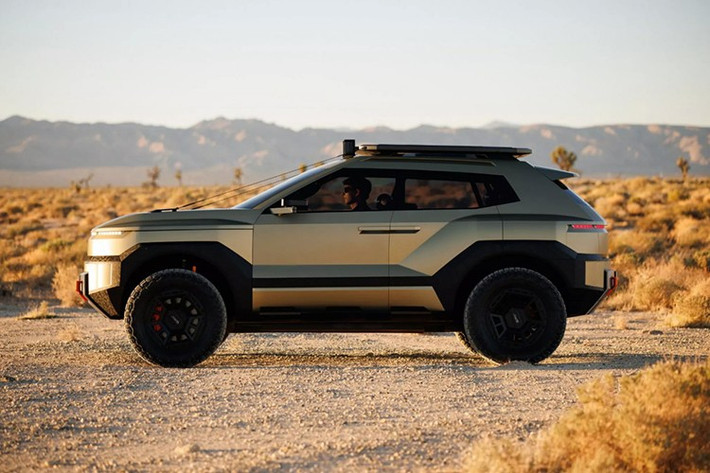
Hyundai’s “Art of Steel” design language, as showcased by the Crater, marks a dramatic departure from the brand’s more organic or fluid forms seen in previous generations. This isn’t about gentle curves; it’s about unapologetic angles, sharp creases, and bodywork that looks less like it was sculpted and more like it was militantly chiseled from a single block of metal. From a manufacturing perspective, “Art of Steel” pushes stamping presses to their absolute limits, achieving deep draws and highly defined forms that imbue the Crater with an almost sci-fi, combat-ready aesthetic. It evokes imagery of a landing craft speeding through an alien landscape, a vehicle that doesn’t just traverse terrain but dominates it.
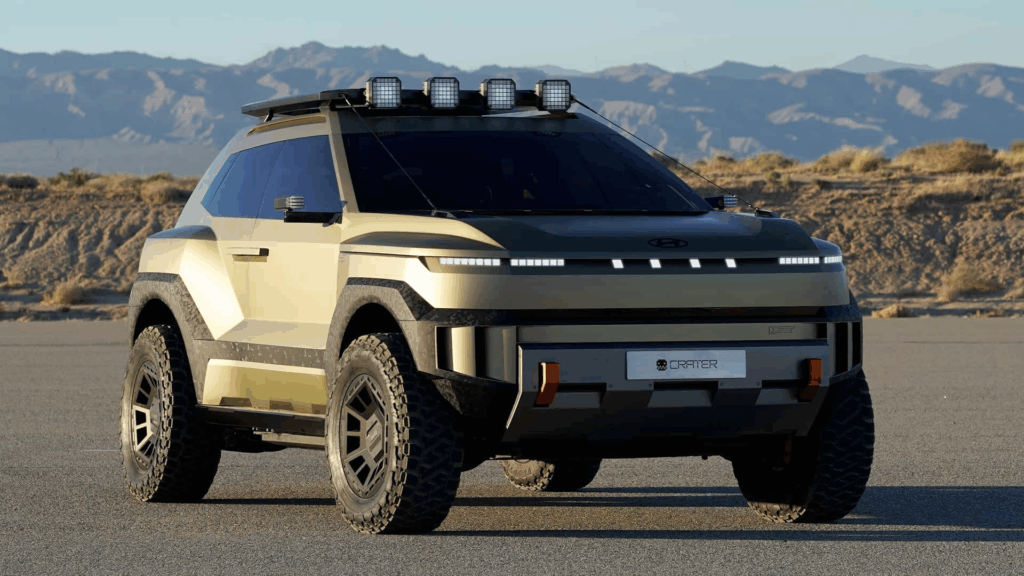
The Crater’s design DNA clearly evolves themes first introduced in the wildly successful Ioniq 5, particularly its parametric pixel lighting. Here, however, those pixel graphics are taken to an extreme. They’re not confined to just the head- and taillights; they’re integrated into auxiliary roof-mounted lights, and even the side mirror camera pods – which, in a truly inspired concept-land touch, double as detachable flashlights. This advanced pixelation doesn’t just look cool; it suggests a modularity and adaptability crucial for an adventure-ready vehicle. The black camo cladding, another signature element seen on the Ioniq 5 XRT, makes a prominent appearance, serving as a functional aesthetic that visually toughens the vehicle while hinting at its EV future – a signature for Hyundai XRT EVs. This design isn’t just about turning heads; it’s about signaling intent, projecting an image of unyielding capability that resonates with the core values of the off-road community.
Form Meets Function: The Crater’s Command Presence
Despite its compact footprint – roughly the same length as an Ioniq 5 – the Crater’s design creates an optical illusion of immense size. This broad, planted stance, tapering aggressively upwards from its massive 35-inch tires to the roof platform, exudes an intimidating presence. These aren’t just large tires for show; they signify serious ground clearance and improved approach/departure angles, essential for any serious off-road SUV. The visually deceptive long wheelbase, characteristic of dedicated EV platforms, contributes to stability while also allowing for exceptional interior packaging, something we’ll delve into shortly.
The name “Crater” itself is symbolic. It’s not a marketing projection of sales figures but rather a metaphor for impact: how a relatively compact object can leave a profound mark. This ethos permeates the Crater’s exterior, which is studded with practical yet stylish features. The orange-anodized front recovery points aren’t just for decoration; they’re essential equipment for extracting a vehicle from tough spots, a testament to the concept’s genuine off-road ambitions. These aren’t just design flourishes; they are affirmations of its purpose, speaking directly to the seasoned off-roader who understands the importance of functional gear.
The Enigma of Crater Man: A Nod to Personality
Concepts thrive on personality, and the Crater delivers with its quirky yet menacing “Crater Man” emblem. Look closely at the driver-side orange recovery point, and you’ll find a skull-like visage machined into the metal. His jagged teeth aren’t just decorative; they ingeniously double as a bottle opener, a perfect touch for tailgate parties at the trailhead.
This subtle yet engaging detail isn’t an isolated incident; Crater Man’s motif is woven throughout the vehicle’s interior. As the opposed-hinge doors swing open – a feature that optimizes ingress and egress for gear and passengers – you notice cubes on the inside of each door, interlocking like teeth. His presence continues in the buckles that secure the utilitarian nylon straps throughout the cabin, and even in the tiny pulls that unlatch the doors. These Easter eggs are more than just fun; they build a cohesive narrative, cementing the Crater’s identity as a vehicle with character, designed by people who truly understand the culture of adventure. This kind of thoughtful integration adds significant value, making the vehicle more than just a mode of transport – it makes it a companion.
Inside the Crater: A Refreshingly Analog Future
While the Crater’s exterior was shaped in California, its interior is a testament to the ingenuity of Hyundai’s Korean design team. The cabin perfectly complements the rugged exterior, yet takes a contrasting approach in its tactile elements. Unlike the sharp exterior lines, the seats, armrests, and tubular dashboard are soft, rounded, and inviting – a necessary comfort after a bone-jarring trail ride. A burly, integrated roll cage not only enhances structural rigidity and safety but also smartly incorporates overhead grab handles, an essential feature when tackling challenging terrain.
Perhaps the most radical departure inside is the explicit rejection of the ubiquitous, monolithic central touchscreen. In 2025, when every automaker is vying for larger, more dominant displays, Hyundai’s choice here is both brave and incredibly insightful. Instead, the Crater adopts a “bring-your-own-device” philosophy, where magnets likely secure a smartphone to the dash, allowing drivers to utilize their preferred navigation and entertainment systems. For vehicle settings and even built-in games, there are four small, detachable digital panels. This modular approach isn’t just minimalist; it’s practical, reducing screen glare and potential damage while off-roading, and offering unparalleled flexibility.
Lest you think the Crater is low-tech, a vivid head-up display spans the entire width of the lower windshield, providing critical driving information without distraction. The steering wheel even incorporates a pixel board, capable of flashing various messages – a unique way to communicate with passengers or even other vehicles on the trail.
However, the real genius of the Crater’s interior lies in its refreshing commitment to analog controls for critical functions. Gear-like toggles on the dashboard and steering wheel manipulate the all-wheel-drive system and locking differentials, while a dedicated panel of physical buttons manages climate settings. This isn’t a nostalgic throwback; it’s a deliberate design choice aimed at enhancing driver focus and safety. In high-stress off-road situations, muscle memory is key. Being able to instinctively manipulate controls without taking your eyes off the trail ahead is not just a convenience; it’s a necessity. This focus on driver engagement over digital clutter makes the Crater a truly compelling proposition for the discerning adventure enthusiast.
The Powertrain Enigma: Electric Asteroid or Hybrid Meteor?
The biggest question mark surrounding the Crater Concept, and indeed many concepts in 2025, revolves around its powertrain. While the concept can move under its own electric motors (albeit slowly), Hyundai has remained tight-lipped about what would power a production version. The limb riser-adorned hood leaves us guessing: is there a cavernous frunk, characteristic of a dedicated EV, or does it conceal a robust combustion engine, perhaps with electric assistance?
Adding to the mystery are the “raucous artificial engine sounds” the concept emits. On one hand, this could be akin to the engaging, artificial noises in the Ioniq 5 N or Ioniq 6 N, designed to provide sensory feedback and enhance the driving experience in an otherwise silent EV. On the other, it might be a subtle hint towards a potential hybrid or even an advanced internal combustion engine option. This non-confirmation speaks volumes about the current industry climate. In 2025, the automotive world is navigating complex terrain, with many manufacturers, including Hyundai, re-evaluating their once-ironclad commitment to an all-electric future, considering the resurgence of interest in hybrids and more efficient ICE powertrains.
Regardless of what ultimately powers it, the Crater is clearly positioned as an all-around adventure vehicle, not strictly a rock crawler, desert runner, or overlander. This broader appeal makes strategic sense, allowing it to capture a wider audience within the competitive SUV market. Whether it emerges as a potent electric off-roader or a highly capable hybrid, its intent is clear: to offer a versatile, durable platform for exploration. For those seeking sustainable off-roading solutions without compromising on performance, an EV variant would be incredibly attractive, while a hybrid would offer a strong compromise for range and power.
2025 Market Impact: Challenging the Establishment
In a market saturated with options, from the iconic Jeep Wrangler and the wildly popular Ford Bronco to the innovative Rivian R1S and the upcoming electric Jeep Recon, the Hyundai Crater Concept arrives with significant disruptive potential. Hyundai has a proven track record of bringing concept cars to production with remarkable fidelity, as seen with the Tucson, Sonata, and various Ioniq models. While some aspects would naturally be toned down for mass production – perhaps the bottle opener recovery point, or the detachable flashlights – the core design language, rugged capability, and innovative interior philosophy would likely remain intact.
If the Crater makes it to production, it would position Hyundai as a serious contender in the lucrative premium adventure vehicle segment. It offers a fresh, modern aesthetic combined with a pragmatic, driver-focused interior that could genuinely differentiate it. For consumers seeking a cutting-edge SUV design that also offers genuine capability and a forward-thinking approach to technology and sustainability, the Crater could be a game-changer. It has the potential to attract buyers who appreciate the heritage of a Wrangler or Bronco but are ready for a new, tech-infused, and potentially electric take on the off-road experience. The Crater is more than just a concept; it’s a clear statement from Hyundai: “We’re here, and we’re ready to play dirty.”
Your Next Adventure Awaits
The Hyundai Crater SUV Concept is a fascinating glimpse into the future of rugged mobility. It’s a testament to bold design, practical innovation, and a serious commitment to the adventure lifestyle. As we eagerly await further developments, one thing is clear: Hyundai is poised to make a massive impact on the off-road landscape.
What are your thoughts on this audacious concept? Are you ready for Hyundai to shake up the electric off-road vehicle market? Share your predictions and join the conversation about the future of adventure vehicles below!